Blog

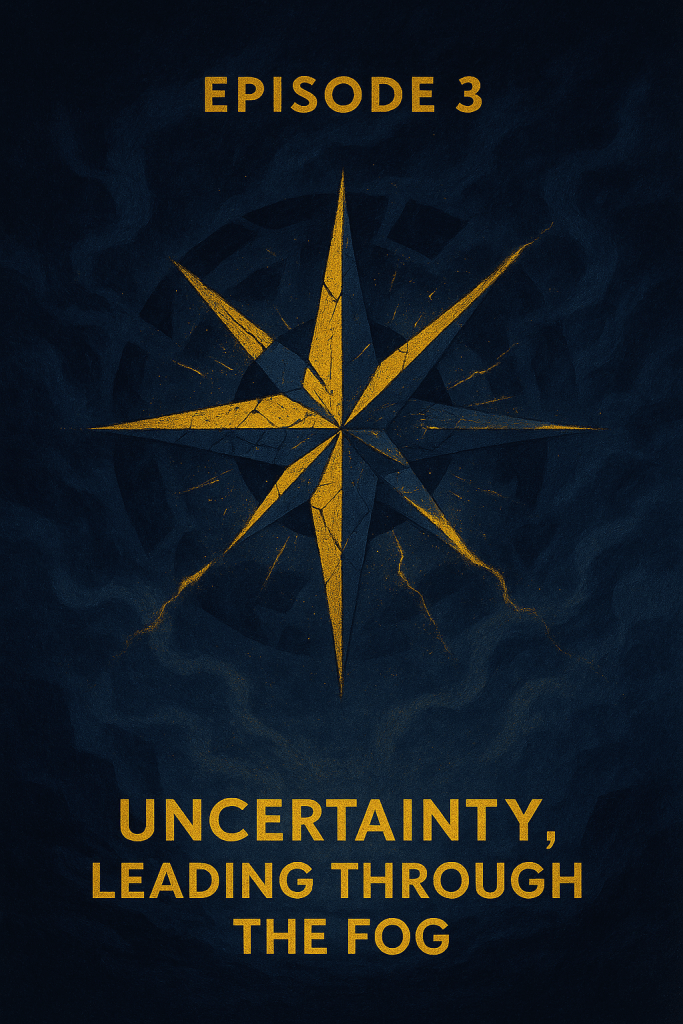
  • 🌫️ Episode 3: Uncertainty, Leading Through the Fog

    🌫️ Episode 3: Uncertainty, Leading Through the Fog

    🌟 Introduction

    Today we explore one of the most defining realities of leadership, the unavoidable fog that surrounds every major decision. This episode will show you why uncertainty is not a flaw in the system but the system itself, how leaders misjudge it, and how to lead decisively when clarity is impossible. By the end, you will understand how to navigate ambiguity with confidence, speed, and strategic intent.


    ⚙️ Core Concepts

    🌫️ The Fog Is the Environment, Not the Exception

    In war and in business, leaders often assume uncertainty is a temporary condition, something to “wait out” until clarity returns. That assumption destroys momentum.
    Uncertainty is the default state of competitive environments. Markets shift, competitors conceal intent, technology evolves, and internal dynamics change faster than leaders can track. The fog is permanent.

    Leaders who wait for perfect information fall behind those who act with disciplined judgment.

    🎯 Decision Pressure Is the Real Test

    Uncertainty is not just informational, it is emotional.
    Leaders face:

    • Conflicting data
    • Incomplete visibility
    • Time pressure
    • High‑stakes consequences
    • Team anxiety
    • Their own fear of being wrong

    The real leadership test is not whether you can analyze uncertainty, but whether you can decide under it.

    🔄 Nonlinearity: Small Inputs, Big Consequences

    Modern environments behave like nonlinear systems.
    A minor event, a single customer complaint, a small competitor pivot, or a subtle shift in team morale can cascade into major outcomes. Leaders who assume proportionality miss the early signals that matter most.

    🧭 Judgment Over Precision

    When uncertainty is high, precision becomes a trap.
    Leaders must shift from:

    • Predictive thinking to probabilistic thinking
    • Perfect plans to flexible frameworks
    • Detailed control to empowered execution

    The leader’s role is not to eliminate uncertainty but to make it survivable and actionable for the team.

    🧠 Human Factors Drive Interpretation

    Two leaders can see the same data and reach opposite conclusions. Why?
    Because uncertainty amplifies:

    • Bias
    • Fear
    • Overconfidence
    • Wishful thinking
    • Organizational politics

    The fog is not just external, it’s internal.
    Leaders must manage their own cognitive distortions before they can guide others.


    🧓 Sage Advice

    Uncertainty punishes hesitation more than imperfection. Move with purpose, adjust with humility, and keep your team oriented on intent.


    💡 Core Insight

    Uncertainty is not a barrier to leadership, it is the arena in which leadership is proven.
    Your ability to decide, communicate intent, and maintain momentum when the path is unclear is what separates operational managers from true leaders.


    🔄 Military to Civilian Translation Table

    Military ConceptLeadership TranslationPractical Application
    Fog of WarIncomplete informationMake decisions with 70 percent clarity
    ReconnaissanceMarket sensingConstantly test assumptions
    Probabilistic ThinkingScenario planningPrepare multiple paths, not one plan
    Commander’s IntentStrategic clarityGive teams direction, not instructions
    TempoOperational momentumAct faster than competitors can adapt
    FrictionOrganizational dragSimplify processes and reduce noise
    NonlinearityDisproportionate outcomesWatch for small signals with big impact

    🧠 Logos, Ethos, and Pathos

    Logos (Logic)

    Uncertainty is structurally unavoidable in competitive systems. Leaders who adopt probabilistic thinking and flexible planning outperform those who rely on prediction and control.

    Ethos (Credibility)

    Modern leaders earn trust not by claiming certainty but by demonstrating clarity of intent, disciplined judgment, and the courage to act when others freeze.

    Pathos (Emotion)

    Teams look to leaders for stability when the environment feels chaotic. Your calm decisiveness becomes their anchor, and your confidence becomes their confidence.


    🗣️ Discussion Prompt

    What is one major decision you delayed because you were waiting for more clarity, and what would have changed if you acted sooner?


    🪖 Final Formation

    Today we covered the reality that uncertainty is permanent, nonlinear, and emotionally charged. You learned why waiting for clarity is a losing strategy, how judgment outperforms precision, and how leaders create momentum even when the path is unclear. In the next episode, we will examine fluidity, the constant motion of competitive environments and how leaders adapt faster than the situation changes.


    Disclaimer: The views expressed in this post reflect those of the author and do not necessarily represent the views of any organization or institution.

    #Business #GovCon #Leadership #TalentAcquistion #TechCareerDevelopment #TechLeadership
  • Friction: Why Simple Things Get Hard

    ⚡ Warfighting Leadership Series, Episode 2

    Friction, Why Simple Things Get Hard

    🔍 Introduction, What You Are About to Learn

    In this episode, you will learn why even the most straightforward tasks become unexpectedly difficult, why friction is unavoidable in leadership environments, and how to turn that resistance into strategic advantage. You will see how friction emerges in business, technology, and human systems, how it pressures leaders at every level, and how to lead through it with clarity and resolve. By the end, you will understand not only what friction is, but how to anticipate it, counter it, and use it to strengthen your team.


    Marines are taught to train like they fight and fight like they train because this approach puts them in contact with the friction points they may encounter and prepares them to respond without hesitation. A mind conditioned to operate in a friction-filled environment enables instincts to take over when friction is introduced. Training at night and during challenging times ensures readiness so that when friction comes, Marines are prepared to act decisively.

    Experienced and knowledgeable leaders, whether in military or business, deliberately place themselves at points of friction to bring order to chaos. By confronting resistance head-on, they create clarity amid confusion and drive momentum where others see only obstacles. This proactive engagement with friction is what separates reactive managers from visionary leaders who shape outcomes despite disorder.


    🧩 Core Concepts

    Friction is the invisible resistance that transforms clean plans into messy execution. It is not a sign of incompetence or poor preparation. It is the natural byproduct of human behavior, imperfect systems, and the unpredictable nature of real work. Experienced leaders know that even the best made plan doesn’t survive first contact. Mike Tyson’s quote, “everyone has a plan until they get punched in the mouth,” captures planning and execution brilliantly.

    1. Organizational Drag

    Teams slow down because:

    • Priorities shift mid‑execution
    • Processes are unclear
    • Approvals stack up
    • Communication breaks down

    A task that should take an hour takes a week.

    2. Human Variability

    People bring emotion, fatigue, ego, and stress into the workplace. A high performer can hesitate. A new hire can freeze. A leader can misread the moment. Human inconsistency is one of the most powerful sources of friction.

    3. Digital Resistance

    Modern friction often comes from:

    • System outages
    • Integration failures
    • Cybersecurity constraints
    • Legacy platforms that refuse to cooperate

    A brilliant strategy collapses when the tool chain buckles.

    4. Competitive Pushback

    Markets react. Competitors counter. Customers’ shift expectations. Every move you make creates resistance you must absorb and adapt to.

    5. Environmental Chaos

    Supply chain shocks, regulatory changes, economic swings, and global instability all inject friction into even the best‑designed plans.

    Sage Advice

    Friction is not a disruption, it is the operating environment. Plan for it.


    🧠 Logos, Ethos, and Pathos

    Logos, The Logic of Friction

    Friction is predictable because systems are imperfect. More moving parts means more resistance. More humans means more variability. More technology means more points of failure. Understanding this logic allows leaders to design simpler plans and anticipate slowdowns.

    Ethos, The Leader’s Credibility Under Pressure

    Your team watches your behavior when things get hard. Do you blame, panic, or freeze, or do you remain steady and redirect effort? Your credibility is forged in friction, not in comfort.

    Pathos, The Emotional Reality

    Friction frustrates people. It drains morale, creates doubt, and tests patience. Leaders who acknowledge the emotional weight of friction build loyalty, trust, and resilience.


    💡 Core Insight

    Friction is not a barrier to leadership, it is the proving ground of leadership.

    Anyone can lead when everything works. Real leaders emerge when nothing works as expected.

    Friction forces leaders to:

    • Simplify plans
    • Prioritize ruthlessly
    • Empower subordinates
    • Communicate with precision
    • Maintain emotional discipline

    At the strategic level, friction shapes long‑term decisions. At the operational level, it disrupts timelines and coordination. At the tactical level, it shows up as the daily grind, the unexpected obstacle, the missing information.

    Leaders who understand friction stop expecting perfection and start designing for reality.


    📊 Military to Civilian Translation Table

    Military TermCivilian EquivalentMeaning in Leadership
    FrictionOrganizational resistanceNatural slowdown when plans meet reality
    Enemy actionMarket or competitor reactionExternal forces pushing back
    TerrainBusiness environmentSystems, culture, regulations, constraints
    FogUnclear informationConfusion caused by incomplete or conflicting data
    TempoOperational speedHow fast your team can execute under pressure

    💬 Discussion Prompt

    Where does friction appear most often in your world, and how do you respond when simple tasks become unexpectedly difficult?


    🎖️ Final Formation, What You Were Told

    Today you learned that friction is the natural resistance leaders face when plans collide with reality. You saw how friction emerges from human behavior, organizational systems, technology, and competitive pressure. You learned how friction affects leaders at every level and how your response to it shapes your credibility, your team’s morale, and your organization’s momentum. Most importantly, you learned that friction is not a sign of failure, but the environment in which leadership is tested and proven.

    In the next episode, we will examine uncertainty, the fog that blinds leaders even when the path seems clear.


    ⚠️ Disclaimer

    Disclaimer: The views expressed in this post reflect those of the author and do not necessarily represent the views of any organization or institution.

    #Business #GovCon #Leadership #TalentAcquistion #TechCareerDevelopment #TechLeadership
  • 🎖️War & Business: Clash of Wills and Markets

    🎖️ War & Business: Clash of Wills and Markets

    🧭 Introduction

    In this first episode of the Warfighting Leadership Series, we explore foundational leadership principles that bridge the worlds of military combat and business competition. We will examine how the realities of friction, uncertainty, fluidity, disorder, and complexity shape leadership decisions and outcomes. This episode sets the stage for navigating complexity and chaos with clarity and confidence.

    ⚔️ Core Concepts

    • Friction and Uncertainty: Just as in combat, business leaders face unpredictable challenges that disrupt plans and require rapid adaptation.
    • Fluidity and Disorder: Markets and battlefields alike are dynamic environments where conditions change rapidly and often without warning.
    • Complexity: Leaders must manage multiple interconnected variables, balancing short-term actions with long-term strategy.

    ⚔️ Combat and Markets: The Enemy Gets a Vote

    Combat and markets share a fundamental truth: the enemy gets a vote. Just as a commander must anticipate and adapt to an opponent’s moves on the battlefield, business leaders must respect the power of competitors and market forces that can disrupt even the best-laid plans.

    Imagine combat as a high-stakes chess match where the opponent not only counters your moves but changes the board itself, forcing constant recalibration. Similarly, markets are dynamic arenas where strategies meet resistance, adaptation, and unexpected shifts. This simile underscores the necessity of humility and vigilance in leadership, recognizing that success depends on responding effectively to external challenges beyond one’s control.

    Sage Advice

    Effective leadership requires embracing uncertainty and maintaining composure under pressure. The leader who anticipates change and adapts swiftly gains the advantage.

    💡 Core Insight

    Leadership in both war and business demands a mindset that accepts chaos as the norm. Success comes from resilience, flexibility, and the ability to influence outcomes despite unpredictable forces.

    ⚔️ Military to Civilian Translation Table

    Military TermBusiness EquivalentExplanation
    FrictionOperational ChallengesUnexpected obstacles that slow progress
    FluidityMarket VolatilityRapid changes in market conditions
    DisorderOrganizational ChaosBreakdown of normal processes or communication
    ComplexityStrategic AmbiguityMultiple factors influencing decisions

    Strategic, Operational, and Tactical Levels in Warfighting and Business

    ⚔️ Strategic Level

    • War: Strategic leaders set overarching goals, allocate resources, and shape the broader campaign to achieve victory. They analyze enemy capabilities, geopolitical factors, and long-term consequences.
    • Business: Strategic leaders define vision, market positioning, and long-term objectives. They assess competitive landscapes, economic trends, and organizational capabilities.
    • Similarity: Both require big-picture thinking, anticipation of future challenges, and alignment of resources to achieve decisive outcomes.

    ⚙️ Operational Level

    • War: Operational leaders coordinate campaigns and major operations, translating strategy into actionable plans. They manage logistics, timing, and synchronization across units.
    • Business: Operational leaders oversee projects, processes, and cross-functional initiatives that implement strategic goals. They manage workflows, budgets, and team coordination.
    • Similarity: Both focus on bridging strategy and tactics, ensuring plans are executable, and resources are effectively utilized.

    Tactical Level

    • War: Tactical leaders direct engagements and battles, making real-time decisions on the ground. They respond to immediate threats and exploit opportunities.
    • Business: Tactical leaders manage day-to-day activities, customer interactions, and frontline problem-solving. They adapt quickly to market feedback and operational issues.
    • Similarity: Both require agility, situational awareness, and decisive action under pressure.

    Logos, Ethos, and Pathos in Warfighting and Business

    Logos (Logic)

    In war, leaders rely on intelligence, strategy, and tactical data to make decisions that can mean life or death. In business, logic manifests through market analysis, financial metrics, and operational data to guide competitive strategies. Both require clear reasoning, but war decisions often demand rapid judgment under extreme uncertainty, while business decisions may allow more time for analysis.

    Ethos (Credibility)

    Military leaders build ethos through demonstrated competence, honor, and command presence, earning trust from troops who depend on them in critical moments. In business, credibility comes from expertise, track record, and ethical leadership, fostering confidence among employees, customers, and investors. While both contexts value trust, the immediacy and stakes in war heighten the impact of ethos.

    Pathos (Emotion)

    War leaders must manage fear, morale, and cohesion among soldiers facing danger, using emotional connection to inspire courage and resilience. Business leaders engage pathos to motivate teams, build brand loyalty, and navigate organizational change, often appealing to shared values and vision. Emotional intelligence is vital in both, but war’s emotional intensity is often more acute and visceral.


    🧠 Discussion Prompt

    Think of a time when you and your team faced significant complexity and uncertainty, perhaps during a period of rapid market changes, organizational chaos, or strategic ambiguity. How did leaders cultivate resilience and adaptability within your group to effectively navigate those challenges?

    ⚔️Final Formation

    This episode introduced the core challenges leaders face in complex environments and highlighted the mindset needed to succeed. By understanding friction, fluidity, disorder, and complexity, leaders can better prepare their teams for the unpredictable.

    Looking ahead, the next episode, Friction: Why Simple Things Get Hard, will venture deeper into the invisible forces that complicate leadership and operations, revealing why even straightforward tasks become challenging under pressure.


    ⚠️ Disclaimer

    Disclaimer: The views expressed in this post reflect those of the author and do not necessarily represent the views of any organization or institution.

    #Business #GovCon #Leadership #TalentAcquistion #TechCareerDevelopment #TechLeadership

  • 🎖️ Warfighting Leadership Series I Introduction: War and Business Realities

    🎖️ WARFIGHTING LEADERSHIP SERIES

    Series I Introduction: War and Business Realities


    🧭 Introduction, What You Are About to Learn

    Every leader eventually discovers a hard truth; the world does not cooperate. Plans collide with resistance, teams face uncertainty, competitors adapt faster than expected, and even the simplest tasks become unexpectedly difficult. Series I, War and Business Realities, exists to prepare leaders for this environment. It introduces the foundational conditions that shape every decision, every strategy, and every outcome in both war and business.

    In this introduction, you will learn what defines the leadership landscape, why friction, uncertainty, fluidity, disorder, complexity, human emotion, courage, balanced power, and evolution are unavoidable forces, and how understanding them gives leaders a decisive advantage. We will preview the ten episodes of Series I, translate military concepts into business language, and set the stage for the rest of the Warfighting Leadership Series. Then, in the final formation, we will summarize what you learned and prepare you for the journey ahead.


    ⚔️ Core Concepts of Series I, Navigating Chaos and Complexity

    1. Leadership Begins With Reality, Not Preference

    Leaders do not get to choose the environment. They inherit it. Markets shift, competitors react, teams struggle, and conditions change faster than plans can keep up. Understanding the environment is the first act of leadership.

    2. Friction Is Universal

    Nothing goes smoothly. Miscommunication, delays, resistance, and unexpected obstacles are not failures, they are the natural cost of action. Leaders who expect friction outperform those who are surprised by it.

    3. Uncertainty Is Permanent

    Information will always be incomplete, late, or contradictory. Leaders must make decisions anyway. The ability to act without perfect clarity separates effective leaders from hesitant ones.

    4. Fluidity Demands Adaptability

    Conditions shift rapidly. Competitors pivot. Technology evolves. Teams reorganize. Leaders must adjust faster than the environment changes or risk losing momentum.

    5. Disorder Is the Default State

    No plan survives contact with reality. Systems break down, priorities collide, and execution becomes messy. Leaders must impose clarity without expecting perfection.

    6. Complexity Defies Total Control

    Organizations, markets, and teams are interconnected systems. Attempts to control everything often create more problems than they solve. Leaders must influence, not micromanage.

    7. The Human Factor Dominates Outcomes

    Emotion, morale, willpower, and trust shape results more than tools or technology. Leadership is ultimately a human endeavor.

    8. Courage Is a Leadership Requirement

    Courage is not dramatic heroism. It is the daily discipline to make hard decisions, accept risk, and act with integrity under pressure.

    9. Balanced Forces Create Advantage

    Leaders must balance physical resources, moral authority, and mental clarity. Strength in one area cannot compensate for weakness in another.

    10. Evolution Is Constant

    Conflict and competition change over time. Leaders must evolve with them or become obsolete.

    Sage advice: You cannot lead the environment until you understand the environment.


    💡 Core Insight

    Leadership is the art of navigating an environment shaped by friction, uncertainty, fluidity, disorder, complexity, and human emotion.
    Those who understand these forces gain clarity. Those who ignore them get overwhelmed.


    🪖 Military to Civilian Translation Table

    Military TermCivilian EquivalentMeaning
    FrictionOperational dragThe small problems that slow execution
    Fog of WarMarket ambiguityUnclear or incomplete information
    ManeuverAgilityGaining advantage through speed and flexibility
    Commander’s IntentExecutive visionThe guiding purpose behind actions
    Main EffortPriority initiativeThe most important task to win
    Combined ArmsCross functional teamsIntegrating diverse capabilities for impact
    Center of GravityCore advantageWhat gives your organization strength
    Mission TacticsDecentralized executionEmpowering teams to act independently

    🧠 Discussion Prompt

    Which of the ten environmental realities do you believe your organization struggles with most, and how does it affect your ability to lead effectively?


    ✅ Final Formation, What We Told You

    In this Series I introduction, we established the foundation for the Warfighting Leadership Series. You learned that leadership begins with understanding the environment, an environment shaped by friction, uncertainty, fluidity, disorder, complexity, human emotion, courage, balanced forces, and constant evolution. These ten realities define the world leaders must operate in, whether on a battlefield or in a boardroom. As we move through Series I, each episode will deepen your understanding of these forces and sharpen your ability to lead through chaos with clarity, adaptability, and moral strength.

    Next up: War and Business, Clash of Wills and Markets.


    Disclaimer: The views expressed in this post reflect those of the author and do not necessarily represent the views of any organization or institution.

    #ITLeadership, #TechManagement, #DigitalTransformation,  #Cybersecurity, #AgileTeams,  #DevOpsCulture,  #CloudComputing, #ITStrategy, #ProjectManagement,  #TechCareerDevelopment, #leadership, #personal-development, #business, #coaching, #management, #mental-health, #wisdom, #philosophy, #ethics, #health

  • 🔲 Principle# 11: Seek Responsibility and Take Responsibility for Your Actions.

    🔲 Principle# 11: Seek Responsibility and Take Responsibility for Your Actions.

    🎯 Introduction

    Leadership is both art and discipline. Across this series we have explored eleven principles that shape resilient leaders, whether in uniform or in the boardroom. In this final principle, Seek responsibility and take responsibility for your actions, we close the loop. The journey began with self-awareness, moved through technical proficiency, care for your people, communication, example-setting, supervision, teamwork, decision-making, responsibility development, capability alignment, and now culminates in accountability.


    📖 Core Concepts

    Seeking responsibility means leaning into challenges rather than avoiding them. Taking responsibility means owning outcomes, both successes and failures. Together, they form the backbone of trust.

    • People follow leaders who stand firm when things go wrong. Accountability builds emotional trust.
    • Leaders who accept responsibility demonstrate integrity, reinforcing their credibility.
    • Without responsibility, systems collapse. Accountability ensures lessons are learned and progress continues.

    Sage advice: The price of leadership is responsibility. Responsibility is not a burden, it is the privilege of leadership.


    💡 Core Insight

    Accountability is the bridge between vision and execution. Leaders who embrace responsibility empower their teams to act boldly, knowing their leader will stand with them. This principle transforms mistakes into lessons and victories into shared triumphs.


    📋 Military to Civilian Translation

    Military PrincipleCivilian EquivalentWhy It Matters
    Seek responsibilityVolunteer for projectsShows initiative and builds credibility
    Take responsibilityOwn outcomesBuilds trust and prevents blame culture
    Command accountabilityProject ownershipEnsures clarity and sustainable progress
    After-action reviewPost-project debriefTurns mistakes into learning opportunities

    🚀 Practical Applications for New Leaders

    Start small and volunteer for tasks. Be the one who says, “I’ll take that.” These small wins build momentum, gradually making you the go-to person and establishing a reputation for initiative. Seeking responsibility naturally leads to more responsibility and a strong leadership presence.

    Begin by taking on manageable tasks and offering to help without waiting to be asked. Each small success builds your confidence and credibility, positioning you as a reliable and proactive leader. Over time, this momentum attracts greater responsibilities and solidifies your reputation for initiative and dependability.


    💣 Pathos, Ethos, and Logos of Responsibility

    Understanding the power of responsibility in leadership starts by exploring its emotional, ethical, and logical dimensions:

    • Pathos (Emotion): Taking responsibility connects deeply with the emotional fabric of leadership. It builds trust and respect by showing vulnerability and courage. Leaders who own their actions inspire loyalty and motivate their teams through authentic emotional connection.
    • Ethos (Credibility): Responsibility is the cornerstone of a leader’s character. When leaders seek and take responsibility, they demonstrate integrity, authenticity, and reliability. This builds their credibility and earns the unwavering trust of those they lead.
    • Logos (Logic): The rational case for responsibility is clear: it drives problem-solving, continuous improvement, and sustainable leadership. Accountability prevents blame culture, fosters learning, and ensures forward progress through reasoned action.

    Together, these appeals create a compelling and holistic case for why responsibility is both the price and privilege of leadership.


    💬 Discussion Prompt

    Think about a time when you stepped forward to take responsibility for a project or decision. How did it change the way others saw you, and how did it change the way you saw yourself?


    🏁 Final Formation

    We began by telling you that accountability is the capstone of leadership. We explored how seeking responsibility demonstrates initiative, and how taking responsibility cements trust. We showed how this principle connects military discipline with civilian leadership.

    Leaders who embrace responsibility transform challenges into opportunities, mistakes into lessons, and victories into shared success. Accountability is not the end of leadership, it is the beginning of trust.


    Disclaimer: The views expressed in this post reflect those of the author and do not necessarily represent the views of any organization or institution.

  • 🛡️Principle# 10: Employ Your Command in Accordance with Its Capabilities

    🛡️ Principle# 10: Employ Your Command in Accordance with Its Capabilities

    Introduction

    Leadership is not about pushing your team to the breaking point; it is about aligning missions with reality. This principle reminds us that success depends on understanding what your team can achieve and deploying them wisely. In this post, we will explore why this matters, how to apply it, and what it means for leaders transitioning from military to civilian roles.

    ⚖️ Persuasion Triad

    • Pathos (Emotion): Protect your team from burnout and frustration.
    • Ethos (Credibility): A leader who respects limits earns respect.
    • Logos (Logic): Matching tasks to capabilities ensures efficiency and success.

    💡 Metaphorical Insight

    A leader must try to bring balance to the workforce, not overextending lines much like the yin and the yang. In the realm of vehicular maintenance, when too little time is scheduled for maintenance because operations take priority, maintenance will schedule itself at the most inopportune time and cause the command to culminate early.

    Leadership that fails to understand and employ the true capabilities of its team risks suffering the “death by a thousand cuts”, a slow burnout caused by constant overextension and misalignment. Just as digging a hole with a spoon is possible but inefficient, so too is pushing your team beyond their strengths. Employing the right tools, or in this case, the right people for the right tasks, ensures efficiency, morale, and long-term success.


    📌 Core Concepts Employing your command effectively means:

    • Assessing capabilities honestly, knowing what your team can and cannot do.
    • Matching tasks to strengths, assigning roles that maximize efficiency and morale.
    • Avoiding overextension, because pushing beyond limits leads to failure and burnout.
    • Building adaptability, preparing for contingencies without compromising core objectives.

    Sage Advice: A leader who understands capacity prevents chaos and fosters trust.


    💡 Core Insight Leadership is not about doing everything, it is about doing the right things with the resources you have. Overestimating capabilities creates risk, underestimating them wastes potential. Balance is key.

    Military ApplicationCivilian Application
    Balancing workforce capacity to avoid overextension, akin to maintaining balance like yin and yang.Managing employee workload to prevent burnout, ensuring sustainable productivity and morale.
    Conducting mission-focused training and readiness drills.Providing continuous professional development and skill-building opportunities.
    Managing resources under high-pressure, time-sensitive conditions.Allocating resources efficiently while balancing multiple stakeholder interests.
    Enforcing accountability through formal evaluations and consequences.Promoting accountability through feedback, coaching, and performance reviews.
    Planning operations with contingency and risk management.Implementing strategic planning with risk assessments and mitigation strategies.
    Leading teams in diverse, multicultural environments.Managing diverse workforces with cultural competence.
    Scheduling adequate vehicular maintenance despite operational pressures to avoid unexpected failures that can prematurely end missions.Planning preventive maintenance and resource allocation to minimize downtime and operational disruptions in civilian fleets.

    Military to Civilian Transition: Beyond Terms to Applications

    Transitioning from military to civilian leadership is not just about translating terminology; it’s about applying leadership principles in new contexts. Military leaders excel in mission focus, discipline, and accountability, but civilian environments often require more collaboration, flexibility, and emotional intelligence.

    Key applications include:

    • Adapting communication styles: Civilian teams may expect more participative dialogue rather than directive orders.
    • Leveraging diverse skills: Recognize and integrate varied professional backgrounds and expertise.
    • Balancing structure with innovation: Maintain operational discipline while encouraging creative problem-solving.
    • Managing different motivators: Understand that civilian employees may be driven by different incentives than military personnel.

    Successful transition means translating your leadership strengths into practices that resonate with civilian teams, fostering engagement, trust, and performance.


    🗣️ Discussion Prompt

    Think of a time when you or your team were asked to do more than you realistically could. How did you handle it? What would you do differently now?


    Key Takeaways

    • Honest self-assessment of your team’s capabilities is foundational.
    • Assign tasks that align with strengths to maximize effectiveness.
    • Avoid pushing beyond limits to prevent burnout and failure.
    • Build adaptability to navigate unforeseen challenges without losing focus.

    🎯 Final Formation We began by emphasizing the importance of aligning missions with capabilities. We explored how honest assessment, strategic tasking, and adaptability prevent failure and build trust. Remember, leadership thrives when expectations match reality. Employ your command wisely, and success will follow.


    ✅ Disclaimer The views expressed in this post reflect those of the author and do not necessarily represent the views of any organization or institution.

  • Principle #9 Develop a Sense of Responsibility Among Subordinates

    🎯 Introduction

    Leadership is a journey of cultivating responsibility through challenge, nurture, accomplishment, and shared roles. In this post, we will tell you how leaders develop responsibility by sharpening each other like steel, molding minds like clay, fostering motivation through accomplishment, and building interconnected teams like a well-planned fire defense.

    🔥 Core Concepts

    🔥 The Forge of Leadership: Steel Sharpening Steel

    Leadership is a dynamic, reciprocal process much like steel sharpening steel. When two blades rub together, the friction hones their edges, making each sharper and stronger. This metaphor captures the essence of how leaders and followers engage in mutual growth. Through constructive feedback, accountability, and shared challenges, they push each other beyond comfort zones. This friction is not conflict but a refining force that sharpens skills, hones character and deepens responsibility. Just as steel becomes stronger and more resilient through contact with another blade, leaders and their teams become more capable and prepared through this ongoing process of sharpening.

    • Create a culture of open feedback
    • Set clear expectations for accountability
    • Challenge team members to step outside their comfort zones When everyone participates in this sharpening process, skills and character are honed, and responsibility deepens.

    🏺 The Sculptor’s Touch: Molding Minds Like Clay

    Leadership also requires the patience and care of a sculptor molding clay. Unlike steel, clay is soft and malleable, shaped deliberately over time. Leaders must nurture the mindset and character of their people with consistent guidance and reinforcement. This process develops what might be called the “give a crap” factor, the intrinsic motivation to care deeply about one’s role, the team, and the mission. Like a sculptor shaping clay, leaders patiently mold attitudes and behaviors, helping individuals internalize responsibility as a core value. This shaping is gradual and requires empathy, persistence, and a clear vision of the desired outcome.

    • Providing consistent coaching and mentoring
    • Reinforcing positive behaviors and attitudes
    • Demonstrating empathy and persistence This gradual shaping helps individuals internalize responsibility as a core value.

    🌟 Developing Responsibility Through Accomplishment and Servant Leadership

    An important theory that complements these leadership principles is the Broken Windows Theory, which emphasizes how small signs of disorder can lead to larger issues if left unaddressed. In leadership and community development, this theory highlights the importance of maintaining standards and accountability to foster responsibility.

    In neighborhoods and teams, addressing minor problems early, like a broken window or a missed task, prevents decline and encourages collective care. Leaders who apply this mindset cultivate a culture where everyone feels responsible for the health and success of the group. This proactive approach strengthens the “give a crap” factor, motivating individuals to uphold standards and contribute positively.

    By integrating the Broken Windows Theory, leaders can develop responsibility not only within their teams but also in broader communities, encouraging vigilance, pride, and mutual support that keep environments safe and thriving.

    A vital part of cultivating responsibility is fostering a sense of accomplishment. Completing tasks and receiving positive reinforcement fuels confidence and motivation. This cycle is central to servant leadership, where leaders empower others to succeed and grow. Recognition and tangible impact deepen commitment, creating a culture where responsibility is embraced and celebrated. When people see the results of their efforts and feel valued, their “give a crap” factor strengthens, reinforcing the sculptor’s work and the sharpening process.

    • Celebrate completed tasks and milestones
    • Offer positive reinforcement regularly
    • Empower team members to take ownership and grow When people see the impact of their efforts, their commitment and sense of responsibility are strengthened.

    🥧 The Leadership Pie: Interlocking Roles and Shared Responsibility

    Leadership is also like a pie, each person holds a slice, essential to the whole. Imagine this pie as a fire plan in a defensive position, with interlocking fields of fire covering every sector. Defilades, areas hidden from direct view, are protected by indirect fire. Similarly, every team member’s role interlocks with others, ensuring no gaps in coverage or responsibility. This interconnectedness builds a resilient, effective team where every part supports the whole. Each slice matters, and the strength of the leadership pie depends on how well these slices fit and function together.

    • Defining clear roles and responsibilities
    • Encouraging collaboration and support across roles
    • Ensuring every member understands how their work fits into the bigger picture The strength of the team depends on how well these slices fit together.

    Sage Advice:

    This is where leaders must have patience and trust the process, have a vision, and measure the progress against the plan.


    📊 Military to Civilian Translation Table

    Military ConceptCivilian Leadership Equivalent
    Steel sharpening steelPeer-to-peer constructive feedback and growth
    Molding clayCoaching and mentoring to develop mindset and values
    Servant leadershipEmpowering team members to take ownership and grow
    Fire plan with interlocking fields of fireCoordinated teamwork with overlapping responsibilities

    💡 Core Insights

    • Leadership responsibility grows through mutual challenge and support, embodying the ethos of credibility and trust that leaders build through consistent, honest engagement.
    • Patience and empathy are essential to shaping attitudes and motivation, appealing to pathos by connecting emotionally to the intrinsic values and care leaders cultivate.
    • Positive reinforcement and accomplishment fuel intrinsic motivation and commitment, using logos to logically demonstrate how recognition and success drive responsibility.
    • Effective leadership depends on interconnected roles working seamlessly like a fire plan, combining ethos, pathos, and logos to create a cohesive, resilient team.

    Sage advice: Leadership is both an art and a science, requiring strength to challenge and patience to nurture, all while fostering a shared sense of purpose and responsibility.


    💬 Discussion Prompt

    How can you apply the metaphors of steel sharpening steel and molding clay in your own leadership or team development? What practical steps can you take to build interconnected responsibility like the leadership pie?


    🏁 Final Formation

    In this post, we explored how leadership responsibility is cultivated through mutual growth, patient guidance, accomplishment, and shared roles. We saw how the metaphor of steel sharpening steel illustrates the refining power of constructive challenge, while molding minds like clay highlights the patient nurturing of motivation and values. We discussed how servant leadership and a sense of accomplishment deepen commitment, and how the leadership pie analogy helps us understand the importance of interconnected roles working together seamlessly. By embracing these principles, leaders can build resilient, responsible teams ready to succeed together.


    Disclaimer: The views expressed in this post reflect those of the author and do not necessarily represent the views of any organization or institution.

  • 🧭 Principle #8: Make Sound and Timely Decisions

    🧭 Principle #8: Make Sound and Timely Decisions

    🎯 Introduction: Decision-Making as a Leadership Crucible

    In the heat of leadership, decisions are the crucible where character, competence, and courage converge. This post explores the eighth principle in our leadership series, “Make sound and timely decisions”, and how mastering this trait transforms reactive managers into proactive leaders. We’ll unpack the tactical urgency behind timely calls, the ethical weight of sound judgment, and the strategic agility offered by John Boyd’s OODA Loop. Whether you’re leading Marines or managing a startup, this principle is your compass in chaos.

    📚 Core Concepts

    1. Sound Decisions: The Ethos of Integrity

    Sound decisions are rooted in values, not just outcomes. They reflect a leader’s moral compass, technical knowledge, and situational awareness. In the military, this means weighing mission success against troop welfare. In civilian life, it means balancing profit with principle.

    • Pathos: Your team feels the impact of your choices. Poor decisions erode trust, while wise ones build loyalty.
    • Ethos: Your credibility is forged in the consistency of your judgment.
    • Logos: Rational analysis, data, precedent, and risk, must guide your call.

    2. Timely Decisions: The Logos of Action

    Timeliness is not haste. It’s decisiveness informed by preparation. Leaders must act before paralysis sets in, especially when stakes are high.

    • Military Example: A convoy commander reroutes in seconds to avoid an ambush.
    • Civilian Parallel: A CEO pivots strategy during a market crash to preserve jobs.

    3. The OODA Loop: Deciding at the Speed of Relevance

    Colonel John Boyd, a legendary U.S. Air Force fighter pilot and strategist, developed the OODA Loop, a decision-making cycle that stands for:

    • Observe: Gather data from your environment.
    • Orient: Analyze the situation through the lens of experience, culture, and context.
    • Decide: Choose a course of action.
    • Act: Execute the decision swiftly.

    This loop isn’t just for fighter pilots, it’s a framework for decision-making under pressure. The OODA Loop is iterative in nature. You don’t just go through it once, you cycle through it faster and more effectively than your adversary or the problem itself.

    Why It Matters for Leaders

    • Observe: Leaders must stay attuned to shifting dynamics, team morale, market trends, operational risks.
    • Orient: This is the most critical and often overlooked step. It’s where your worldview, training, and biases shape how you interpret what you see.
    • Decide: Clarity here is key. A delayed decision is often worse than a flawed one.
    • Act: Execution must be timely and decisive, with feedback loops to re-enter the cycle.

    Speed of decision is often more decisive than the decision itself. The OODA Loop teaches us that agility beats rigidity.

    4. The Cost of Indecision

    Indecision breeds confusion, delays, and missed opportunities. It signals uncertainty and undermines confidence. Leaders must learn to make imperfect decisions with clarity and own the consequences.

    Remember, not making a decision is itself a decision, one that can cost momentum, clarity, and trust. Leadership demands the courage to act, even amid uncertainty, because inaction often shapes outcomes as much as action does.

    Sage Advice

    “A good plan violently executed now is better than a perfect plan executed next week.” General George S. Patton

    🔄 Military to Civilian Translation

    Military ConceptCivilian Equivalent
    Command decision under fireCrisis management in business
    Mission-first mindsetStrategic prioritization
    Risk assessment in combat zonesMarket analysis and contingency planning
    Orders issued with clarityClear directives in team leadership
    Chain of command accountabilityOrganizational responsibility and ownership
    OODA Loop in combatAgile decision-making in dynamic environments

    💡 Core Insight

    Leadership is not about knowing everything, it’s about knowing when to decide, how to decide, and being willing to stand by that decision. Sound and timely decisions are the heartbeat of effective leadership, especially when time is short and consequences are long. The OODA Loop gives leaders a repeatable framework to stay ahead of chaos and act with clarity.

    Leadership Insight: The Kandahar Airfield Operation and Decisive Leadership

    The operation to seize the Kandahar airfield, known as the longest amphibious landing into a landlocked country, stands as a powerful example of decisive leadership under complex conditions. General James Mattis and his Marines demonstrated how bold, timely decisions, grounded in extensive experience and strategic foresight, can shape the course of a mission.

    This story embodies the essence of leadership: preparation meeting opportunity. The ability to act swiftly in critical moments is often the result of years of training, reflection, and readiness.

    This example reminds leaders that decisive action is not about haste but about confidence built on a foundation of knowledge and experience. It underscores the importance of being prepared to seize the moment when it arrives.

    🗣️ Discussion Prompt

    Think of a time when hesitation cost you or your team momentum. What factors contributed to the delay, and how would you approach it differently now? How might the OODA Loop have helped you adapt faster?

    🧵 Final Formation

    We began by exploring the importance of decision-making as a leadership crucible. We examined how sound decisions reflect integrity and how timely ones reflect readiness. We introduced the OODA Loop as a strategic framework for adaptive leadership and translated battlefield urgency into boardroom clarity. We closed with the insight that leadership demands courage in the moment and agility in the process. In your journey to lead, whether in uniform or in business, remember that your decisions shape the terrain your team walks on.


    Disclaimer: The views expressed in this post reflect those of the author and do not necessarily represent the views of any organization or institution.

  • 🧭 Principle #7: Train your Marines as a Team

    🧭 Principle #7: Train your Marines as a Team

    Building the Team That Builds the Mission. In leadership, the lone wolf is a liability. Principle #7, “Train your Marines as a team,” is a call to forge unity through shared struggle, synchronized effort, and mutual trust. This post explores how leaders cultivate cohesion, why team training is a strategic imperative, and how this principle translates into civilian leadership environments. We’ll walk through the emotional resonance (pathos), credibility (ethos), and logical structure (logos) of team development, then close with actionable insights and a challenge for reflection.


    🛠️ Core Concepts: The Mechanics of Team Training

    • Shared Purpose Requires Shared Practice: Teams don’t form by proximity, they form through repetition, friction, and resolution. Training together builds muscle memory not just in tasks, but in trust.
    • Leaders Set the Rhythm A team’s tempo is set by its leader. If you train sporadically, expect chaos. If you train consistently, expect synergy.
    • Training Is a Leadership Act, Not a Delegated Task: Leaders must be present in training,  not just to observe, but to participate, correct, and reinforce standards.
    • Building Team Familiarity and Trust: When team members train together deeply, they develop an intrinsic understanding of each other’s reactions and responses. This familiarity breeds confidence under pressure and creates a safe environment where members know they can rely on one another.
    • Training Together Builds Intrinsic Communication and Muscle Memory: Through consistent, deliberate practice, teams train to anticipate each other’s moves and reactions. This muscle memory makes communication almost instinctive, allowing the team to operate seamlessly even in chaotic situations.
    • Consistency Is Key, But Anticipated Chaos Must Be Injected: Training should be steady and reliable to build strong habits, but leaders should also introduce controlled chaos to prepare the team for real-world unpredictability. This balance ensures readiness for expected scenarios.
    • Train as You Fight, Fight as You Train: The goal of training is to make performance so reliable that failure becomes nearly impossible. Training must simulate real conditions so that when the team faces actual challenges, their responses are automatic and effective.
    • The 7 Ps: Prior Proper Planning Prevents Poor Performance Success in training and operations hinges on thorough preparation. The 7 Ps remind leaders and teams that careful planning is foundational to excellence.
    • Success Happens at the Intersection of Preparation and Opportunity: No matter how well a team trains, success depends on being ready when opportunity arises. Preparation primes the team to seize the moment.
    • The Tuckman Model: Forming, Storming, Norming, Performing, and Adjourning Building a team means understanding that it will progress through multiple stages. Since its introduction by Bruce Tuckman in 1965, this model has been an excellent tool for measuring team development and progress against training plans.
    • Forming: Team members meet and start to understand the mission and each other.
    • Storming: Conflicts and challenges arise as personalities and roles are tested.
    • Norming: The team establishes norms, roles, and stronger cohesion.
    • Performing: The team operates efficiently toward goals with high trust and communication.
    • Adjourning: The team disbands or transitions after mission completion.

    Understanding these stages helps leaders tailor training and support to the team’s current needs, ensuring steady progress and resilience.


    🧠 Core Insight

    Training is not just preparation, it’s transformation. It turns individuals into a unit, and a unit into a force. The leader’s role is not to manage that transformation from the sidelines, but to guide it from within.


    🪖 Military to Civilian Translation Table

    Military ConceptCivilian Equivalent
    Fire Team DrillsDepartmental Workflow Simulations
    Battle RhythmWeekly Operational Cadence
    After Action Review (AAR)Post-Project Debrief
    Squad Leader MentorshipTeam Lead Coaching
    Tactical RehearsalsRole-Playing Client Scenarios
    Field ExercisesCross-Functional Team Workshops

    🤝 Building Teamwork Beyond Training

    Team cohesion extends beyond formal training sessions. Shared experiences outside the operational environment foster deeper bonds and open channels for communication and insight sharing. Consider incorporating activities such as:

    • Cookouts and BBQs: Casual gatherings where team members relax, share stories, and build camaraderie.
    • Team Building Events: Structured activities designed to challenge the team collectively and encourage problem-solving together.
    • Collaborative Workshops: Opportunities for team members to share expertise and learn from one another in a supportive setting.
    • Volunteer Projects: Working together on community service builds shared purpose and mutual respect.
    • Informal Social Gatherings: Coffee breaks, group lunches, or hobby clubs that create natural opportunities for connection.

    These events help break down barriers, foster trust, and create a culture where open communication and mutual support become the norm.


    🌿 Leadership and the Tao of Teamwork

    Drawing from Taoism, effective leadership is about setting the conditions for the team to flourish rather than forcing outcomes. A leader acts like water, flexible, adaptive, and nurturing, creating an environment where teamwork emerges naturally. This philosophy emphasizes harmony, balance, and flow, encouraging leaders to guide without micromanaging.

    By embodying the Taoist principle of “wu wei” (effortless action), leaders cultivate trust and autonomy within the team. This approach aligns with building psychological safety and intrinsic communication, allowing the team to respond fluidly to challenges as a cohesive unit.

    In practice, this means designing training and team environments that encourage organic collaboration, mutual respect, and shared responsibility, setting the stage so the team can self-organize and excel together.


    💬 Discussion Prompt

    Think of a time when your team failed under pressure. Was it a lack of skill, or a lack of cohesion? What training could have prevented that failure?


    🧩 Final Formation

    We began with the premise that team training is the bedrock of mission success. We explored how leaders shape cohesion through rhythm, presence, and shared adversity. We translated military drills into civilian workflows and closed with a challenge to reflect on your own team’s readiness. Remember, training isn’t a checkbox,  it’s a crucible. And leaders must enter it with their teams. Train your team as a unit, not a collection of individuals. Your mission depends on it.


    Disclaimer: The views expressed in this post reflect those of the author and do not necessarily represent the views of any organization or institution.

  • Principle # 6: Ensure the Task is Understood, Supervised, and Accomplished

    🎯 Principle # 6: Ensure the Task is Understood, Supervised, and Accomplished

    🧭 Introduction

    In the chaos of operations, whether on the battlefield or in a boardroom, clarity is a leader’s most powerful weapon. This principle is about more than giving orders. It’s about communication, accountability, and execution. We’ll explore how to ensure your team not only hears what needs to be done, but understands it, receives support along the way, and delivers results. We’ll translate this into civilian leadership language, offer practical tools, and close with a call to action.

    🧠 Core Concepts

    • Clarity is a leadership responsibility If your team doesn’t understand the task, that’s not their failure, it’s yours. Clear intent, expectations, and context are non-negotiable.
    • Supervision is not micromanagement Effective leaders check in, not hover. They verify progress, remove blockers, and reinforce standards without stifling autonomy.
    • Completion is the standard, not effort Good intentions don’t move missions forward. Leaders must ensure that tasks are finished to standard, on time, and with accountability.
    • Feedback loops close the gap After-action reviews, retrospectives, and performance check-ins help leaders refine how they communicate and supervise.

    Sage advice: If you’re surprised by a task’s failure, you weren’t leading, you were assuming, and when we ass_u_me it makes an ASS out of  U and ME .

    🛠️ Military to Civilian Translation

    Military ConceptCivilian Equivalent
    Ensure the task is understood, supervised, and accomplishedCommunicate clearly, manage progress, and deliver outcomes
    Fragmentary Order (FRAGO)Project update or scope change
    Spot checks and inspectionsQuality assurance and milestone reviews
    Commander’s intentStrategic objective or business goal

    💡 Core Insight

    Execution is where leadership becomes visible. It’s not enough to assign work, you must ensure it’s understood, supported, and completed. This principle is the bridge between vision and results.

    🧩 BAMCIS: A Leadership Framework

    The military mnemonic BAMCIS stands for:

    • Begin the Planning: Initiate the process by gathering information and setting clear objectives. This step ensures leaders define the mission’s purpose and desired end state, setting the foundation for success.
    • Arrange the Reconnaissance: Organize the gathering of intelligence to inform decisions. Leaders identify what information is needed and who will collect it, ensuring the team is prepared with relevant data.
    • Make the Reconnaissance: Execute the information-gathering mission. This step involves actively seeking out the facts on the ground, enabling leaders to adapt plans based on real-time insights.
    • Complete the Plan: Finalize the plan based on gathered intelligence. Leaders synthesize information into a coherent strategy, anticipating challenges and allocating resources effectively.
    • Issue the Order: Communicate the plan clearly to the team. Effective leaders ensure every member understands their role, the timeline, and the objectives, leaving no room for ambiguity.
    • Supervise: Oversee execution and adjust as necessary. Leaders monitor progress, provide support, and intervene when deviations occur to keep the mission on track.

    Why BAMCIS is a Powerful Leadership Tool

    BAMCIS is more than a checklist; it is a dynamic leadership framework that ensures thorough preparation, clear communication, and active oversight. By following BAMCIS, leaders reduce uncertainty, align their teams, and increase the likelihood of mission success. It emphasizes that leadership is a continuous process, from planning through execution, where every step matters.

    Military and Civilian Parallels

    In military operations, BAMCIS guides commanders through complex, high-stakes missions where precision and timing are critical. In civilian leadership, the same principles apply to project management, strategic initiatives, and team leadership. Whether launching a product, managing a crisis, or leading a department, BAMCIS helps leaders navigate uncertainty and maintain control.

    Leadership Accountability

    A fundamental truth in leadership is that leaders are responsible for everything their team accomplishes or fails to accomplish. If a task falters, the leader must first ask: Did I convey the information clearly? If the leader did not communicate effectively, they must expect that the message was not received. This mindset fosters ownership and drives leaders to be proactive in ensuring clarity and understanding.

    Napoleon’s Corporal Concept

    Napoleon Bonaparte, one of history’s most renowned military strategists and leaders, earned his ethos through extensive battlefield experience and his transformative impact on military doctrine. His Corporal concept emphasizes that every team member, regardless of their role or rank, must fully understand the plan and their responsibilities within it. This is not about hierarchy but about ensuring that clarity and ownership permeate every level of the team. When each member grasps the plan, the entire team moves forward with confidence and cohesion, reducing errors and increasing effectiveness. This principle holds true in both military and civilian leadership contexts, where empowering all team members with understanding fosters unity and success.

    😄 Anecdotal Leadership Insight: The Three D’s

    A sergeant I worked with years ago shared with me his memorable, “Three D’s of Leadership”:

    1. Direction: Give clear guidance on what needs to be done.
    2. Disappear: Step back and let your team execute without hovering.
    3. Discipline: Return to enforce standards and correct course as needed.

    This playful yet profound approach highlights the balance between providing leadership and empowering autonomy, applicable in both military and civilian settings.

    🗣️ Discussion Prompt

    Think of a time when a task failed or went off track. Was the breakdown in understanding, supervision, or execution? What would you do differently now?

    🧾 Final Formation

    We began by emphasizing that clarity, supervision, and follow-through are the backbone of effective leadership. We explored how to communicate with intent, support your team without micromanaging, and ensure results. We translated this into civilian terms and offered tools for execution. Remember, leadership isn’t about giving orders—it’s about ensuring outcomes.


    Disclaimer: The views expressed in this post reflect those of the author and do not necessarily represent the views of any organization or institution.