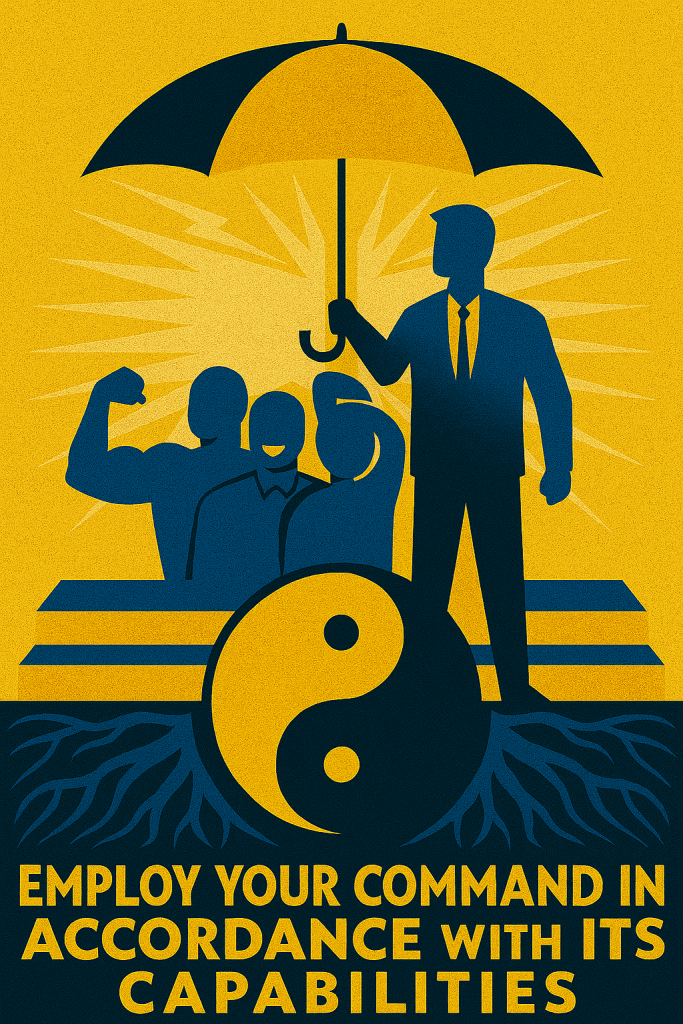
🛡️ Principle# 10: Employ Your Command in Accordance with Its Capabilities
Introduction
Leadership is not about pushing your team to the breaking point; it is about aligning missions with reality. This principle reminds us that success depends on understanding what your team can achieve and deploying them wisely. In this post, we will explore why this matters, how to apply it, and what it means for leaders transitioning from military to civilian roles.
⚖️ Persuasion Triad
- Pathos (Emotion): Protect your team from burnout and frustration.
- Ethos (Credibility): A leader who respects limits earns respect.
- Logos (Logic): Matching tasks to capabilities ensures efficiency and success.
💡 Metaphorical Insight
A leader must try to bring balance to the workforce, not overextending lines much like the yin and the yang. In the realm of vehicular maintenance, when too little time is scheduled for maintenance because operations take priority, maintenance will schedule itself at the most inopportune time and cause the command to culminate early.
Leadership that fails to understand and employ the true capabilities of its team risks suffering the “death by a thousand cuts”, a slow burnout caused by constant overextension and misalignment. Just as digging a hole with a spoon is possible but inefficient, so too is pushing your team beyond their strengths. Employing the right tools, or in this case, the right people for the right tasks, ensures efficiency, morale, and long-term success.
📌 Core Concepts Employing your command effectively means:
- Assessing capabilities honestly, knowing what your team can and cannot do.
- Matching tasks to strengths, assigning roles that maximize efficiency and morale.
- Avoiding overextension, because pushing beyond limits leads to failure and burnout.
- Building adaptability, preparing for contingencies without compromising core objectives.
Sage Advice: A leader who understands capacity prevents chaos and fosters trust.
💡 Core Insight Leadership is not about doing everything, it is about doing the right things with the resources you have. Overestimating capabilities creates risk, underestimating them wastes potential. Balance is key.
| Military Application | Civilian Application |
| Balancing workforce capacity to avoid overextension, akin to maintaining balance like yin and yang. | Managing employee workload to prevent burnout, ensuring sustainable productivity and morale. |
| Conducting mission-focused training and readiness drills. | Providing continuous professional development and skill-building opportunities. |
| Managing resources under high-pressure, time-sensitive conditions. | Allocating resources efficiently while balancing multiple stakeholder interests. |
| Enforcing accountability through formal evaluations and consequences. | Promoting accountability through feedback, coaching, and performance reviews. |
| Planning operations with contingency and risk management. | Implementing strategic planning with risk assessments and mitigation strategies. |
| Leading teams in diverse, multicultural environments. | Managing diverse workforces with cultural competence. |
| Scheduling adequate vehicular maintenance despite operational pressures to avoid unexpected failures that can prematurely end missions. | Planning preventive maintenance and resource allocation to minimize downtime and operational disruptions in civilian fleets. |
Military to Civilian Transition: Beyond Terms to Applications
Transitioning from military to civilian leadership is not just about translating terminology; it’s about applying leadership principles in new contexts. Military leaders excel in mission focus, discipline, and accountability, but civilian environments often require more collaboration, flexibility, and emotional intelligence.
Key applications include:
- Adapting communication styles: Civilian teams may expect more participative dialogue rather than directive orders.
- Leveraging diverse skills: Recognize and integrate varied professional backgrounds and expertise.
- Balancing structure with innovation: Maintain operational discipline while encouraging creative problem-solving.
- Managing different motivators: Understand that civilian employees may be driven by different incentives than military personnel.
Successful transition means translating your leadership strengths into practices that resonate with civilian teams, fostering engagement, trust, and performance.
🗣️ Discussion Prompt
Think of a time when you or your team were asked to do more than you realistically could. How did you handle it? What would you do differently now?
Key Takeaways
- Honest self-assessment of your team’s capabilities is foundational.
- Assign tasks that align with strengths to maximize effectiveness.
- Avoid pushing beyond limits to prevent burnout and failure.
- Build adaptability to navigate unforeseen challenges without losing focus.
🎯 Final Formation We began by emphasizing the importance of aligning missions with capabilities. We explored how honest assessment, strategic tasking, and adaptability prevent failure and build trust. Remember, leadership thrives when expectations match reality. Employ your command wisely, and success will follow.
✅ Disclaimer The views expressed in this post reflect those of the author and do not necessarily represent the views of any organization or institution.
 Lead.Manage.Succeed
Leave a comment