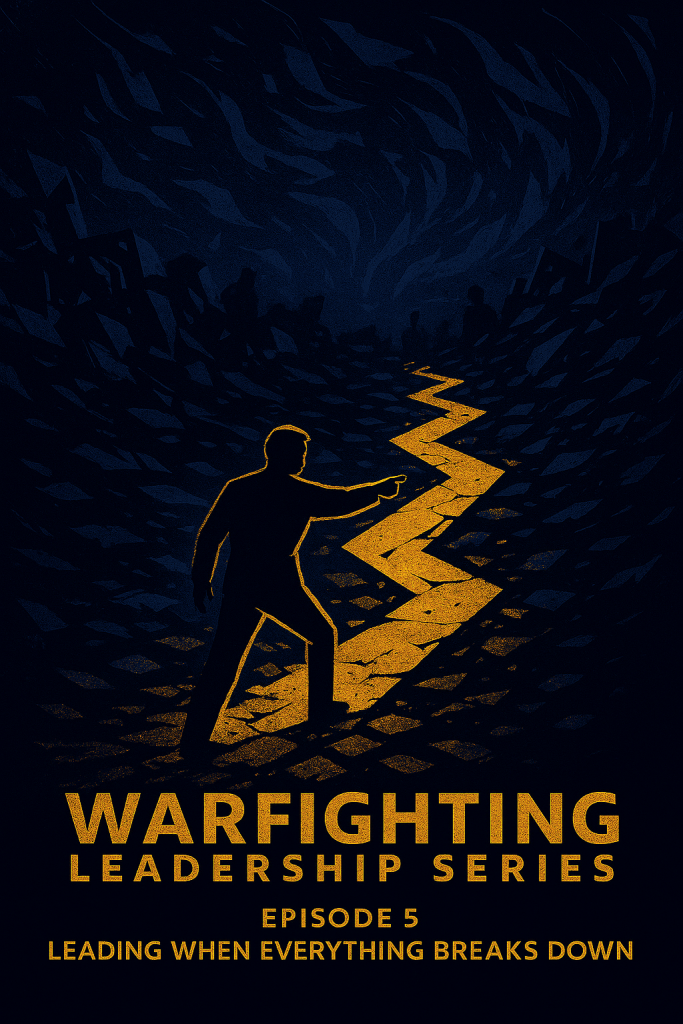
⚡️ Chaos: Leading When Everything Breaks Down
Warfighting Leadership Series, Episode 5
INTRODUCTION 🔥
This episode examines the reality of chaos and the leadership demands that come with it. You will see why breakdowns are unavoidable, how leaders can operate when systems fail, and what separates those who freeze from those who act. The goal is to understand chaos as a natural part of complex environments and to learn how to lead through it with clarity and confidence.
CORE CONCEPTS 🧨
🧩 Chaos Is the Default, Not the Exception
In any complex environment, chaos is normal. Systems drift out of alignment, communication falters, and people interpret information differently (Boyd’s OODA loop helps leaders decide, communicate, and act). Leaders who expect everything to run smoothly are always surprised. Leaders who expect chaos build teams that can adjust quickly, expect the unexpected.
Chaos comes from unpredictability, human mistakes, external influences, and internal friction. It is not a sign that something is wrong. It is a sign that you are operating in a real, dynamic environment. The leader’s responsibility is not to eliminate chaos but to function effectively within it, they bring order to the chaos.
🧠 Control Is an Illusion
The more interconnected a system becomes, the less any single person can control. Leaders who try to manage every detail during a breakdown slow the team and create confusion. They unintentionally become the obstacle, decision paralysis can take hold.
Effective leaders shift from control to influence. They set intent, shape priorities, and empower others to act. They understand that trying to FORCE order onto a chaotic situation usually makes it worse. They understand that Influence moves faster than control, and trust moves faster than oversight. Leaders enable those closest to the problem with the ability to maneuver through the problem space using feedback loops to cut through the fog and navigate the situation.
🛠️ Improvisation Is a Core Skill, Not a Last Resort
When systems collapse, improvisation becomes the primary method of execution. This does not mean guessing. It means adapting with purpose. Improvisation works when leaders have created the right conditions: clear intent, distributed judgment, psychological safety, and trust.
Leaders must treat improvisation as a legitimate form of action. They should reward initiative and avoid punishing people for adjusting to reality. In chaos, the best solutions are often the ones that were never written into the plan but still align with the mission. Judgement is essential and the ability to be decisive is necessary.
🧭 The Leadership Reveal
Chaos exposes leaders. When everything is falling apart, you discover what a person is truly made of. Pressure does not create character, it reveals it. The same boiling water that softens a potato hardens an egg. The environment is the same, but the internal composition determines the outcome.
In moments of panic, people split into two paths. Some rise to the challenge with clarity and resolve. Others freeze, hoping someone else will act first. This is the moment when leadership becomes unmistakable. All eyes turn to the person who steps forward. If the designated leader hesitates, the next person who moves with purpose becomes the real leader, regardless of rank or title.
A leader understands what must be done, when it must be done, and acts without waiting for perfect conditions. Decisive action in the midst of chaos builds confidence. It reassures the team that someone is carrying the weight, someone is thinking clearly, and someone is willing to move when others cannot.
Chaos does not test the plan. It tests the leader.
Sage Advice: When the environment breaks down, leadership becomes visible.
CORE INSIGHT 🎯
Chaos is not the enemy. It is the moment when leadership stands out. Those who act with clarity and resolve become the anchor for everyone else.
MILITARY TO CIVILIAN TRANSLATION TABLE 📘
| Military Concept | Leadership Translation | Business or IT Example |
| Battlefield chaos | System breakdown | Network outage or supply chain collapse |
| Loss of control | Decentralized execution | Agile pivot or crisis response |
| Improvisation | Adaptive strategy | Rapid product shift or live incident handling |
| Friction and chaos | Human error and volatility | Miscommunication or conflicting priorities |
| Command under pressure | Leadership visibility | Executive response during crisis |
LOGOS, ETHOS, PATHOS TRIAD 🎙️
Logos (Logic)
Chaos is inevitable in complex systems. Leaders must design organizations that can adapt rather than rely on rigid structures.
Ethos (Credibility)
Credibility grows when leaders stay composed during breakdowns. Calm decisions and clear communication build trust.
Pathos (Emotion)
Chaos creates fear and frustration. Leaders must help people channel those emotions into purposeful action instead of paralysis.
DISCUSSION PROMPT 💬
Think of a moment when your team faced unexpected breakdown. What did you do, and what would you change if you could revisit that moment?
FINAL FORMATION 🪖
This episode explored the nature of chaos, why control fails, and how leaders operate when systems collapse. You learned how leadership becomes visible in chaos, and how decisive action builds trust and momentum. In the next episode, we move into the deeper mechanics of complexity with Episode 6: Complexity, Why Control Fails.
Disclaimer: The views expressed in this post reflect those of the author and do not necessarily represent the views of any organization or institution.
#Business #GovCon #Leadership #TalentAcquistion #TechCareerDevelopment #TechLeadership
 Lead.Manage.Succeed
Leave a comment