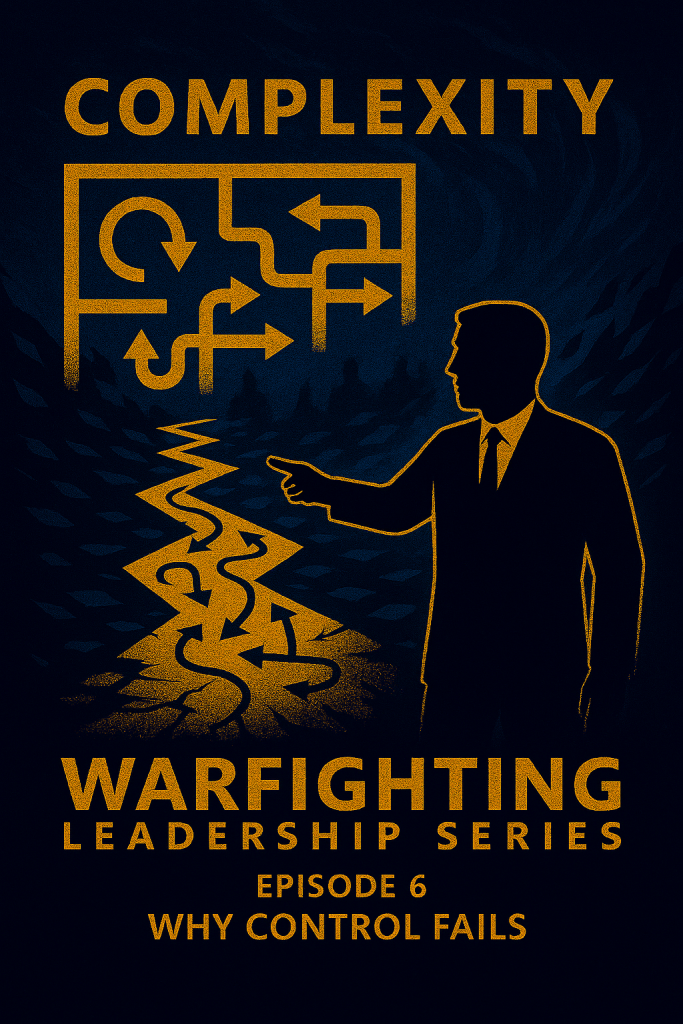
⚙️ Episode 6: Complexity: Why Control Fails
🔍 INTRODUCTION
This episode explores the nature of complexity and why traditional control mechanisms break down in dynamic environments. You’ll learn how complexity differs from chaos, why centralized control becomes a liability, and how leaders must shift from command to influence. The goal is to understand complexity as a defining feature of modern leadership environments and to develop strategies for navigating it effectively.
🧠 CORE CONCEPTS
🕸️ Complexity Is Not Chaos
Chaos is randomness. Complexity is interaction. Complex systems have patterns, but they are unpredictable and nonlinear. Trying to control them with rigid plans leads to failure. Complexity emerges from interdependent parts, feedback loops, and distributed decision-making. Leaders must recognize that complexity is not a flaw, it’s the environment.
🔄 Control Fails Because Systems Interact
In complex environments, every action affects multiple parts. Feedback loops, delays, and emergent behavior make prediction unreliable. Leaders who try to control everything slow the system and create bottlenecks. The more centralized the control, the more fragile the system becomes.
🧭 Influence Beats Control
Influence is faster than control. Leaders must shape intent, priorities, and culture, not micromanage execution. The goal is alignment, not obedience. Influence allows distributed actors to make decisions that support the mission without waiting for permission.
🧩 Decentralization Is Not Disorder
Decentralized execution works when intent is clear and trust is high. It allows teams to adapt faster than any central authority. Leaders must design systems that can operate without constant supervision. This requires clarity of purpose, shared understanding, and mutual trust.
🧠 Complexity Demands Clarity
The more complex the environment, the simpler the guidance must be. Leaders must distill intent into clear, teachable principles. Clarity is not about detail, it’s about direction. In complexity, clarity is the most powerful form of control.
Sage Advice: In complexity, clarity moves faster than control, empowering teams by providing intent in complex systems exponentially amplifies the team’s ability to operate with purpose to achieve goals and win.
🎯 CORE INSIGHT
Control fails in complexity. In today’s fast pace, highly connected digital age Influence, clarity, and trust are the new tools of leadership.
📘 MILITARY TO CIVILIAN TRANSLATION TABLE
| Military Concept | Leadership Translation | Business or IT Example |
| Complex battlefield | Interdependent systems | Distributed teams and platforms |
| Centralized command | Bottlenecked decision-making | Slow executive approvals |
| Decentralized execution | Empowered teams | Agile squads with clear mission intent |
| Commander’s intent | Strategic clarity | Product vision or campaign goal |
| Feedback loops | Emergent behavior | Customer response shaping product roadmap |
🎙️ LOGOS, ETHOS, PATHOS TRIAD
Logos (Logic)
Complex systems cannot be controlled through linear planning. Leaders must design for adaptability, embracing flexible frameworks that allow for emergent solutions. Logical decision-making in complexity involves recognizing patterns, anticipating interactions, and preparing for multiple contingencies rather than fixed outcomes.
Ethos (Credibility)
Credibility grows when leaders trust their teams and communicate clear intent. Authentic leadership in complex environments requires transparency, consistency, and a demonstrated commitment to empowering others. Building ethos means fostering a culture where expertise is valued, and accountability is shared.
Pathos (Emotion)
Complexity creates anxiety and uncertainty. Leaders must replace fear with clarity and empower others to act with confidence. Emotional intelligence is critical; understanding and addressing the emotional landscape helps maintain morale and resilience. Inspiring a shared sense of purpose transforms anxiety into motivation and collective strength.
💬 DISCUSSION PROMPT
Think of a time when centralized control slowed your team. What could have been done differently to enable faster, smarter decisions?
🪖 FINAL FORMATION
This episode explored the nature of complexity, why control fails, and how leaders must shift from command to influence. You learned how clarity, trust, and decentralized execution outperform rigid control in dynamic environments. In the next episode, we explore the human dimension of leadership with Episode 7: The Human Factor: Emotion and Willpower.
Disclaimer: The views expressed in this post reflect those of the author and do not necessarily represent the views of any organization or institution.
#Business #GovCon #Leadership #TalentAcquistion #TechCareerDevelopment #TechLeadership
 Lead.Manage.Succeed
Leave a comment