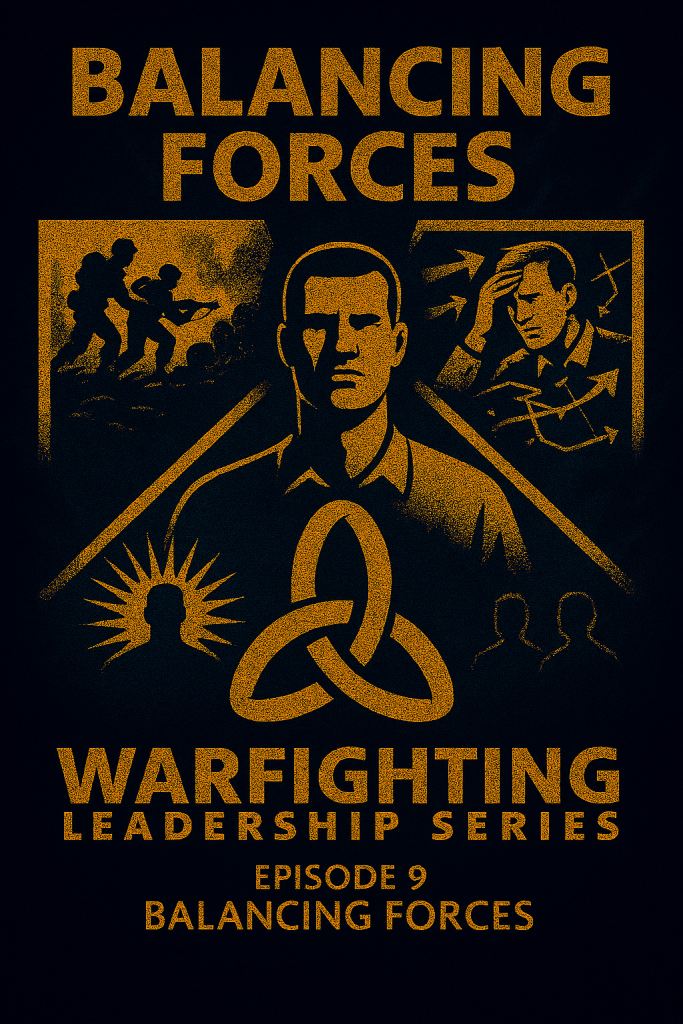
⚖️ Episode 9: Balancing Forces, Physical, Moral, Mental Power
INTRODUCTION 🔍
Leaders do not operate on a single axis. They fight on three fronts at once, the physical, the moral, and the mental. These fronts collide, bleed into each other, and shape every decision you make. Today we are going to talk about how these forces work, how they fail, and how leaders keep them in balance when the pressure hits.
CORE CONCEPTS 💡
🪨 1. Physical Power, The Hard Limits
Every leader eventually runs into the wall. Time, energy, resources, bodies, bandwidth. Physical power is the most visible force and the easiest to measure. That is why inexperienced leaders obsess over it. They think more people, more hours, more tools will solve the problem. Sometimes they do. Often they do not. Physical power is the floor, not the ceiling.
🧭 2. Moral Power, The Force People Feel
Morale, trust, belief. These are not soft ideas. They are the accelerants of human action. When moral power is high, teams move faster, endure more, and take risks they would normally avoid. When it is low, even simple tasks feel impossible. People that are trusted and empowered go above and beyond expectations to succeed. Trust creates a sense of purpose and responsibility to the mission lighting the fire of action. A leader’s moral power is built in quiet moments and tested in violent ones.
🧠 3. Mental Power, Clarity Under Pressure
Mental power is the ability to think when everything around you is trying to make you stop thinking. It is judgment under fire. It is the ability to see patterns in noise, to make decisions without perfect information, and to stay oriented when the situation shifts under your feet.
Mental power is not intelligence, It is steadiness under pressure.
🔗 4. These Forces Do Not Add, They Multiply
This principle echoes the wisdom of Taoism, where success is not forced but cultivated by setting the right conditions. Leadership is about creating balance, carefully planning and forecasting what must happen while remaining adaptable. Like the Taoist path, leaders prepare contingencies and flow with change, harmonizing forces rather than battling them. This balance creates the fertile ground where physical, moral, and mental powers amplify each other, enabling resilience and sustained success.
These forces do not stack like blocks. They amplify each other positively when applied with balance but negatively when the balance is out of whack.
Low morale destroys mental clarity.
Mental fatigue erodes physical performance.
Physical exhaustion crushes moral resolve.
You do not manage these forces, you create balance them setting the conditions for success.
⚠️ 5. Imbalance Is the Real Enemy
A team with high physical power but low moral power becomes brittle.
A team with high moral power but low mental power becomes reckless.
A team with high mental power but low physical power becomes paralyzed.
Leaders must constantly read the terrain and adjust. Not perfectly. Just honestly.
Sage Advice:
When one force collapses, the others follow. Protect the balance.
CORE INSIGHT 🎯
Leadership strength is not found in any single dimension. It is found in the balance, the tension, between physical limits, moral conviction, and mental clarity.
MILITARY TO CIVILIAN TRANSLATION TABLE 📘
| Military Force | Leadership Equivalent | Business or IT Example |
| Physical Power | Resources and capacity | Staffing, tools, time, budget |
| Moral Power | Trust, cohesion, belief | Team culture, psychological safety |
| Mental Power | Judgment and clarity | Decision-making under pressure |
| Force Imbalance | Organizational drag | Burnout, confusion, turnover |
| Force Alignment | High-performance tempo | Teams executing with speed and unity |
LOGOS, ETHOS, PATHOS TRIAD 🎙️
Logos (Logic)
Balanced forces create stability. Imbalanced forces create failure. This is not theory. It is observable in every high-pressure environment. When physical resources are depleted, mental clarity drops. When mental clarity drops, moral strength collapses. The logic is simple. Human systems fail the same way mechanical systems fail, through imbalance and overload. An example you are likely to relate to is car maintenance. If a car does not go in for regular service it will continue to operate but strain the vehicle creating imbalance. Operating under this strain for too long will render the vehicle inoperable. On the other hand getting regular services balances the operations and maintenance schedule enabling the vehicle to operate at peak performance.
Ethos (Credibility)
Leaders earn credibility when they acknowledge limits without surrendering to them. When they protect morale instead of burning it for short-term gains. When they stay mentally steady while others spiral. Credibility is not built through speeches. It is built through the way a leader carries pressure, the way they treat people when the clock is running out, and the way they make decisions when the consequences are real.
Pathos (Emotion)
People follow leaders who feel the strain and still move. They follow leaders who admit fear without letting fear decide. They follow leaders who show that moral strength is not a slogan but a lived behavior. Emotion is not a weakness in leadership. It is the connective tissue that binds teams together when the situation turns hostile.
DISCUSSION PROMPT 💬
Which of the three forces, physical, moral, or mental, do you tend to over rely on, and which one do you neglect when pressure rises?
FINAL FORMATION 🪖
We explored the three forces that shape every leader’s reality, physical limits, moral conviction, and mental clarity. You saw how they interact, how they fail, and how leaders maintain balance under pressure. Next, we shift from balance to evolution with Episode 10, Evolution, What Changes and What Endures.
Disclaimer: The views expressed in this post do not necessarily represent the views of any organization or institution.
#Business #GovCon #Leadership #TalentAcquistion #TechCareerDevelopment #TechLeadership #Coaching
 Lead.Manage.Succeed
Leave a comment