Category: USMC Leadership Traits

Leadership Traits define the character, judgment, and discipline leaders rely on to inspire trust, make hard decisions, influence teams, and drive purposeful action under pressure.

  • 🏁 Endurance: The Final Push in Leadership

    🏁 Endurance: The Final Push in Leadership

    In the Marine Corps, endurance isn’t just a trait it’s a necessity. It’s what keeps you moving when your legs are shot, your mind is foggy, and the mission is far from over. It’s the quiet force behind every successful operation, every completed march, every fulfilled promise. And in the corporate world, endurance plays the same role, just with different terrain.

    Whether you’re leading a platoon through hostile territory or guiding a team through a volatile quarter, endurance is the ability to keep going even when you don’t want to. It’s the mental and physical toughness that separates leaders who finish from those who fade.


    🪖 Military vs. Corporate: The Endurance Parallel

    Marine CorpsCorporate World
    Long-range patrols under harsh conditionsLong-term projects with shifting goals and limited resources
    Sleep deprivation, physical exhaustionEmotional fatigue, decision overload, and constant pivots
    Mission-first mindset despite personal discomfortVision-first leadership despite personal setbacks

    In both worlds, endurance isn’t about brute force, it’s about commitment to the mission. It’s the leader who stays late to support their team, who keeps morale up during layoffs, who doesn’t abandon the strategy when the market turns.


    🧠 Why Leaders Must Master Endurance

    Leadership isn’t a sprint rather it’s a series of marathons. And each one tests your resolve:

    • When the team loses motivation, you carry the torch.
    • When the results stall, you keep the vision alive.
    • When the pressure mounts, you stay composed.

    Endurance is what allows leaders to see things through to the end, even when the end feels impossibly far away.

    One of my closest friends once told me, “The little things matter.” He shared a story from his first time in enemy contact, when chaos erupted and uncertainty loomed, all eyes turned to him. In that moment, his endurance and composure became the anchor for his team. They watched what he would do, ready to follow his lead. That’s the power of enduring leadership, it becomes the compass others rely on in crisis.

    My Recruiting Station Commanding Officer had a favorite line when talking about leadership: “The difference between good and great is that little bit extra.” He believed that going the extra mile, doing the service after the sell, and adding that final touch transforms the ordinary into the extraordinary. It’s not just about doing your job; it’s about doing it with excellence, with heart, and with purpose.

    This reminds me of the saying: “If not me, then who? If not now, then when?” Endurance is the answer to that call.


    🛠️ Practical Ways to Build Endurance

    Here are some actionable strategies to strengthen your leadership stamina:

    1. Train Your Mind Like a Muscle

    • Practice mindfulness or meditation to increase mental resilience.
    • Use journaling to track progress and reflect on setbacks.

    2. Break Big Goals into Tactical Wins

    • Divide long-term objectives into short, achievable milestones.
    • Celebrate small victories to maintain momentum.

    3. Build a Support System

    • Surround yourself with peers who challenge and encourage you.
    • Delegate when needed, endurance doesn’t mean doing it all alone.

    4. Embrace Discomfort

    • Take on tasks that stretch your limits.
    • Learn to sit with frustration and fatigue without quitting.

    5. Stay Physically Fit

    • Regular exercise improves not just stamina but discipline.
    • Physical health reinforces mental toughness.

    📌 Real-World Example: The Long Haul of Leadership

    Imagine a corporate leader navigating a multi-year digital transformation:

    • The initial excitement fades after year one.
    • Budget cuts, staff turnover, and tech failures pile up.
    • But the leader stays the course, adjusting strategy, rallying the team, and pushing through.

    That’s endurance. Not flashy. Not fast. But absolutely vital.


    🎖️ Final Formation: Leadership That Lasts

    With Endurance, we complete the JJ DID TIE BUCKLE series. Each trait: Justice, Judgment, Dependability, Initiative, Decisiveness, Tact, Integrity, Enthusiasm, Bearing, Unselfishness, Courage, Knowledge, Loyalty, has its place. But endurance is what holds them together when the mission gets hard.

    So, stand tall. You’ve earned it. And remember leadership isn’t about being the strongest in the room, it’s about being the one who never stops showing up.

  • Loyalty in Leadership: JJDIDTIEBUCKLE Principles in Military and Business Contexts

    Loyalty in Leadership: JJDIDTIEBUCKLE Principles in Military and Business Contexts

    Loyalty is essential for effective leadership. By examining its definition, manifestations, and challenges, we can uncover actionable insights for leaders in any field.

    🔍 Definition

    Loyalty is steadfast allegiance to a person, mission, or set of values even when tested by adversity or personal cost. It is not blind obedience; rather, it is a conscious commitment rooted in trust, respect, and shared purpose.

    Loyalty is the glue that binds teams together, enabling them to weather storms and achieve shared goals. It is a dynamic force that evolves with circumstances, requiring leaders to constantly evaluate and nurture it.

    🪖 Military Parallel

    In the military, loyalty is foundational to the chain of leadership, the unit, and the mission. Soldiers rely on loyalty for cohesion under pressure, knowing their team won’t abandon them when stakes are high. Loyalty flows both upward and downward: leaders protect their troops, and troops support their leaders.

    Example: A platoon leader who shields their team from unnecessary risk while still executing orders demonstrates loyalty both to their people and the mission.

    Loyalty in the military is not just about following orders; it is about creating a culture of mutual respect and trust. This culture ensures that every member feels valued and understood, fostering a sense of belonging that drives performance and resilience.

    💼 Business Parallel

    In business, loyalty is manifested as commitment to the organization’s vision, team integrity, and ethical leadership. It is tested during layoffs, crises, or when a leader must choose between short-term gain and long-term trust. Loyalty builds retention, morale, and brand reputation — but misplaced loyalty, such as toxic leadership, can be destructive.

    Example: A manager who advocates for their team’s well-being during budget cuts, even if it means challenging upper management, demonstrates principled loyalty.

    Loyalty in business is a delicate balance. Leaders must navigate the complexities of maintaining loyalty to their team while ensuring alignment with organizational goals. This requires transparent communication, empathy, and a commitment to ethical practices that inspire trust and dedication.

    🧭 Key Tensions

    Loyalty often comes with inherent tensions that leaders must navigate:

    • Loyalty vs. Integrity: When loyalty to a person conflict with loyalty to values, which wins?
    • Loyalty vs. Advancement: Will you speak truth to power if it risks your promotion?
    • Loyalty vs. Groupthink: Can you be loyal without becoming complicit?

    These tensions are not just theoretical; they play out in real-world scenarios where leaders must make tough decisions. Navigating these dilemmas requires a deep understanding of one’s values and the courage to act in alignment with them, even when the path is challenging.

    💡 Loyalty Insights

    Loyalty cannot be bought; it is earned through consistent actions, trust, and mutual respect. When leaders have loyal followers, they bear a responsibility to protect, support, and advocate for them. This responsibility is not just ethical but essential for maintaining the trust and cohesion that loyalty fosters.

    In the job market, identifying true loyalty is challenging. Candidates may display surface-level commitment, but discerning genuine loyalty requires looking for indicators such as:

    • Consistency in actions: Do they follow through on promises and demonstrate reliability?
    • Alignment with values: Are their actions and decisions aligned with the organization’s mission and principles?
    • Willingness to go above and beyond: Do they show initiative and dedication beyond their immediate responsibilities?
    • Resilience under pressure: How do they respond to challenges or setbacks?

    By understanding these indicators, leaders can better identify and cultivate loyalty within their teams, ensuring a foundation of trust and mutual respect that drives long-term success.

    🎖️ Final Formation

    In both military and business contexts, the final formation is where accountability meets reflection. It’s the moment leaders stand before their teams not just to give orders, but to embody the values they preach. Loyalty, when practiced with integrity and courage, becomes more than a trait; it becomes a legacy.

    Leaders who cultivate loyalty don’t just inspire compliance, they earn commitment. They create environments where people feel safe to speak truth, take risks, and grow. Whether you’re leading a squad or a startup, your final formation is not a speech, it’s the sum of your actions, decisions, and the trust you’ve built.


    By understanding loyalty’s nuances and applications, leaders can foster trust, resilience, and ethical alignment in their teams. Whether in the high-stakes environment of the military or the dynamic world of business, loyalty remains a vital trait that defines great leadership.

  • Knowledgeable: A Leader Who Knows, Goes, and Shows

    Knowledgeable: A Leader Who Knows, Goes, and Shows

    In the pursuit of leadership, knowledge isn’t just power, it’s responsibility. Being knowledgeable means more than retaining facts or mastering systems. It means embodying what you understand, making decisions informed by both insight and experience, and guiding others with clarity and conviction.

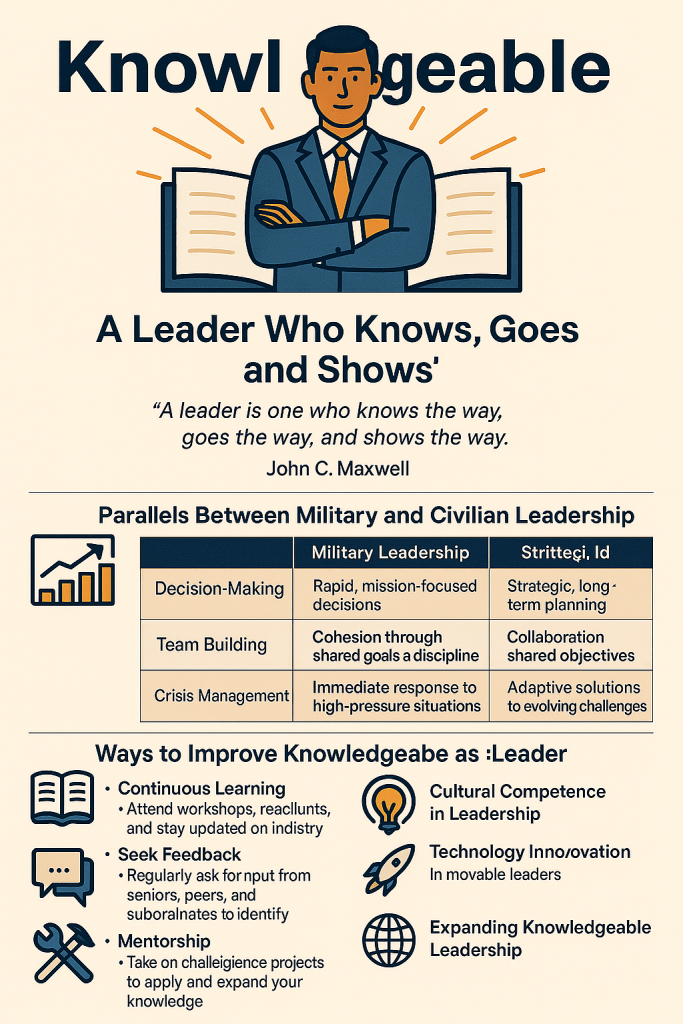
    John C. Maxwell summed it up best: “A leader is one who knows the way, goes the way, and shows the way.”1 This quote captures the essence of knowledgeable leadership, they know what needs to happen they walk the path all the while illuminating it for others.


    Parallels Between Military and Civilian Leadership

    📊 Military leadership emphasizes structure, discipline, and chain of command, while civilian leadership often focuses on adaptability, collaboration, and innovation. Despite these differences, both share the need for knowledgeable leaders who can inspire and guide their teams effectively.

    Examples of Knowledgeable Leadership

    AspectMilitary LeadershipCivilian Leadership
    Decision-MakingRapid, mission-focused decisionsStrategic, long-term planning
    Team BuildingCohesion through shared goals and disciplineCollaboration through shared objectives
    Crisis ManagementImmediate response to high-pressure situationsAdaptive solutions to evolving challenges

    Ways to Improve Knowledge as a Leader

    📚 – Continuous Learning: Attend workshops, read books, and stay updated on industry trends.

    💬 – Seek Feedback: Regularly ask for input from seniors, peers, and subordinates to identify areas for growth.

    🤝 – Mentorship: Learn from experienced leaders and share your knowledge with others.

    🛠️ – Practical Experience: Take on challenging projects to apply and expand your knowledge.

    🌐 – Networking: Build relationships with professionals in your field to exchange insights and ideas.


    Expanding Knowledgeable Leadership

    The Role of Emotional Intelligence

    💡 Knowledgeable leaders understand that emotional intelligence is key to effective leadership. By recognizing and managing their own emotions, as well as empathizing with others, leaders can build stronger relationships and foster a positive team environment. I was once told that people with high EQ (emotional intelligence) often make the best leaders. I believe that to be so because all the leaders that I have known, and over 28 years of serving with the best leaders in the world in the best leadership organization, I would have to agree. An authentic leader who can pick up on the tone of the room can identity what needs to be done to sway room and will build confidence in the future. This is someone that people will follow to the ends of the earth and beyond.

    Cultural Competence in Leadership

    🌍 In an increasingly globalized world, cultural competence is essential for knowledgeable leaders. Understanding and respecting diverse perspectives allows leaders to navigate complex social dynamics and avoid making cultural blunders at the expense of reputation. Know cultural norms, mores, and values this builds trust and shows you’re authentic and interested.

    Technology and Innovation

    🚀 Staying ahead in the digital age requires leaders to embrace technology and innovation. Knowledgeable leaders leverage tools and platforms to streamline processes, enhance communication, and drive progress. If it can be automated, then automate to free up human capital to do the higher level thinking that we are all capable of and unlock peoples innovation and creativity.

    The 3000-Year-Old Mind

    📜 Knowledgeable leaders understand the value of learning from history. By studying the works and experiences of those who came before us, we can cultivate the 3000-year-old mind. This approach allows leaders to avoid the pitfalls of others on the road to greatness and build on the wisdom of the past. Knowledge is power not just the power of rank or title, but the power to inspire and lead others through understanding and insight. The Marine Corps has really ingrained the 3000-year-old mind idea into their organizational leaders at all levels through reading lists, professional military education, tactical decision games, and online learning venues just to name a few tools they use.

    Real-Life Examples of Knowledgeable Leadership

    • Military Example: General Dwight D. Eisenhower’s strategic planning during World War II showcased his deep understanding of logistics and coalition-building.2
    • Civilian Example: Steve Jobs’ leadership at Apple exemplified visionary thinking and innovation, transforming the company into a global leader in technology and design.

    Actionable Tips for Aspiring Leaders

    🎯 – Develop a Learning Plan: Set specific goals for acquiring new skills and knowledge.

    🔍 – Engage in Cross-Disciplinary Learning: Explore topics outside your immediate field to gain broader insights.

    🗣️ – Participate in Leadership Forums: Join discussions and workshops to exchange ideas with other leaders.

    🔄 – Reflect and Adapt: Regularly assess your leadership style and make adjustments based on feedback and outcomes.


    Final Formation

    📖 Knowledgeable leadership is not a destination but a journey. It requires continuous learning, adaptability, and a commitment to growth. The best leaders are lifelong learners. By embracing the principles outlined in this blog, leaders can inspire their teams, navigate challenges, and leave a lasting impact. .

    Let’s lead with knowledge, empathy, and innovation—because the world needs leaders who know, go, and show.


    1: John C. Maxwell, “The 21 Irrefutable Laws of Leadership.”

    2: Eisenhower, Dwight D., “Crusade in Europe.”

  • Courage: The Backbone of Leadership

    Courage: The Backbone of Leadership

    Courage is the cornerstone of effective leadership, and it holds a special place in the JJDIDTIEBUCKLE series. This series, which highlights the core traits of leadership, emphasizes the importance of moral and physical courage in navigating challenges and inspiring others.

    Courage is not the absence of fear but the ability to face it head-on. It is about taking risks, standing up for what is right, and persevering in the face of adversity. Whether it’s making tough decisions, admitting mistakes, or defending your values, courage is the trait that enables leaders to act with integrity and conviction.

    🛡️ The USMC Definition of Courage

    The United States Marine Corps (USMC) defines courage as “the mental, moral, and physical strength ingrained in Marines. It steadies them in times of stress, carries them through every challenge, and aids them in facing fear and overcoming adversity with resolve.”1 This definition underscores the essence of courage as a steadfast force that empowers individuals to confront fear and adversity with resolve.

    ⚖️ Courageous Leadership

    Courageous leadership is about distinguishing between doing things right and doing the right things. While doing things right focuses on efficiency and adherence to rules, doing the right things emphasizes moral integrity and ethical decision-making. As the adage goes, “What’s wrong is wrong, even if everyone is doing it. What’s right is right, even if no one is doing it.” This principle serves as a guiding light for leaders who strive to uphold ethical standards and make decisions that align with their values.

    🌟 Everyday Acts of Courage

    Courage manifests in various forms, shaping the way leaders interact with their teams and communities. It is present in everyday decisions and actions, from admitting a mistake to supporting a colleague. Courageous leaders are unafraid to challenge authority or the status quo when necessary. They understand the importance of voicing concerns and advocating for change, even in the face of opposition.

    🌍 Courage Across Contexts

    In both the military and the corporate world, courage is a universal trait that transcends environments. Military leaders must make quick, high-stakes decisions under pressure, while corporate executives face critical choices that can shape the future of their organizations. Both understand the importance of fostering trust and unity within their teams, inspiring loyalty and collaboration.

    AspectMilitary LeadershipBusiness Leadership
    Decision-MakingCourage to make quick, high-stakes decisions under pressureCourage to make strategic, long-term decisions with organizational impact
    Team DynamicsCourage to foster trust and unity in high-stress environmentsCourage to build collaboration and loyalty across diverse teams
    Risk ManagementCourage to take calculated risks with potential life-or-death consequencesCourage to balance innovation with financial and reputational risks
    Ethical StandardsCourage to uphold strict codes of conduct and honorCourage to navigate complex ethical dilemmas in a competitive market

    🎖️ Final Formation

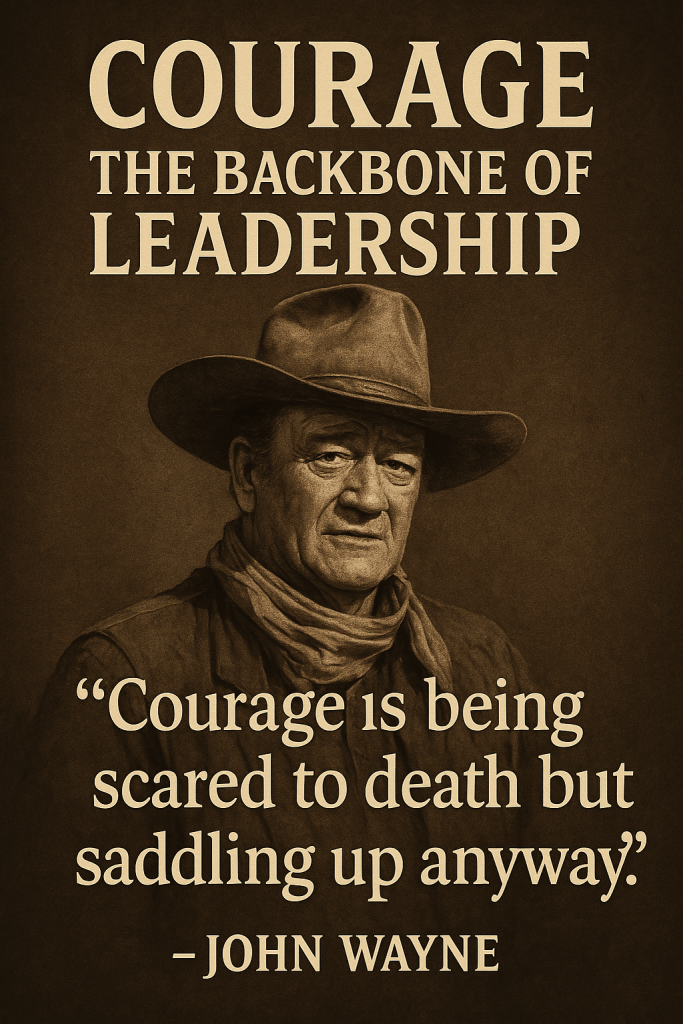
    Courage is the backbone of leadership, and it’s a trait that deserves to be celebrated and cultivated. Let it guide you as you navigate the complexities of leadership and strive to make a positive impact. As Billy Graham said, “Courage is contagious. When a brave man takes a stand, the spines of others are often stiffened.”2 And as John Wayne famously remarked, “Courage is being scared to death but saddling up anyway.”3

    Footnotes:

    1. The USMC definition of courage is sourced from the Leading Marines publication, which outlines the core leadership traits that define the Marine ethos.
    2. Billy Graham’s quote originates from his 1964 Reader’s Digest article, “A Time for Moral Courage,” where he emphasized the ripple effect of moral courage in inspiring others to act with integrity.
    3. John Wayne’s quote highlights the essence of courage as action in the face of fear, encapsulating the spirit of resilience and determination.
  • Unselfishness: The Leadership Trait That Commands Loyalty Without Demanding It

     Unselfishness: The Leadership Trait That Commands Loyalty Without Demanding It

    In the long march of leadership, one trait keeps proving itself in the field and in the boardroom: unselfishness. It’s not a buzzword. It’s the difference between managing and leading. Between commanding and inspiring.

    Those who lead with unselfishness don’t just hold positions they earn devotion. They don’t win compliance through rank. They win followership through sacrifice.


    🎖️ From the Battlefield to the Breakroom: Unselfishness in Action

    Whether you’re wearing combat boots or dress shoes, the fundamentals are strikingly similar. In the military, leadership starts with service. Officers eat last. They train with their troops. They are at point of friction, and they make the hard calls often quietly, and almost always with others in mind.

    The Marine Corps defines unselfishness as the “avoidance of providing for one’s own comfort and personal advancement at the expense of others.” It’s not just generosity it’s a mindset that puts mission over self and team over ego.

    In business, leadership should echo the same ethic. When managers handle heavy lifting, absorb pressure, and push credit toward their teams, they create loyalty no paycheck can buy.


    📊 Military vs. Business Leadership Applications

    Leadership QualityMilitary ApplicationBusiness Application
    Lead by ExampleTrain and endure alongside your unitTackle high-pressure work with your team
    Share PowerDelegate to build readiness and trustEmpower autonomy and accountability
    Mission Over SelfPrioritize the operation over egoFocus on purpose, not promotion
    Team LoyaltyNever leave anyone behindBack your team through wins and weather

    🛠️ How to Lead Unselfishly, Every Day

    • Take Initiative Before You’re Asked
      Spot pain points. Remove roadblocks. Be the teammate who eases burdens without being told.
    • Remove Obstacles Quietly
      Ask “What’s slowing us down?” then act. Leadership isn’t about being seen it’s about making sure others can move forward.
    • Give Credit, Hold the Blame
      Success? Spotlight your team. Failure? Take responsibility. It builds trust brick by brick.
    • Empower with Trust
      Share responsibility. Let others shine. Leadership is not a solo act it’s a stage for many.
    • Model Generosity That Costs Something
      Real unselfishness is inconvenient. That’s what makes it powerful. Give your time, your attention, your praise freely.
    • Win People, Not Just Titles
      Rank earns obedience. Unselfishness earns loyalty. If you’re respected beyond your role, you’re truly leading.

    🫡 Final Formation

    Unselfish leaders don’t ask for loyalty they earn it. They don’t demand respect, they generate it. The deepest kind of influence comes not from titles or policy, but from the kind of leadership that rolls up sleeves, stays late, and lifts others up being a bucket filler and not a bucket dipper.

    If you’re building a legacy, not just a career, then commit to unselfishness as your operational standard. Because teams won’t remember your title in five years. They’ll remember how you made them feel under pressure, how you led when it counted, and how you put the mission and the team ahead of yourself.

    This is the kind of leadership that lasts.

  • Bearing: The Silent Authority Behind Leadership

    Bearing: The Silent Authority Behind Leadership

    Some traits shout. Bearing whispers but everyone listens.

    In the JJDIDTIEBUCKLE leadership model, Bearing is the quiet force that precedes words, steers emotion, and commands respect without display. It’s not just how you carry yourself it’s the internal mastery that makes people carry you in their minds long after you’ve left the room.

    📖 Definition

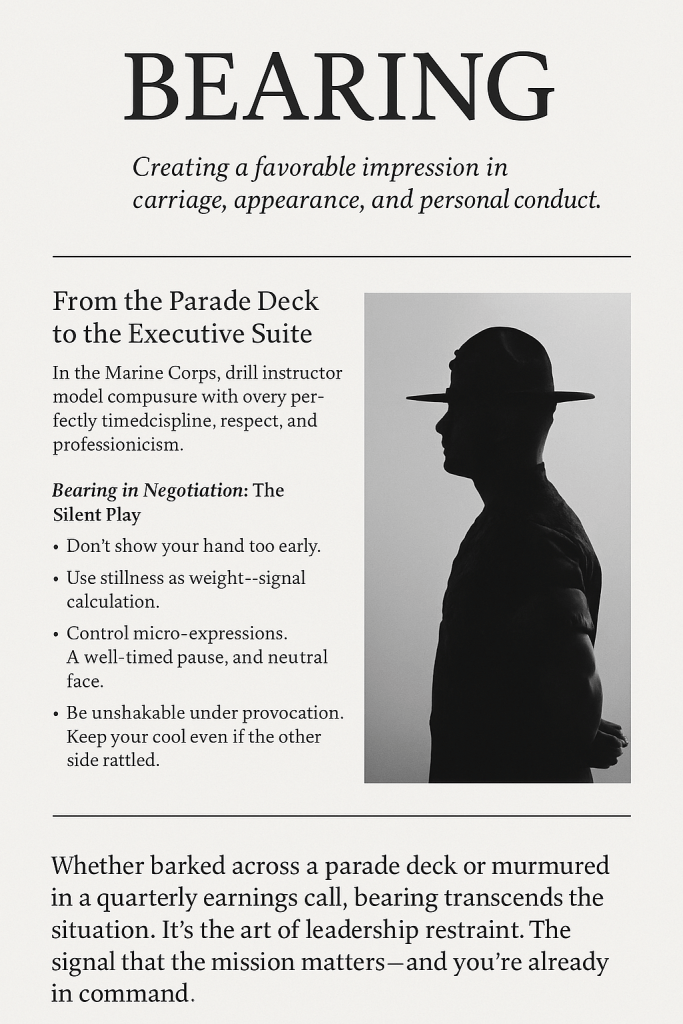
    Bearing: Creating a favorable impression in carriage, appearance, and personal conduct.

    From a Marine standing tall on the parade deck to a negotiator holding poise in a high-stakes meeting, bearing is what defines the temperature of the room and who holds the thermostat.


    🪖 Bearing in the Marine Corps: Posture as Purpose

    In the Marine Corps, bearing is mission-critical.

    • Drill Instructors model composure with every perfectly timed pause and unshakable expression. Their stern posture, razor-precise movements, and deliberate tones are not just performative they create a transformation container for recruits to shed uncertainty and build discipline.
    • Combat Leaders project calm in chaos, transmitting resolve through posture, tone, and deliberate control. The leader’s stillness becomes the squad’s anchor. When bullets fly or uncertainty spikes, Marines look to the leader not for answers, but for bearing.

    🧠 Bearing in Business: Authority Without Ego

    In the corporate world, bearing manifests in quieter but no less commanding ways.

    • In Negotiation, bearing is your armor. A composed posture, unwavering eye contact, and strategic silence can unsettle opponents without a word. Confidence radiates when your body says, “I don’t need to convince you. I already know my value.”
    • In Leadership, bearing is the tone-setter. Whether managing crisis, delivering hard truths, or introducing change, your emotional regulation becomes everyone else’s permission slip. You’re not reacting you’re conducting.

    🔧 How to Practice Bearing Daily

    ElementPractice Tip
    Emotional disciplinePause before responding. Control tone and body language.
    Visual composureMaintain posture. Let stillness become a signal.
    Dress and movement intentionAlign style with values and mission not vanity.
    Negotiation presenceUse silence, calm gaze, and timing to project control.
    Role integrityStay in character for the good of the moment, not ego.

    💬 Closing Formation

    Leadership is more than what you say it’s how you hold yourself. Bearing isn’t loud. It’s unwavering. It’s the reason a room leans forward when you stand still. Whether in the sands of Parris Island or across a polished walnut boardroom table, bearing is the quietest form of command and often the most powerful.

  • Enthusiasm: The Spark Between Initiative and Integrity

    Enthusiasm: The Spark Between Initiative and Integrity

    In the leadership arsenal of the United States Marine Corps, few traits exist in isolation. Initiative drives the action. Integrity ensures the action is right. But what brings both to life what gives direction heart and momentum is Enthusiasm.

    This isn’t about surface-level hype. It’s about belief made visible. In the Corps, we don’t follow empty energy. We follow leaders who care so deeply about the mission that it spills into everything they do.

    Earned in the Mud, Carried Through the Fog

    In the Marine Corps, enthusiasm is more than morale, it’s operational fuel. It’s the fire in a squad leader’s voice on a rainy field op. It’s the unspoken “let’s get after it” because things don’t get done by themselves. It’s showing up again, and again, and again, because the mission’s worth it.

    In civilian leadership, enthusiasm plays out differently but no less powerfully. It looks like a team lead who invests in their people. A startup founder who stays late because they believe in the product. A nurse who keeps showing up with compassion at the end of a long shift.

    In both worlds, enthusiasm invites buy-in without demanding it. It doesn’t coerce it compels it.

    Why Enthusiasm Isn’t Optional

    Let’s call it what it is: enthusiasm connects the dots.

    • It amplifies initiative. Energy fuels action that’s not just quick but committed.
    • It confirms integrity. Belief in the mission shows through when you show up.
    • It builds trust. When people see your fire, they feel safe striking their own match.

    If initiative says, “I’ll go,” and integrity says, “I’ll go the right way,” enthusiasm adds, “and I’m honored to do it.”

    Lead Like a Marine: How to Build Enthusiasm That Lasts

    This isn’t about loud. It’s about real. Whether you’re leading Marines, managing a team, or coaching a crew, enthusiasm is earned and built.

    1. Know your mission and own it.
      Reconnect with your “why.” If you don’t believe, no one else will.
    2. Celebrate wins, however small.
      Every step forward is a foothold for morale.
    3. Face adversity with curiosity.
      Marines embrace the suck but they learn from it. Bring that to your setbacks.
    4. Protect your inputs.
      Choose gritty over passive. Surround yourself with fire-starters, not flame-snuffers.
    5. Operate from your strengths.
      Lead from solid ground. Confidence breeds calm energy.
    6. Set the emotional tone.
      Whether you wear stripes or slacks, you’re the emotional barometer. Make it count.

    Final Formation

    Enthusiasm isn’t decoration it’s direction. It turns static values into kinetic leadership. Whether you’re leading a patrol through the bush or guiding a project through chaos, remember:

    As Steve Jobs once said, “If you are working on something exciting that you really care about, you don’t have to be pushed. The vision pulls you.” Let that vision become the gravity that draws others forward make it so clear and compelling that following you feels natural.

    Initiative drives the action. Integrity keeps it honest. Enthusiasm makes it contagious.

    So bring the fire. Let them feel it in your tone, see it in your choices, and believe it through your presence.

  • Above the Cut Line: Leading Before You’re Asked

    Above the Cut Line: Leading Before You’re Asked

    In the Marine Corps, Initiative is more than a buzzword it’s survival. You don’t wait for perfect orders when the fog rolls in and the situation shifts. You act. Because “no plan survives contact with the enemy,” and leadership means being ready to pivot, adapt, and push forward even when things fall apart.

    That mindset transfers directly to the civilian world.

    In business and life, Initiative looks like stepping up without being told not just spotting problems, but bringing solutions. That’s where most people fall short. Pointing out issues is easy. But proposing a fix, that’s operating above the cut line.

    Taking Initiative in industry might mean:

    • Drafting a project proposal to fill a capability gap you noticed weeks before anyone mentioned it.
    • Streamlining a bloated process.
    • Volunteering to lead a stalled-out effort and breathing new life into it.
    • Mentoring someone quietly struggling, because you saw what no one else was paying attention to.

    And when you do act, know this: it won’t go exactly to plan.
    So have a Plan B. Maybe even a Plan C. Then leave some white space for real-time adjustments. That’s leadership in motion action with awareness.

    That’s why Marines live by the mantra: Improvise. Adapt. Overcome.
    It’s not just a slogan it’s a mindset. When the terrain shifts, you shift with it. When the tools break, you find another way. When the plan fails, you build a new one mid-stride. That’s Initiative in its rawest form.

    Just like GySgt Highway in Heartbreak Ridge, Initiative means doing what needs to be done even if it ruffles feathers. Highway didn’t wait for permission to whip his Recon platoon into shape. He saw the problem, took action, and made leaders out of hooligans. He didn’t follow the manual he followed the mission. See the gap, fill the gap, and take the heat if it goes sideways.

    Sometimes you’ll have to execute with only 70% of the information. Sometimes the tools won’t be perfect. And sometimes the outcome will sting a little. But Initiative isn’t about flawless execution it’s about intentional momentum and the courage to take responsibility, even if it means later saying, “That one’s on me.”

    As legendary UCLA coach John Wooden, winner of 10 NCAA championships, once said:

    “The [person] who is afraid to risk failure seldom has to face success.”

    What I take from that is simple: the answer is always no unless you ask. Take the shot, and you’ll either fail—or you’ll learn. Either way, you’re moving forward.

    And here’s the truth most won’t say out loud: real leadership lives in discomfort. Growth doesn’t happen in the safe zone. It happens when you lean into the awkward, and uncertain. When you’re willing to be uncomfortable, to speak up, to take the risk, to own the outcome you’re not just showing Initiative. You’re showing grit.

    You don’t need rank to lead. You need vision, guts, and the willingness to step into uncertainty with purpose. Just like in the Corps, the people who rise are the ones who act when no one’s watching.

    So take the shot. Adjust fire as needed. Improvise. Adapt. Overcome.
    That’s how leaders emerge above the cut line.

  • Tact: The Art of Making a Point Without Making an Enemy

    Tact: The Art of Making a Point Without Making an Enemy

    In both the military and business worlds, success depends not only on strategy and execution but also on communication. One of the most powerful tools in any leader’s arsenal is tact the ability to make a point without making an enemy. It’s what separates effective leaders from those who, despite having good ideas, struggle to gain support and influence.

    Tact in the Military: A Matter of Discipline and Diplomacy

    In military operations, tact is more than just a social skill, it’s a survival skill. Commanders must give orders with authority, but they also need to inspire confidence and cooperation among troops. Soldiers rely on their leaders for direction, yet trust can quickly erode if commands are delivered with unnecessary harshness or disrespect.

    Consider a seasoned officer correcting a younger recruit. If done with tact, the correction strengthens discipline while maintaining morale. If handled poorly through public embarrassment or excessive rigidity it breeds resentment, which can affect unit cohesion. Similarly, in diplomacy and intelligence operations, tact is essential when negotiating with allies and adversaries. Military leaders must assert their objectives clearly while avoiding unnecessary provocations that could escalate conflicts.

    Tact in Business: The Cornerstone of Leadership

    In business, tact separates a good manager from a great leader. Professionals must navigate negotiations, address conflicts, and provide feedback all while preserving relationships. A blunt critique of an employee’s performance may be accurate, but without tact, it can demoralize rather than motivate. The best leaders know that how a message is delivered is just as important as the message itself.

    Take, for instance, high-stakes boardroom discussions. A tactful executive presenting a dissenting opinion doesn’t just challenge ideas; they encourage dialogue. Instead of saying, “That plan is flawed,” a tactful leader might say, “I see some potential risks with this approach perhaps we can explore ways to mitigate them.” The difference? One statement shuts down discussion, the other fosters collaboration.

    The Common Thread: Precision in Communication

    Whether in military strategy or corporate decision-making, tact isn’t about being overly cautious or avoiding difficult conversations it’s about precision in communication. A tactful leader delivers strong messages without alienating others. They frame criticism constructively, command respect without instilling fear, and advocate for their positions without diminishing those of others.

    Winston Churchill once said, “Tact is the ability to tell someone to go to hell in such a way that they look forward to the trip.” While dramatic, the essence of the quote holds true across both the battlefield and the boardroom: influence and persuasion are as much about delivery as they are about intent.

    Developing Tact as a Skill

    Tact isn’t innate, it’s learned and practiced. Here are a few ways to sharpen it:

    • Pause before responding: In high-pressure environments, a moment of reflection can prevent unnecessary friction.
    • Frame criticism constructively: Instead of highlighting faults, suggest improvements.
    • Recognize different perspectives: The best leaders listen before they speak.
    • Maintain composure: Staying calm, even when tensions rise, makes conversations more productive.

    At its core, tact is a bridge between people and ideas. It ensures that bold strategies don’t become reckless, that firm leadership doesn’t turn into dictatorship, and that necessary corrections don’t devolve into conflicts. Whether commanding troops or leading teams, those who master the art of tact will always have an edge.

  • Dependability: The Backbone of Leadership

    Dependability: The Backbone of Leadership

    “Let your ‘yes’ be yes and your ‘no’ be no.”

    Dependability is more than a leadership trait, it’s the foundation of trust. Leaders who follow through on commitments, provide accurate information, and deliver under pressure earn confidence from both their superiors and subordinates. In military and business settings alike, reliability fuels strong decision-making, cohesion, and mission success.

    A dependable leader ensures that when something is said, it is followed by action. This predictability creates a leadership environment where teams instinctively trust decisions because they trust the leader providing them.

    Trust Through Reliability

    Leadership isn’t about grand promises it’s about consistent execution. Trust is earned when leaders commit to action and deliver. Seniors rely on a leader’s judgment and execution, while subordinates gain confidence knowing they are being led by someone who follows through.

    Showing Up When It Counts

    Dependability is proven in moments of pressure. Whether ensuring resources arrive on time or making a pivotal call in a crisis, leadership requires follow-through. A dependable leader operates with urgency, providing clarity when it matters most.

    Truth and Timeliness in Leadership

    Bad news does not improve with time. The sooner critical information is discovered and conveyed, the sooner teams can adapt and mitigate risks. Delayed communication weakens decision-making, erodes trust, and turns minor setbacks into major failures. Leadership requires delivering truth promptly and decisively.

    Decisions are only as strong as the information they rely on. When leaders consistently provide accurate updates, they strengthen confidence, allowing decisive action to unfold smoothly. Hesitation leads to uncertainty, but a dependable leader ensures every decision is backed by trustworthy intelligence.

    Dependability as Strategic Foresight

    Leaders operate with a vision, they see the battlefield, the boardroom, or the mission space with clarity. Dependable information shapes strategy, allowing leaders to maneuver with precision. A commander with reliable intelligence can anticipate threats, position forces for a decisive strike, or identify business opportunities before competitors.

    This ability to checkmate the opposition, whether in warfare or industry, depends on confidence in the data supporting each move. Without dependability, leadership becomes reactive, decisions falter, and momentum is lost. The most effective leaders never gamble on guesswork, they base every action on trust, clarity, and consistency in the intelligence they receive.

    A Culture of Dependability

    Effective leadership builds momentum. Reliable reporting leads to stronger confidence, which fuels better decisions, reinforcing trust at every level. Conversely, inconsistent or vague communication leads to operational delays, uncertainty, and weakened cohesion.

    Conclusion: The Power of Dependability

    Leadership is about more than just making decisions, it is about ensuring those decisions are built on a foundation of trust, reliability, and execution. Dependability is not a passive trait; it requires deliberate commitment, timely communication, and unwavering accountability. When a leader speaks, those words must carry weight because they are backed by action.

    The leaders who stand the test of time are the ones whose teams never have to question whether they will follow through. Dependability is not just a characteristic; it is a legacy that defines leadership effectiveness across generations.