Category: USMC Leadership Traits

Leadership Traits define the character, judgment, and discipline leaders rely on to inspire trust, make hard decisions, influence teams, and drive purposeful action under pressure.

  • Integrity and Ethics: The Unshakable Core of Leadership

    Integrity and Ethics: The Unshakable Core of Leadership

    Leadership is not just about making decisions, it is about making the right, most ethical decisions. In both the military and business worlds, integrity and ethics are not secondary considerations; they are the forefront of decision-making and trust-building. Without them, leadership crumbles, and organizations rot from within, much like a piece of wood with its heartwood decayed.

    Integrity and Ethics: The Foundation of Trust

    Trust is the currency of leadership. Subordinates and juniors must believe that their leaders are guided not just by strategy, but by moral clarity. They need confidence that orders are given with honor, decisions are made with fairness, and accountability is upheld without compromise.

    In the military, a platoon follows their commander into battle because they trust that their leader is acting in their best interest not for personal gain or misguided ambition. In business, employees rally behind an executive who leads with honesty, ensuring that policies are fair and practices are ethical. Without that foundation, doubt creeps in, morale declines, and the organization’s core begins to rot.

    Decision-Making Rooted in Integrity

    Decisiveness without integrity leads to reckless, destructive choices. A strong leader does not just act quickly, they act rightly. Structured decision-making tools, like SWOT analysis, force field analysis, and OODA loops, work best when rooted in ethical leadership. An unethical leader may manipulate these frameworks to justify deceitful actions, but an honorable leader uses them to enhance transparency, fairness, and accountability.

    Leaders with integrity-based decisiveness ensure that every choice aligns with a higher standard. They ask:

    • Is this decision ethical?
    • Does it uphold our values and the trust of our people?
    • Would I stand by this choice under scrutiny?

    Making ethical choices strengthens leadership credibility, reinforcing a culture where subordinates feel secure in following orders, executing strategies, and trusting that they are part of something honorable.

    The Rot of Corrupt Leadership

    A leader without integrity is like a tree whose heartwood is rotten. On the surface, it may seem strong, but the core is hollow ready to collapse under pressure. Organizations led by unethical figures eventually crumble under their own deceit.

    History has shown that military units collapse when leaders prioritize personal survival over honor. Businesses implode when executives engage in fraud or mistreatment of employees. No amount of skill, intelligence, or decisiveness can salvage an organization that lacks ethical leadership.

    The Enduring Legacy of Ethical Leadership

    Marines, soldiers, and professionals alike follow leaders who embody trust, honesty, and fairness. Whether commanding troops or running a business, the most respected leaders leave behind a legacy of integrity-driven decision-making.

    An honorable leader understands that ethics are not a restriction, they are the true power behind strong leadership. A leader who prioritizes integrity inspires loyalty, builds lasting trust, and ensures that their influence extends beyond their immediate sphere of control.

  • Decisiveness: The Warfighter and the Business Leader

    Decisiveness: The Warfighter and the Business Leader

    Decisiveness is the backbone of leadership whether in battle or in business. Both warfighters and executives face moments where hesitation can cost lives, opportunities, or momentum. While instinct and experience are invaluable, effective leaders also use structured decision-making tools to weigh their options and commit to action with confidence.

    Operational Tempo vs. Business Agility

    A warfighter operates under operational tempo the speed at which decisions are made and executed. A commander who waits for perfect intelligence risks losing the initiative to the enemy. Similarly, in business, agility is key. Companies that act swiftly in response to market changes outmaneuver competitors, while those waiting for perfect conditions often fall behind.

    “A Good Plan Now Beats a Perfect Plan Too Late”

    Military leaders understand that a good plan executed now is better than a perfect plan executed too late. In warfare, hesitation can mean losing ground or failing to capitalize on an opening. In business, delayed decisions result in missed market opportunities, lost deals, and eroded confidence. Imperfect plans, when executed with enthusiasm and adaptability, often yield better results than meticulously crafted strategies that arrive too late.

    The Role of Risk-Based Decisions

    Both warfighters and business leaders must evaluate risk before committing to action. The key difference?

    • Military leaders risk lives both their own and those of their team. Every decision in combat carries profound consequences. A miscalculated strategy can lead to casualties, mission failure, or long-term instability.
    • Business leaders risk resources capital, reputation, and strategic positioning. A poorly timed move may cost a company millions, damage relationships, or allow competitors to seize the advantage.

    Despite the stakes being different, the methodology behind risk assessment remains similar:

    1. Identifying Threats – What could go wrong?
    2. Weighing Consequences – What is the impact of failure?
    3. Mitigating Risks – Can adjustments be made to reduce uncertainty?
    4. Decisive Execution – Commit with confidence, knowing adaptation will be key.

    Decision-Making Tools for Warfighters and Business Leaders

    While strong intuition plays a role in leadership, structured methods enhance clarity and speed. Here are a few tools used in both combat strategy and business decision-making:

    • SWOT Analysis (Strengths, Weaknesses, Opportunities, Threats)
      • Used to assess internal and external factors before committing to a course of action.
      • Warfighters use it to evaluate enemy advantages and weaknesses, while businesses leverage it for competitive analysis.
    • Force Field Analysis
      • Identifies driving forces that push a decision forward and restraining forces that hold it back.
      • In military strategy, this helps leaders assess risk versus reward when engaging an enemy. In business, it aids in weighing barriers to market entry or organizational change.
    • OODA Loop (Observe, Orient, Decide, Act)
      • A rapid decision-making cycle used in combat to maintain advantage over adversaries.
      • Businesses use it for agile response to industry shifts monitoring trends, adapting quickly, and executing decisions decisively.
    • Wishbone Analysis
      • Splits a decision into two distinct paths one focused on bold action and the other on cautious execution.
      • Useful for assessing whether to take an aggressive stance (e.g., launching a disruptive product) or a conservative approach (e.g., refining existing offerings).

    Decisiveness Under Pressure

    Combat leaders must make rapid assessments under fire, adjusting strategies in real-time. Likewise, CEOs and entrepreneurs face unexpected crises economic downturns, competitive threats, supply chain disruptions where bold, adaptive decision-making is essential.

    Risk Assessment and Calculated Action

    Military teams don’t charge blindly into battle they make rapid risk assessments and execute with precision. Similarly, successful business leaders don’t make reckless choices; they evaluate data, test assumptions, and move forward with conviction.

    Leadership That Inspires Action

    In war, a hesitant commander erodes morale. Soldiers need a leader who exudes confidence and conviction even in uncertainty. The same principle applies in business: employees follow leaders who trust their judgment, act decisively, and inspire commitment.

    The Winning Mentality

    Both warfighters and business leaders understand:

    • Indecision is riskier than a flawed decision.
    • Adaptability is more valuable than waiting for perfection.
    • Momentum wins battles—whether on the ground or in the market.

    Decisiveness isn’t about always being right it’s about the willingness to act, adapt, and lead with conviction. Those who hesitate get left behind on the battlefield and in business alike.

  • Judgment in Leadership: The Wisdom of Experience and Education

    Judgment in Leadership: The Wisdom of Experience and Education

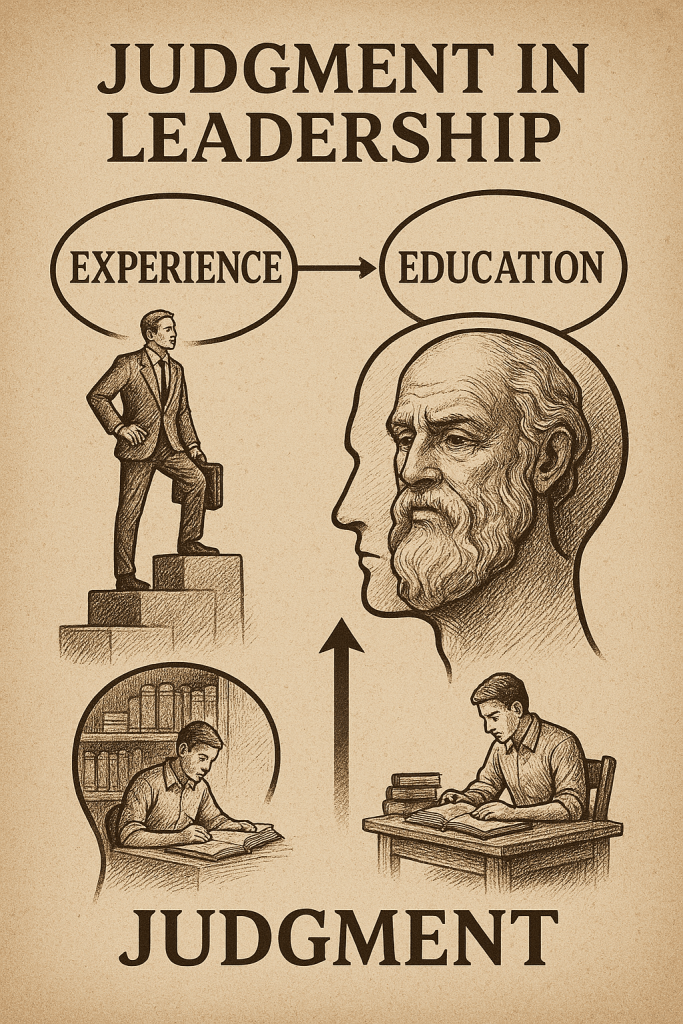
    Leadership is not just about making decisions it’s about making the right decisions. At the heart of every great leader is a keen sense of judgment, the ability to analyze situations, weigh options, and navigate challenges with clarity. But judgment isn’t something people are born with it’s built through experience and education, refined over time, and expanded through learning from others.

    Experience: The Crucible of Judgment

    Those who dedicate themselves to developing their judgment ultimately stand above the noise, leading with clarity, confidence, and wisdom.

    There’s a reason the best leaders often have years of experience under their belts. They’ve seen patterns, recognized pitfalls, and developed instincts that textbooks can’t fully teach. Mistakes, setbacks, victories, and unexpected twists each moment contributes to sharper judgment. When leaders go through real-world situations, they learn how to anticipate consequences, understand human behavior, and refine their problem-solving abilities.

    Consider a CEO navigating a sudden market downturn. A first-time executive might panic, reacting emotionally or making impulsive decisions. But a leader with years of experience likely sees beyond the immediate crisis, assessing long-term outcomes, relying on past lessons, and making measured, strategic choices.

    Education: Expanding the Mind’s Horizon

    While experience is invaluable, relying on only personal experience is limiting. A leader may have seen a hundred situations but what if the next challenge is something completely new? This is where education steps in, acting as a force multiplier for judgment.

    Books, microlearning, mentorships, case studies, and structured learning expose leaders to thousands of years of wisdom. The world has already seen financial crashes, wars, industrial revolutions, technological disruptions, ethical dilemmas, and visionary breakthroughs. By studying history, leadership theory, psychology, and the experiences of others, leaders can build a “3,000-year-old mind” an intellect that doesn’t just rely on one lifetime of lessons but on the accumulated wisdom of humanity.

    From biographies of great leaders to short-form learning (microlearning) that distills key insights, education expands judgment beyond personal experience. It teaches leaders to analyze data, think critically, recognize patterns across time, and gain insights from diverse industries and cultures.

    Learning from Others: The Shortcut to Wisdom

    If experience shapes instincts and education sharpens perspective, learning from others accelerates both. Leaders who actively seek mentorship, engage in discussions, and analyze case studies tap into collective intelligence.

    Imagine a young entrepreneur seeking guidance from seasoned business minds. Instead of waiting decades to make certain mistakes, they can preemptively learn from those who’ve already faced those challenges. Seeking counsel, watching interviews, and reading leadership reflections allow individuals to borrow wisdom, skipping unnecessary failures and refining judgment faster.

    Conclusion

    Great leadership is not just about making decisions it’s about making the best possible decisions. Judgment is a lifelong journey, built through the fires of experience and polished through education. By constantly learning, absorbing historical wisdom, and seeking insights from others, leaders cultivate deep, insightful judgment the kind that can see beyond the immediate, anticipate change, and shape the future.

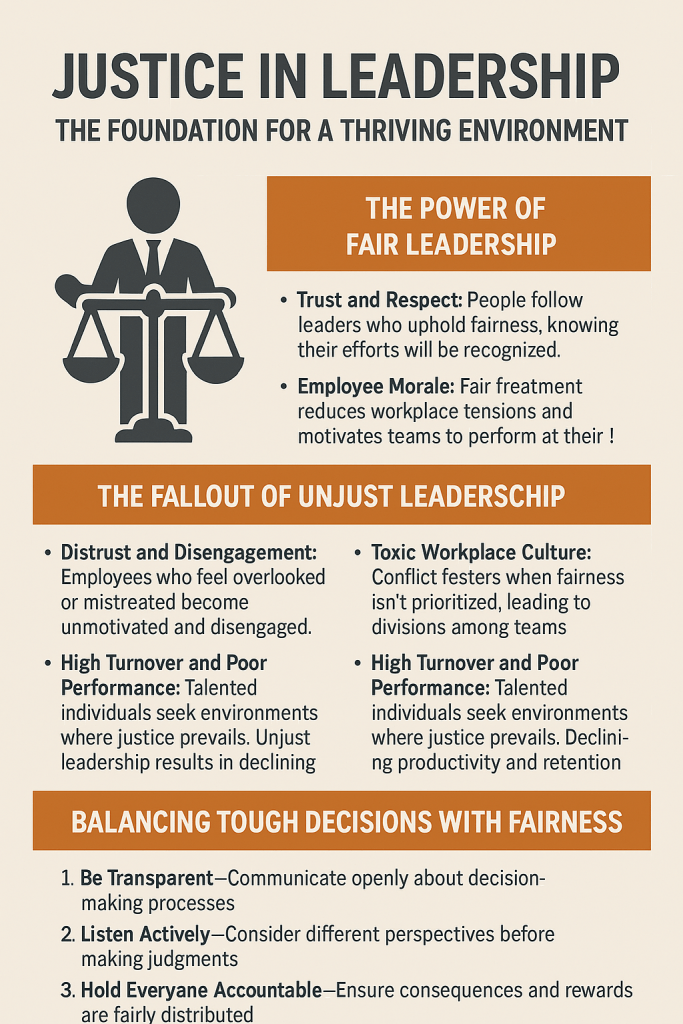
  • Justice in Leadership: The Foundation for a Thriving Environment

    Justice isn’t just a moral ideal it’s the bedrock of effective leadership. Leaders who prioritize fairness foster trust, loyalty, and collaboration, while those who act unjustly create resentment and chaos. In this blog, we’ll explore why fairness matters in leadership, how it shapes a positive work culture, and what happens when justice is absent.

    The Power of Fair Leadership

    A just leader ensures that decisions are made transparently, rewards are given equitably, and discipline is enforced consistently. This fosters:

    • Trust and Respect: People follow leaders who uphold fairness, knowing their efforts will be recognized.
    • Employee Morale: Fair treatment reduces workplace tensions and motivates teams to perform at their best.
    • Collaboration and Innovation: When employees feel valued and heard, they’re more likely to contribute ideas and work together seamlessly.

    The Fallout of Unjust Leadership

    On the flip side, unfair leadership erodes confidence and drives talented individuals away. An environment tainted by favoritism, inconsistent decision-making, or unchecked biases leads to:

    • Distrust and Disengagement: Employees who feel overlooked or mistreated become unmotivated and disengaged.
    • Toxic Workplace Culture: Conflict festers when fairness isn’t prioritized, leading to divisions among teams.
    • High Turnover and Poor Performance: Talented individuals seek environments where justice prevails. Unjust leadership results in declining productivity and retention.

    Balancing Tough Decisions with Fairness

    Fair leaders must make difficult choices, but justice ensures that even tough decisions are respected. Leaders should:

    1. Be Transparent—Communicate openly about decision-making processes.
    2. Listen Actively—Consider different perspectives before making judgments.
    3. Hold Everyone Accountable—Ensure consequences and rewards are fairly distributed.

    Final Thoughts

    Justice isn’t just about doing what’s right it’s about creating a foundation for success. Whether leading a company, a team, or an entire organization, fairness can be the difference between a thriving environment and a failing one. Great leaders recognize that integrity isn’t optional it’s essential.

  • Leadership Lessons from the Marine Corps: A Foundation for Success

    Leadership Lessons from the Marine Corps: A Foundation for Success

    Leadership isn’t about holding a title, it’s about how you influence, guide, and support those around you. Some of the most valuable leadership lessons I’ve learned came from my time in the United States Marine Corps, starting with Recruit Training, where leadership was ingrained in every aspect of our experience from day one.

    If you’ve never been through Marine Corps boot camp, imagine an environment designed to challenge you physically, mentally, and emotionally all while instilling essential leadership qualities. It’s a place where teamwork is non-negotiable, accountability is expected, and core leadership principles become second nature.

    For me, stepping onto the yellow footprints at Marine Corps Recruit Depot Parris Island was my first real introduction to formal leadership training. My drill instructors Staff Sergeant Roberts, Sergeant Falls, and Sergeant Stewart were relentless in pushing us to understand, apply, and live by the principles of leadership. These weren’t just words in a handbook; they were woven into every training exercise, every lesson, and every challenge we faced.

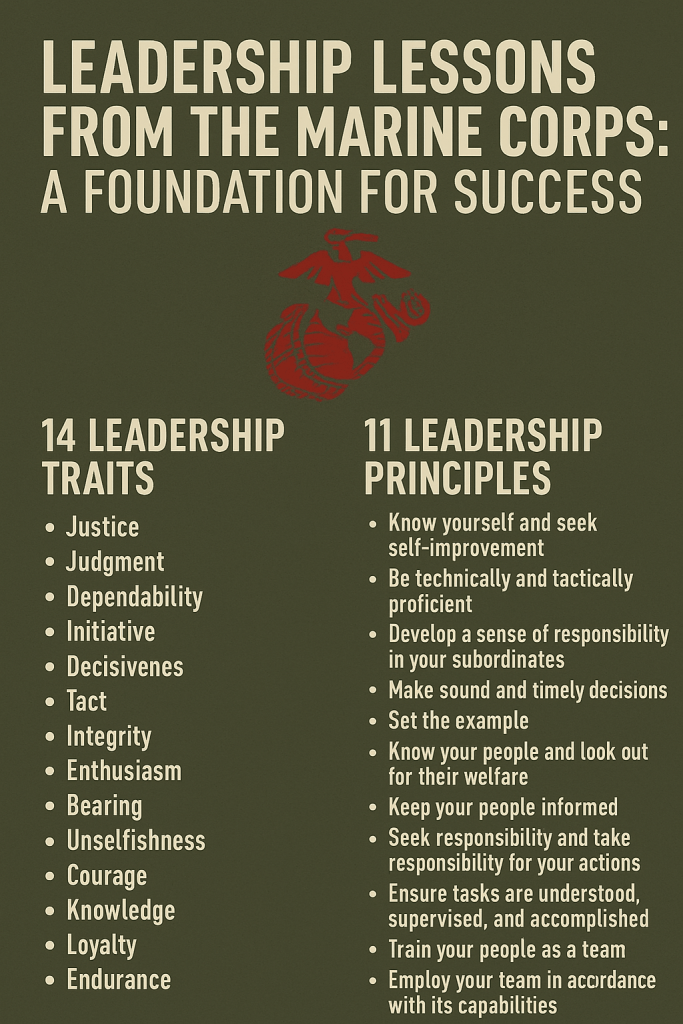
    One of the first things drilled into us was the 14 Leadership Traits and 11 Leadership Principles not as textbook definitions but as lessons we lived through daily. These concepts shaped the way Marines lead, and over the course of my 28-plus-year career, I’ve relied on them as a guide for leadership in any situation, whether in the military or beyond.

    The 14 Leadership Traits: JJDIDTIEBUCKLE

    Marines remember the 14 Leadership Traits using the acronym JJDIDTIEBUCKLE, each letter representing a critical trait that defines strong leadership:

    • Justice – Being fair and consistent in decisions.
    • Judgment – Making sound and logical choices.
    • Dependability – Being reliable and trustworthy.
    • Initiative – Acting without being told.
    • Decisiveness – Making firm, timely decisions.
    • Tact – Handling situations with diplomacy.
    • Integrity – Always being honest and ethical.
    • Enthusiasm – Bringing energy and passion to leadership.
    • Bearing – Presenting a professional and confident demeanor
    • Unselfishness – Putting the needs of others before your own.
    • Courage – Facing challenges with strength and resolve.
    • Knowledge – Continually learning and improving.
    • Loyalty – Staying committed to your team and mission.
    • Endurance – Pushing through hardships with resilience.

    These traits became second nature, not just during my time in the Marine Corps but throughout my career and life. And when leadership starts to feel overwhelming or challenges pile up, I always come back to these basics because they provide clarity when things get complicated.

    The 11 Leadership Principles

    While the leadership traits define who a leader should be, the 11 Leadership Principles focus on what a leader should do. These principles serve as a practical guide for leading effectively, ensuring that leaders not only possess strong character but also apply it in their actions:

    1. Know yourself and seek self-improvement – Leadership begins with self-awareness and continuous growth.
    2. Be technically and tactically proficient – Leaders must understand their role and the skills required to execute it successfully.
    3. Develop a sense of responsibility in your subordinates – Empowering others to take ownership fosters stronger teams.
    4. Make sound and timely decisions – Leadership requires decisiveness, especially in challenging situations.
    5. Set the example – Actions speak louder than words. Leaders must embody the values they expect from others.
    6. Know your people and look out for their welfare – True leadership involves caring for those you lead, both professionally and personally.
    7. Keep your people informed – Transparency and clear communication build trust and unity within a team.
    8. Seek responsibility and take responsibility for your actions – Leaders don’t shy away from challenges or accountability.
    9. Ensure tasks are understood, supervised, and accomplished – A great plan means nothing without execution.
    10. Train your people as a team – Cohesion and teamwork are the backbone of success in any organization.
    11. Employ your team in accordance with its capabilities – Effective leadership means understanding strengths and assigning tasks accordingly.

    These principles provide a framework for leadership in any environment, reinforcing accountability, trust, and execution.

    Why These Lessons Matter Beyond the Marines

    You don’t need to be in the military to benefit from these leadership principles. Whether you’re leading a business, a team, or even your own personal growth, these traits and principles create a solid foundation for effective leadership. They remind us that leadership isn’t about power, it’s about service, accountability, and making the right choices even when they’re difficult.

    This post is just the starting point. In future articles, I’ll dive deeper into each of these principles, sharing real-world applications and how they remain just as valuable today as they were when I first learned them. Strong leadership starts with a solid foundation so let’s build it together.

  • Leadership and Management are not the same thing

    Leadership and management may often be lumped together, but they’re not quite the same thing. Understanding the difference is really important if you want your organization to thrive in the long run. When the lines between the two blur, it can lead to all kinds of issues and confusion in decision-making, team dysfunction, and a lack of clear strategy. Simply put, leadership is about having a vision and inspiring people to rally around it, while management is about ensuring that vision is put into action through well-organized processes. Without both, things can go sideways fast, either you’re adrift with no direction or drowning in chaos because no one’s steering the ship.

    That’s why a blog about leadership and management has to begin here. Before we jump into deep-dive strategies, industry trends, or personal growth tips, it’s vital to lay down some basics. Yes, leaders and managers sometimes share tasks, but knowing how they differ, and how they work together is the secret to building strong teams, creating lasting change, and setting up organizations for success.

    Leadership is all about inspiration. It’s about guiding people, shaping a vision, and motivating teams to come together to achieve big goals. Great leaders set direction, influence the culture, and foster growth, both in individuals and the organization as a whole.

    Management, on the other hand, is more about making sure everything runs like clockwork. It’s about organizing projects, improving processes, and keeping operations efficient. Managers deal with the nitty-gritty of logistics, resource coordination, and sticking to plans to meet specific goals.

    Now, here’s where things get interesting: Strategic leadership and management take these roles to another level. Strategic leaders look at the big picture, they think long-term, make bold decisions, and position their organizations to stay ahead of the game. They anticipate changes, adapt proactively, and align people toward future success.

    Strategic management steps in to make sure all those big ideas and plans actually happen. It’s about creating systems, allocating resources, and keeping track of progress to turn leadership’s vision into measurable results.

    In a nutshell, leadership is about lighting the fire, and management keeps it burning. Strategic leadership plots the course for the future, while strategic management ensures the ship arrives safely at its destination.