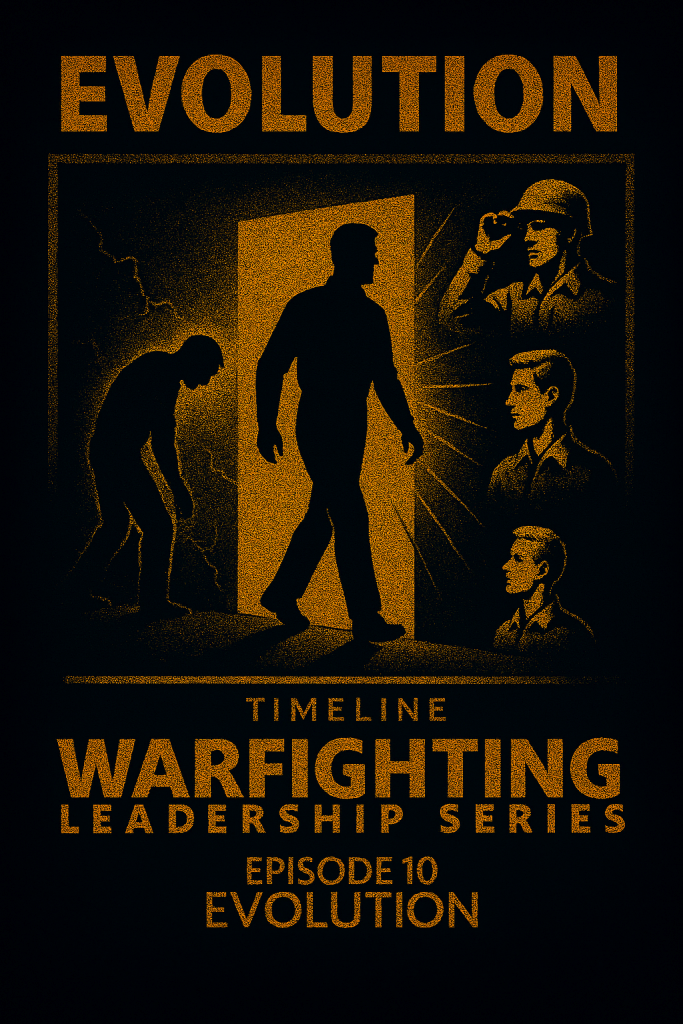
🌱 Episode 10: Evolution, What Changes and What Endures
INTRODUCTION 🔍
Leadership changes you. Sometimes slowly, like water wearing down stone. Sometimes all at once, like a blast wave that rearranges the room and leaves you blinking in the dust. This episode is about that change. What bends. What breaks. What refuses to move no matter how much pressure you put on it. And what you carry forward whether you want to or not.
We are talking about evolution, not as a slogan, but as the quiet, uncomfortable truth of leadership.
CORE CONCEPTS 💡
🌪️ 1. Environments Change Faster Than Leaders Expect
You think you have a handle on things. Then the ground shifts. A new threat. A new constraint. A new personality in the room who changes the entire emotional temperature. Leaders who cling to the old pattern get left behind. The environment does not wait for you to catch up.
🔥 2. Pressure Burns Away Illusions
There is a moment in every leader’s life when the story they tell themselves stops working. Maybe it happens in a meeting where you realize you are out of your depth. Maybe it happens in a crisis when you freeze for half a second longer than you should. Pressure strips away the parts of you that were never real. What remains is the beginning of evolution.
🧭 3. Adaptation Is Not Reinvention
People love to talk about reinvention. It sounds dramatic. Clean. But real adaptation is messy. You keep some things. You discard others. You learn to move differently. You stop pretending you can be everything to everyone. You evolve by subtraction as much as addition.
🪨 4. Some Things Should Not Change
This is the part people forget. Not everything evolves. Some things must stay exactly where they are. Integrity. Judgment. The ability to tell the truth even when it costs you. These are the anchor points. If you let them drift, everything else drifts with them.
🌱 5. Evolution Is a Series of Small, Uncomfortable Choices
It is not a single moment. It is a hundred small ones. The conversation you avoid. The decision you delay. The apology you owe. The standard you enforce even when you are tired. Evolution is not glamorous. It is the slow, steady work of becoming someone worth following.
Sage Advice:
If you want to evolve, stop trying to look evolved. Do the work instead.
CORE INSIGHT 🎯
Leaders do not transform in a single moment. They evolve through pressure, honesty, and the choices they make when no one is watching.
MILITARY TO CIVILIAN TRANSLATION TABLE 📘
| Military Concept | Leadership Translation | Business or IT Example |
| Changing battlefield | Shifting market or org landscape | New competitors, new tech, new constraints |
| Friction | Organizational resistance | Legacy systems, culture drag |
| Adaptation | Leadership growth | Changing management style or priorities |
| Anchoring principles | Core values | Ethics, trust, long term vision |
| Evolution under pressure | Growth through adversity | Crisis leadership, restructuring |
LOGOS, ETHOS, PATHOS TRIAD 🎙️
Logos (Logic)
Change is not optional. Systems evolve. Teams evolve. Threats evolve. Leaders who refuse to evolve become the bottleneck. The logic is simple. Adaptation is the only way to stay relevant in a world that does not slow down for anyone.
Ethos (Credibility)
Credibility comes from the willingness to confront your own limitations. People trust leaders who admit what they do not know, who adjust their approach when the situation demands it, and who hold onto their principles even when everything else is shifting. Credibility is earned in the moments when you choose growth over ego.
Pathos (Emotion)
Evolution hurts. It asks you to let go of the version of yourself that once worked. It forces you to face the parts of your leadership that are outdated or fragile. But there is something powerful in that discomfort. People follow leaders who are willing to grow in public, who show that change is possible even when it is painful.
DISCUSSION PROMPT 💬
Think back to a moment when the environment changed faster than you did. What did it force you to confront about yourself?
FINAL FORMATION 🪖
We explored evolution as the final force in Series I. You saw how leaders change, what they must protect, and how pressure shapes growth. In the next series, we shift from internal development to thinking and acting to gain advantage in conflict and markets. Series II: Purpose Drives Action: War and Business Policy.
Disclaimer: The views expressed in this post do not represent the views of any organization or institution.
#Business #GovCon #Leadership #TalentAcquistion #TechCareerDevelopment #TechLeadership
 Lead.Manage.Succeed