Blog

  • Courage: The Backbone of Leadership

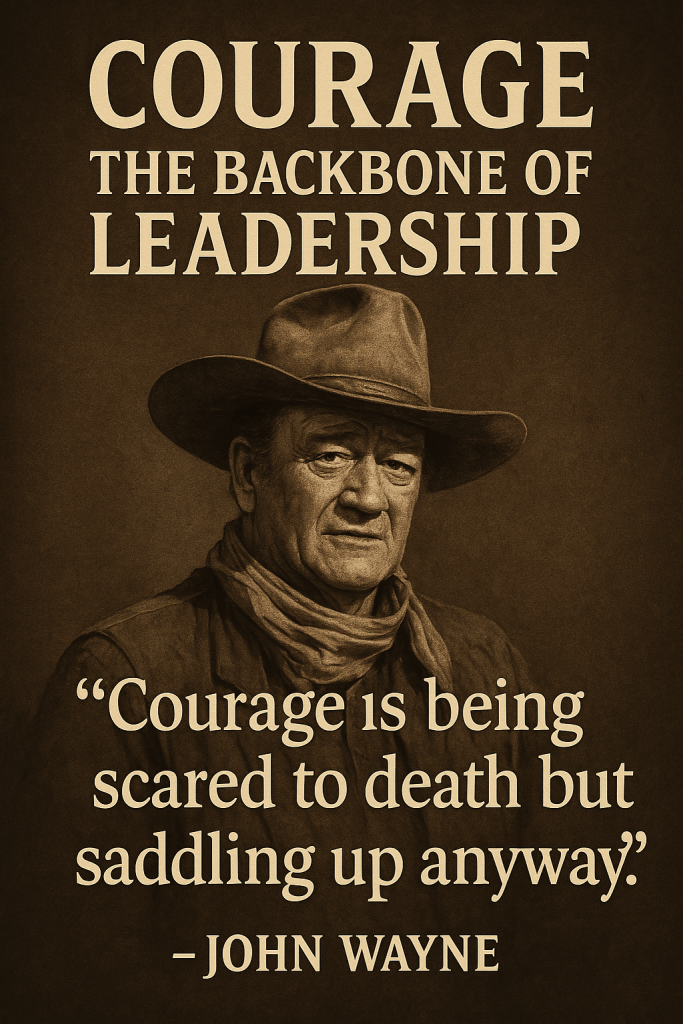
    Courage: The Backbone of Leadership

    Courage is the cornerstone of effective leadership, and it holds a special place in the JJDIDTIEBUCKLE series. This series, which highlights the core traits of leadership, emphasizes the importance of moral and physical courage in navigating challenges and inspiring others.

    Courage is not the absence of fear but the ability to face it head-on. It is about taking risks, standing up for what is right, and persevering in the face of adversity. Whether it’s making tough decisions, admitting mistakes, or defending your values, courage is the trait that enables leaders to act with integrity and conviction.

    🛡️ The USMC Definition of Courage

    The United States Marine Corps (USMC) defines courage as “the mental, moral, and physical strength ingrained in Marines. It steadies them in times of stress, carries them through every challenge, and aids them in facing fear and overcoming adversity with resolve.”1 This definition underscores the essence of courage as a steadfast force that empowers individuals to confront fear and adversity with resolve.

    ⚖️ Courageous Leadership

    Courageous leadership is about distinguishing between doing things right and doing the right things. While doing things right focuses on efficiency and adherence to rules, doing the right things emphasizes moral integrity and ethical decision-making. As the adage goes, “What’s wrong is wrong, even if everyone is doing it. What’s right is right, even if no one is doing it.” This principle serves as a guiding light for leaders who strive to uphold ethical standards and make decisions that align with their values.

    🌟 Everyday Acts of Courage

    Courage manifests in various forms, shaping the way leaders interact with their teams and communities. It is present in everyday decisions and actions, from admitting a mistake to supporting a colleague. Courageous leaders are unafraid to challenge authority or the status quo when necessary. They understand the importance of voicing concerns and advocating for change, even in the face of opposition.

    🌍 Courage Across Contexts

    In both the military and the corporate world, courage is a universal trait that transcends environments. Military leaders must make quick, high-stakes decisions under pressure, while corporate executives face critical choices that can shape the future of their organizations. Both understand the importance of fostering trust and unity within their teams, inspiring loyalty and collaboration.

    AspectMilitary LeadershipBusiness Leadership
    Decision-MakingCourage to make quick, high-stakes decisions under pressureCourage to make strategic, long-term decisions with organizational impact
    Team DynamicsCourage to foster trust and unity in high-stress environmentsCourage to build collaboration and loyalty across diverse teams
    Risk ManagementCourage to take calculated risks with potential life-or-death consequencesCourage to balance innovation with financial and reputational risks
    Ethical StandardsCourage to uphold strict codes of conduct and honorCourage to navigate complex ethical dilemmas in a competitive market

    🎖️ Final Formation

    Courage is the backbone of leadership, and it’s a trait that deserves to be celebrated and cultivated. Let it guide you as you navigate the complexities of leadership and strive to make a positive impact. As Billy Graham said, “Courage is contagious. When a brave man takes a stand, the spines of others are often stiffened.”2 And as John Wayne famously remarked, “Courage is being scared to death but saddling up anyway.”3

    Footnotes:

    1. The USMC definition of courage is sourced from the Leading Marines publication, which outlines the core leadership traits that define the Marine ethos.
    2. Billy Graham’s quote originates from his 1964 Reader’s Digest article, “A Time for Moral Courage,” where he emphasized the ripple effect of moral courage in inspiring others to act with integrity.
    3. John Wayne’s quote highlights the essence of courage as action in the face of fear, encapsulating the spirit of resilience and determination.
  • Unselfishness: The Leadership Trait That Commands Loyalty Without Demanding It

     Unselfishness: The Leadership Trait That Commands Loyalty Without Demanding It

    In the long march of leadership, one trait keeps proving itself in the field and in the boardroom: unselfishness. It’s not a buzzword. It’s the difference between managing and leading. Between commanding and inspiring.

    Those who lead with unselfishness don’t just hold positions they earn devotion. They don’t win compliance through rank. They win followership through sacrifice.


    🎖️ From the Battlefield to the Breakroom: Unselfishness in Action

    Whether you’re wearing combat boots or dress shoes, the fundamentals are strikingly similar. In the military, leadership starts with service. Officers eat last. They train with their troops. They are at point of friction, and they make the hard calls often quietly, and almost always with others in mind.

    The Marine Corps defines unselfishness as the “avoidance of providing for one’s own comfort and personal advancement at the expense of others.” It’s not just generosity it’s a mindset that puts mission over self and team over ego.

    In business, leadership should echo the same ethic. When managers handle heavy lifting, absorb pressure, and push credit toward their teams, they create loyalty no paycheck can buy.


    📊 Military vs. Business Leadership Applications

    Leadership QualityMilitary ApplicationBusiness Application
    Lead by ExampleTrain and endure alongside your unitTackle high-pressure work with your team
    Share PowerDelegate to build readiness and trustEmpower autonomy and accountability
    Mission Over SelfPrioritize the operation over egoFocus on purpose, not promotion
    Team LoyaltyNever leave anyone behindBack your team through wins and weather

    🛠️ How to Lead Unselfishly, Every Day

    • Take Initiative Before You’re Asked
      Spot pain points. Remove roadblocks. Be the teammate who eases burdens without being told.
    • Remove Obstacles Quietly
      Ask “What’s slowing us down?” then act. Leadership isn’t about being seen it’s about making sure others can move forward.
    • Give Credit, Hold the Blame
      Success? Spotlight your team. Failure? Take responsibility. It builds trust brick by brick.
    • Empower with Trust
      Share responsibility. Let others shine. Leadership is not a solo act it’s a stage for many.
    • Model Generosity That Costs Something
      Real unselfishness is inconvenient. That’s what makes it powerful. Give your time, your attention, your praise freely.
    • Win People, Not Just Titles
      Rank earns obedience. Unselfishness earns loyalty. If you’re respected beyond your role, you’re truly leading.

    🫡 Final Formation

    Unselfish leaders don’t ask for loyalty they earn it. They don’t demand respect, they generate it. The deepest kind of influence comes not from titles or policy, but from the kind of leadership that rolls up sleeves, stays late, and lifts others up being a bucket filler and not a bucket dipper.

    If you’re building a legacy, not just a career, then commit to unselfishness as your operational standard. Because teams won’t remember your title in five years. They’ll remember how you made them feel under pressure, how you led when it counted, and how you put the mission and the team ahead of yourself.

    This is the kind of leadership that lasts.

  • Bearing: The Silent Authority Behind Leadership

    Bearing: The Silent Authority Behind Leadership

    Some traits shout. Bearing whispers but everyone listens.

    In the JJDIDTIEBUCKLE leadership model, Bearing is the quiet force that precedes words, steers emotion, and commands respect without display. It’s not just how you carry yourself it’s the internal mastery that makes people carry you in their minds long after you’ve left the room.

    📖 Definition

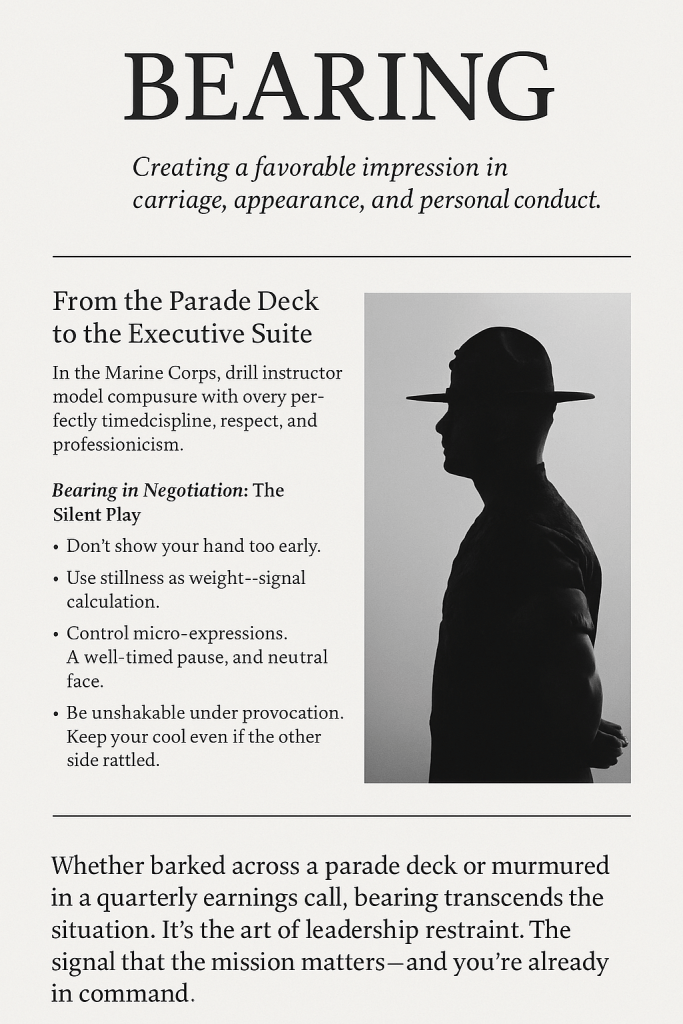
    Bearing: Creating a favorable impression in carriage, appearance, and personal conduct.

    From a Marine standing tall on the parade deck to a negotiator holding poise in a high-stakes meeting, bearing is what defines the temperature of the room and who holds the thermostat.


    🪖 Bearing in the Marine Corps: Posture as Purpose

    In the Marine Corps, bearing is mission-critical.

    • Drill Instructors model composure with every perfectly timed pause and unshakable expression. Their stern posture, razor-precise movements, and deliberate tones are not just performative they create a transformation container for recruits to shed uncertainty and build discipline.
    • Combat Leaders project calm in chaos, transmitting resolve through posture, tone, and deliberate control. The leader’s stillness becomes the squad’s anchor. When bullets fly or uncertainty spikes, Marines look to the leader not for answers, but for bearing.

    🧠 Bearing in Business: Authority Without Ego

    In the corporate world, bearing manifests in quieter but no less commanding ways.

    • In Negotiation, bearing is your armor. A composed posture, unwavering eye contact, and strategic silence can unsettle opponents without a word. Confidence radiates when your body says, “I don’t need to convince you. I already know my value.”
    • In Leadership, bearing is the tone-setter. Whether managing crisis, delivering hard truths, or introducing change, your emotional regulation becomes everyone else’s permission slip. You’re not reacting you’re conducting.

    🔧 How to Practice Bearing Daily

    ElementPractice Tip
    Emotional disciplinePause before responding. Control tone and body language.
    Visual composureMaintain posture. Let stillness become a signal.
    Dress and movement intentionAlign style with values and mission not vanity.
    Negotiation presenceUse silence, calm gaze, and timing to project control.
    Role integrityStay in character for the good of the moment, not ego.

    💬 Closing Formation

    Leadership is more than what you say it’s how you hold yourself. Bearing isn’t loud. It’s unwavering. It’s the reason a room leans forward when you stand still. Whether in the sands of Parris Island or across a polished walnut boardroom table, bearing is the quietest form of command and often the most powerful.

  • Enthusiasm: The Spark Between Initiative and Integrity

    Enthusiasm: The Spark Between Initiative and Integrity

    In the leadership arsenal of the United States Marine Corps, few traits exist in isolation. Initiative drives the action. Integrity ensures the action is right. But what brings both to life what gives direction heart and momentum is Enthusiasm.

    This isn’t about surface-level hype. It’s about belief made visible. In the Corps, we don’t follow empty energy. We follow leaders who care so deeply about the mission that it spills into everything they do.

    Earned in the Mud, Carried Through the Fog

    In the Marine Corps, enthusiasm is more than morale, it’s operational fuel. It’s the fire in a squad leader’s voice on a rainy field op. It’s the unspoken “let’s get after it” because things don’t get done by themselves. It’s showing up again, and again, and again, because the mission’s worth it.

    In civilian leadership, enthusiasm plays out differently but no less powerfully. It looks like a team lead who invests in their people. A startup founder who stays late because they believe in the product. A nurse who keeps showing up with compassion at the end of a long shift.

    In both worlds, enthusiasm invites buy-in without demanding it. It doesn’t coerce it compels it.

    Why Enthusiasm Isn’t Optional

    Let’s call it what it is: enthusiasm connects the dots.

    • It amplifies initiative. Energy fuels action that’s not just quick but committed.
    • It confirms integrity. Belief in the mission shows through when you show up.
    • It builds trust. When people see your fire, they feel safe striking their own match.

    If initiative says, “I’ll go,” and integrity says, “I’ll go the right way,” enthusiasm adds, “and I’m honored to do it.”

    Lead Like a Marine: How to Build Enthusiasm That Lasts

    This isn’t about loud. It’s about real. Whether you’re leading Marines, managing a team, or coaching a crew, enthusiasm is earned and built.

    1. Know your mission and own it.
      Reconnect with your “why.” If you don’t believe, no one else will.
    2. Celebrate wins, however small.
      Every step forward is a foothold for morale.
    3. Face adversity with curiosity.
      Marines embrace the suck but they learn from it. Bring that to your setbacks.
    4. Protect your inputs.
      Choose gritty over passive. Surround yourself with fire-starters, not flame-snuffers.
    5. Operate from your strengths.
      Lead from solid ground. Confidence breeds calm energy.
    6. Set the emotional tone.
      Whether you wear stripes or slacks, you’re the emotional barometer. Make it count.

    Final Formation

    Enthusiasm isn’t decoration it’s direction. It turns static values into kinetic leadership. Whether you’re leading a patrol through the bush or guiding a project through chaos, remember:

    As Steve Jobs once said, “If you are working on something exciting that you really care about, you don’t have to be pushed. The vision pulls you.” Let that vision become the gravity that draws others forward make it so clear and compelling that following you feels natural.

    Initiative drives the action. Integrity keeps it honest. Enthusiasm makes it contagious.

    So bring the fire. Let them feel it in your tone, see it in your choices, and believe it through your presence.

  • Above the Cut Line: Leading Before You’re Asked

    Above the Cut Line: Leading Before You’re Asked

    In the Marine Corps, Initiative is more than a buzzword it’s survival. You don’t wait for perfect orders when the fog rolls in and the situation shifts. You act. Because “no plan survives contact with the enemy,” and leadership means being ready to pivot, adapt, and push forward even when things fall apart.

    That mindset transfers directly to the civilian world.

    In business and life, Initiative looks like stepping up without being told not just spotting problems, but bringing solutions. That’s where most people fall short. Pointing out issues is easy. But proposing a fix, that’s operating above the cut line.

    Taking Initiative in industry might mean:

    • Drafting a project proposal to fill a capability gap you noticed weeks before anyone mentioned it.
    • Streamlining a bloated process.
    • Volunteering to lead a stalled-out effort and breathing new life into it.
    • Mentoring someone quietly struggling, because you saw what no one else was paying attention to.

    And when you do act, know this: it won’t go exactly to plan.
    So have a Plan B. Maybe even a Plan C. Then leave some white space for real-time adjustments. That’s leadership in motion action with awareness.

    That’s why Marines live by the mantra: Improvise. Adapt. Overcome.
    It’s not just a slogan it’s a mindset. When the terrain shifts, you shift with it. When the tools break, you find another way. When the plan fails, you build a new one mid-stride. That’s Initiative in its rawest form.

    Just like GySgt Highway in Heartbreak Ridge, Initiative means doing what needs to be done even if it ruffles feathers. Highway didn’t wait for permission to whip his Recon platoon into shape. He saw the problem, took action, and made leaders out of hooligans. He didn’t follow the manual he followed the mission. See the gap, fill the gap, and take the heat if it goes sideways.

    Sometimes you’ll have to execute with only 70% of the information. Sometimes the tools won’t be perfect. And sometimes the outcome will sting a little. But Initiative isn’t about flawless execution it’s about intentional momentum and the courage to take responsibility, even if it means later saying, “That one’s on me.”

    As legendary UCLA coach John Wooden, winner of 10 NCAA championships, once said:

    “The [person] who is afraid to risk failure seldom has to face success.”

    What I take from that is simple: the answer is always no unless you ask. Take the shot, and you’ll either fail—or you’ll learn. Either way, you’re moving forward.

    And here’s the truth most won’t say out loud: real leadership lives in discomfort. Growth doesn’t happen in the safe zone. It happens when you lean into the awkward, and uncertain. When you’re willing to be uncomfortable, to speak up, to take the risk, to own the outcome you’re not just showing Initiative. You’re showing grit.

    You don’t need rank to lead. You need vision, guts, and the willingness to step into uncertainty with purpose. Just like in the Corps, the people who rise are the ones who act when no one’s watching.

    So take the shot. Adjust fire as needed. Improvise. Adapt. Overcome.
    That’s how leaders emerge above the cut line.

  • Tact: The Art of Making a Point Without Making an Enemy

    Tact: The Art of Making a Point Without Making an Enemy

    In both the military and business worlds, success depends not only on strategy and execution but also on communication. One of the most powerful tools in any leader’s arsenal is tact the ability to make a point without making an enemy. It’s what separates effective leaders from those who, despite having good ideas, struggle to gain support and influence.

    Tact in the Military: A Matter of Discipline and Diplomacy

    In military operations, tact is more than just a social skill, it’s a survival skill. Commanders must give orders with authority, but they also need to inspire confidence and cooperation among troops. Soldiers rely on their leaders for direction, yet trust can quickly erode if commands are delivered with unnecessary harshness or disrespect.

    Consider a seasoned officer correcting a younger recruit. If done with tact, the correction strengthens discipline while maintaining morale. If handled poorly through public embarrassment or excessive rigidity it breeds resentment, which can affect unit cohesion. Similarly, in diplomacy and intelligence operations, tact is essential when negotiating with allies and adversaries. Military leaders must assert their objectives clearly while avoiding unnecessary provocations that could escalate conflicts.

    Tact in Business: The Cornerstone of Leadership

    In business, tact separates a good manager from a great leader. Professionals must navigate negotiations, address conflicts, and provide feedback all while preserving relationships. A blunt critique of an employee’s performance may be accurate, but without tact, it can demoralize rather than motivate. The best leaders know that how a message is delivered is just as important as the message itself.

    Take, for instance, high-stakes boardroom discussions. A tactful executive presenting a dissenting opinion doesn’t just challenge ideas; they encourage dialogue. Instead of saying, “That plan is flawed,” a tactful leader might say, “I see some potential risks with this approach perhaps we can explore ways to mitigate them.” The difference? One statement shuts down discussion, the other fosters collaboration.

    The Common Thread: Precision in Communication

    Whether in military strategy or corporate decision-making, tact isn’t about being overly cautious or avoiding difficult conversations it’s about precision in communication. A tactful leader delivers strong messages without alienating others. They frame criticism constructively, command respect without instilling fear, and advocate for their positions without diminishing those of others.

    Winston Churchill once said, “Tact is the ability to tell someone to go to hell in such a way that they look forward to the trip.” While dramatic, the essence of the quote holds true across both the battlefield and the boardroom: influence and persuasion are as much about delivery as they are about intent.

    Developing Tact as a Skill

    Tact isn’t innate, it’s learned and practiced. Here are a few ways to sharpen it:

    • Pause before responding: In high-pressure environments, a moment of reflection can prevent unnecessary friction.
    • Frame criticism constructively: Instead of highlighting faults, suggest improvements.
    • Recognize different perspectives: The best leaders listen before they speak.
    • Maintain composure: Staying calm, even when tensions rise, makes conversations more productive.

    At its core, tact is a bridge between people and ideas. It ensures that bold strategies don’t become reckless, that firm leadership doesn’t turn into dictatorship, and that necessary corrections don’t devolve into conflicts. Whether commanding troops or leading teams, those who master the art of tact will always have an edge.

  • Dependability: The Backbone of Leadership

    Dependability: The Backbone of Leadership

    “Let your ‘yes’ be yes and your ‘no’ be no.”

    Dependability is more than a leadership trait, it’s the foundation of trust. Leaders who follow through on commitments, provide accurate information, and deliver under pressure earn confidence from both their superiors and subordinates. In military and business settings alike, reliability fuels strong decision-making, cohesion, and mission success.

    A dependable leader ensures that when something is said, it is followed by action. This predictability creates a leadership environment where teams instinctively trust decisions because they trust the leader providing them.

    Trust Through Reliability

    Leadership isn’t about grand promises it’s about consistent execution. Trust is earned when leaders commit to action and deliver. Seniors rely on a leader’s judgment and execution, while subordinates gain confidence knowing they are being led by someone who follows through.

    Showing Up When It Counts

    Dependability is proven in moments of pressure. Whether ensuring resources arrive on time or making a pivotal call in a crisis, leadership requires follow-through. A dependable leader operates with urgency, providing clarity when it matters most.

    Truth and Timeliness in Leadership

    Bad news does not improve with time. The sooner critical information is discovered and conveyed, the sooner teams can adapt and mitigate risks. Delayed communication weakens decision-making, erodes trust, and turns minor setbacks into major failures. Leadership requires delivering truth promptly and decisively.

    Decisions are only as strong as the information they rely on. When leaders consistently provide accurate updates, they strengthen confidence, allowing decisive action to unfold smoothly. Hesitation leads to uncertainty, but a dependable leader ensures every decision is backed by trustworthy intelligence.

    Dependability as Strategic Foresight

    Leaders operate with a vision, they see the battlefield, the boardroom, or the mission space with clarity. Dependable information shapes strategy, allowing leaders to maneuver with precision. A commander with reliable intelligence can anticipate threats, position forces for a decisive strike, or identify business opportunities before competitors.

    This ability to checkmate the opposition, whether in warfare or industry, depends on confidence in the data supporting each move. Without dependability, leadership becomes reactive, decisions falter, and momentum is lost. The most effective leaders never gamble on guesswork, they base every action on trust, clarity, and consistency in the intelligence they receive.

    A Culture of Dependability

    Effective leadership builds momentum. Reliable reporting leads to stronger confidence, which fuels better decisions, reinforcing trust at every level. Conversely, inconsistent or vague communication leads to operational delays, uncertainty, and weakened cohesion.

    Conclusion: The Power of Dependability

    Leadership is about more than just making decisions, it is about ensuring those decisions are built on a foundation of trust, reliability, and execution. Dependability is not a passive trait; it requires deliberate commitment, timely communication, and unwavering accountability. When a leader speaks, those words must carry weight because they are backed by action.

    The leaders who stand the test of time are the ones whose teams never have to question whether they will follow through. Dependability is not just a characteristic; it is a legacy that defines leadership effectiveness across generations.

  • Integrity and Ethics: The Unshakable Core of Leadership

    Integrity and Ethics: The Unshakable Core of Leadership

    Leadership is not just about making decisions, it is about making the right, most ethical decisions. In both the military and business worlds, integrity and ethics are not secondary considerations; they are the forefront of decision-making and trust-building. Without them, leadership crumbles, and organizations rot from within, much like a piece of wood with its heartwood decayed.

    Integrity and Ethics: The Foundation of Trust

    Trust is the currency of leadership. Subordinates and juniors must believe that their leaders are guided not just by strategy, but by moral clarity. They need confidence that orders are given with honor, decisions are made with fairness, and accountability is upheld without compromise.

    In the military, a platoon follows their commander into battle because they trust that their leader is acting in their best interest not for personal gain or misguided ambition. In business, employees rally behind an executive who leads with honesty, ensuring that policies are fair and practices are ethical. Without that foundation, doubt creeps in, morale declines, and the organization’s core begins to rot.

    Decision-Making Rooted in Integrity

    Decisiveness without integrity leads to reckless, destructive choices. A strong leader does not just act quickly, they act rightly. Structured decision-making tools, like SWOT analysis, force field analysis, and OODA loops, work best when rooted in ethical leadership. An unethical leader may manipulate these frameworks to justify deceitful actions, but an honorable leader uses them to enhance transparency, fairness, and accountability.

    Leaders with integrity-based decisiveness ensure that every choice aligns with a higher standard. They ask:

    • Is this decision ethical?
    • Does it uphold our values and the trust of our people?
    • Would I stand by this choice under scrutiny?

    Making ethical choices strengthens leadership credibility, reinforcing a culture where subordinates feel secure in following orders, executing strategies, and trusting that they are part of something honorable.

    The Rot of Corrupt Leadership

    A leader without integrity is like a tree whose heartwood is rotten. On the surface, it may seem strong, but the core is hollow ready to collapse under pressure. Organizations led by unethical figures eventually crumble under their own deceit.

    History has shown that military units collapse when leaders prioritize personal survival over honor. Businesses implode when executives engage in fraud or mistreatment of employees. No amount of skill, intelligence, or decisiveness can salvage an organization that lacks ethical leadership.

    The Enduring Legacy of Ethical Leadership

    Marines, soldiers, and professionals alike follow leaders who embody trust, honesty, and fairness. Whether commanding troops or running a business, the most respected leaders leave behind a legacy of integrity-driven decision-making.

    An honorable leader understands that ethics are not a restriction, they are the true power behind strong leadership. A leader who prioritizes integrity inspires loyalty, builds lasting trust, and ensures that their influence extends beyond their immediate sphere of control.

  • Decisiveness: The Warfighter and the Business Leader

    Decisiveness: The Warfighter and the Business Leader

    Decisiveness is the backbone of leadership whether in battle or in business. Both warfighters and executives face moments where hesitation can cost lives, opportunities, or momentum. While instinct and experience are invaluable, effective leaders also use structured decision-making tools to weigh their options and commit to action with confidence.

    Operational Tempo vs. Business Agility

    A warfighter operates under operational tempo the speed at which decisions are made and executed. A commander who waits for perfect intelligence risks losing the initiative to the enemy. Similarly, in business, agility is key. Companies that act swiftly in response to market changes outmaneuver competitors, while those waiting for perfect conditions often fall behind.

    “A Good Plan Now Beats a Perfect Plan Too Late”

    Military leaders understand that a good plan executed now is better than a perfect plan executed too late. In warfare, hesitation can mean losing ground or failing to capitalize on an opening. In business, delayed decisions result in missed market opportunities, lost deals, and eroded confidence. Imperfect plans, when executed with enthusiasm and adaptability, often yield better results than meticulously crafted strategies that arrive too late.

    The Role of Risk-Based Decisions

    Both warfighters and business leaders must evaluate risk before committing to action. The key difference?

    • Military leaders risk lives both their own and those of their team. Every decision in combat carries profound consequences. A miscalculated strategy can lead to casualties, mission failure, or long-term instability.
    • Business leaders risk resources capital, reputation, and strategic positioning. A poorly timed move may cost a company millions, damage relationships, or allow competitors to seize the advantage.

    Despite the stakes being different, the methodology behind risk assessment remains similar:

    1. Identifying Threats – What could go wrong?
    2. Weighing Consequences – What is the impact of failure?
    3. Mitigating Risks – Can adjustments be made to reduce uncertainty?
    4. Decisive Execution – Commit with confidence, knowing adaptation will be key.

    Decision-Making Tools for Warfighters and Business Leaders

    While strong intuition plays a role in leadership, structured methods enhance clarity and speed. Here are a few tools used in both combat strategy and business decision-making:

    • SWOT Analysis (Strengths, Weaknesses, Opportunities, Threats)
      • Used to assess internal and external factors before committing to a course of action.
      • Warfighters use it to evaluate enemy advantages and weaknesses, while businesses leverage it for competitive analysis.
    • Force Field Analysis
      • Identifies driving forces that push a decision forward and restraining forces that hold it back.
      • In military strategy, this helps leaders assess risk versus reward when engaging an enemy. In business, it aids in weighing barriers to market entry or organizational change.
    • OODA Loop (Observe, Orient, Decide, Act)
      • A rapid decision-making cycle used in combat to maintain advantage over adversaries.
      • Businesses use it for agile response to industry shifts monitoring trends, adapting quickly, and executing decisions decisively.
    • Wishbone Analysis
      • Splits a decision into two distinct paths one focused on bold action and the other on cautious execution.
      • Useful for assessing whether to take an aggressive stance (e.g., launching a disruptive product) or a conservative approach (e.g., refining existing offerings).

    Decisiveness Under Pressure

    Combat leaders must make rapid assessments under fire, adjusting strategies in real-time. Likewise, CEOs and entrepreneurs face unexpected crises economic downturns, competitive threats, supply chain disruptions where bold, adaptive decision-making is essential.

    Risk Assessment and Calculated Action

    Military teams don’t charge blindly into battle they make rapid risk assessments and execute with precision. Similarly, successful business leaders don’t make reckless choices; they evaluate data, test assumptions, and move forward with conviction.

    Leadership That Inspires Action

    In war, a hesitant commander erodes morale. Soldiers need a leader who exudes confidence and conviction even in uncertainty. The same principle applies in business: employees follow leaders who trust their judgment, act decisively, and inspire commitment.

    The Winning Mentality

    Both warfighters and business leaders understand:

    • Indecision is riskier than a flawed decision.
    • Adaptability is more valuable than waiting for perfection.
    • Momentum wins battles—whether on the ground or in the market.

    Decisiveness isn’t about always being right it’s about the willingness to act, adapt, and lead with conviction. Those who hesitate get left behind on the battlefield and in business alike.

  • Judgment in Leadership: The Wisdom of Experience and Education

    Judgment in Leadership: The Wisdom of Experience and Education

    Leadership is not just about making decisions it’s about making the right decisions. At the heart of every great leader is a keen sense of judgment, the ability to analyze situations, weigh options, and navigate challenges with clarity. But judgment isn’t something people are born with it’s built through experience and education, refined over time, and expanded through learning from others.

    Experience: The Crucible of Judgment

    Those who dedicate themselves to developing their judgment ultimately stand above the noise, leading with clarity, confidence, and wisdom.

    There’s a reason the best leaders often have years of experience under their belts. They’ve seen patterns, recognized pitfalls, and developed instincts that textbooks can’t fully teach. Mistakes, setbacks, victories, and unexpected twists each moment contributes to sharper judgment. When leaders go through real-world situations, they learn how to anticipate consequences, understand human behavior, and refine their problem-solving abilities.

    Consider a CEO navigating a sudden market downturn. A first-time executive might panic, reacting emotionally or making impulsive decisions. But a leader with years of experience likely sees beyond the immediate crisis, assessing long-term outcomes, relying on past lessons, and making measured, strategic choices.

    Education: Expanding the Mind’s Horizon

    While experience is invaluable, relying on only personal experience is limiting. A leader may have seen a hundred situations but what if the next challenge is something completely new? This is where education steps in, acting as a force multiplier for judgment.

    Books, microlearning, mentorships, case studies, and structured learning expose leaders to thousands of years of wisdom. The world has already seen financial crashes, wars, industrial revolutions, technological disruptions, ethical dilemmas, and visionary breakthroughs. By studying history, leadership theory, psychology, and the experiences of others, leaders can build a “3,000-year-old mind” an intellect that doesn’t just rely on one lifetime of lessons but on the accumulated wisdom of humanity.

    From biographies of great leaders to short-form learning (microlearning) that distills key insights, education expands judgment beyond personal experience. It teaches leaders to analyze data, think critically, recognize patterns across time, and gain insights from diverse industries and cultures.

    Learning from Others: The Shortcut to Wisdom

    If experience shapes instincts and education sharpens perspective, learning from others accelerates both. Leaders who actively seek mentorship, engage in discussions, and analyze case studies tap into collective intelligence.

    Imagine a young entrepreneur seeking guidance from seasoned business minds. Instead of waiting decades to make certain mistakes, they can preemptively learn from those who’ve already faced those challenges. Seeking counsel, watching interviews, and reading leadership reflections allow individuals to borrow wisdom, skipping unnecessary failures and refining judgment faster.

    Conclusion

    Great leadership is not just about making decisions it’s about making the best possible decisions. Judgment is a lifelong journey, built through the fires of experience and polished through education. By constantly learning, absorbing historical wisdom, and seeking insights from others, leaders cultivate deep, insightful judgment the kind that can see beyond the immediate, anticipate change, and shape the future.