Tag: coaching

  • 🛍 Principle #1: Know Yourself, Seek Self-Improvement

    🛍 Principle #1: Know Yourself, Seek Self-Improvement

    📣 Introduction

    Leadership begins with the individual. In this post, we explore the foundational Marine Corps principle of knowing yourself and seeking self-improvement. You’ll encounter biblical wisdom, strategic doctrine, psychological models, and tactical tools that translate military insight into civilian leadership. By the end, you’ll have a framework for personal growth that’s both reflective and actionable.

    🔍 Core Insight

    Before you can lead others, you must first lead yourself. This principle calls for honest introspection, a clear understanding of your strengths and weaknesses, and a commitment to continuous growth. Leadership is not a static trait; it is a discipline forged through reflection and refinement.

    This echoes the biblical wisdom of Jesus in Matthew 7:5, who taught, “You hypocrite, first take the plank out of your own eye, and then you will see clearly to remove the speck from your brother’s eye.” True leadership begins with humility and self-awareness.

    You are in the best position to assess your perceived strengths and weaknesses. Play to your strengths while you build your weaknesses. This is reinforced by Sun Tzu in The Art of War: “If you know the enemy and know yourself, you need not fear the result of a hundred battles.” Self-knowledge is not just moral, it is strategic. The battlefield of leadership demands clarity, not just of mission, but of self.

    Psychologically, we are three people: the person we think we are, the person others perceive us to be, and the person we truly are. Self-reflection helps reconcile these selves, aligning perception with reality and guiding authentic leadership.

    In Marine Corps boot camp, recruits are taught to critique their own performance before receiving feedback. This ritual builds the habit of self-assessment, a skill that separates reactive leaders from reflective ones. It’s not just about knowing what went wrong, it’s about owning it and improving.

    🧠 Civilian Translation

    In business, education, and community leadership, this principle shows up as emotional intelligence, professional development, and feedback loops. Leaders who seek improvement model a growth mindset, creating cultures of accountability and learning.

    Military ConceptCivilian Equivalent
    Self-critique after performanceReflective practice and performance reviews
    Boot camp feedback ritualsStructured onboarding and mentorship
    Owning mistakesAccountability and transparency
    Continuous improvement mindsetProfessional development and growth mindset
    Peer and subordinate feedback360-degree feedback and team evaluations

    🛠️ Tactical Application

    • Conduct weekly self-assessments using the STRAR method: What did I do well, what could I improve? STRAR stands for Situation, Task, Response, Assessment, and Repetition. It’s a reflective framework that helps leaders analyze their actions and refine their approach. Start by identifying the Situation and Task you faced, then describe your Response. Assess what worked and what didn’t, and finally, determine how you’ll Repeat or adjust your actions going forward.
    • Ask for feedback from peers and subordinates, not just superiors. This widens your perspective and reveals blind spots that rank alone can’t uncover. Peer feedback fosters mutual respect, while subordinate input builds trust and shows you value every voice in the chain of command.
    • Set one micro-goal each week tied to a known weakness. Micro-goals are small, achievable targets that chip away at larger challenges. By focusing on one area at a time, whether it’s active listening, time management, or delegation, you build momentum and reinforce the habit of improvement.
    • Keep a leadership journal to track patterns, progress, and blind spots. A journal isn’t just a log, it’s a mirror over time. Use it to record key decisions, emotional responses, and lessons learned. Over weeks and months, you’ll spot recurring themes and growth markers that inform your leadership evolution.

    🧕‍ Discussion Prompt

    What’s one area of your leadership that you’ve avoided confronting, why, and what would change if you faced it head-on?


    Final Formation

    We began with the idea that leadership starts within. Through biblical wisdom, strategic doctrine, and psychological insight, we explored how self-awareness fuels growth. We examined tactical tools like STRAR, feedback loops, micro-goals, and journaling, each reinforcing the discipline of reflection and refinement. Whether you’re in uniform or leading in civilian life, the path to improvement begins with the courage to look in the mirror, and the discipline to act on what you see.


    Disclaimer: The views expressed in this post reflect that of the author and the author alone.

  • Leadership Beyond Traits: Introducing the 11 Principles of Marine Corps Leadership

    🧠 Leadership Beyond Traits: Introducing the 11 Principles of Marine Corps Leadership

    Leadership isn’t just about who you are, it’s about what you do.

    In our last series, we explored the 14 traits of Marine Corps leadership through the lens of JJDIDTIEBUCKLE. Those traits, justice, judgment, dependability, and more, form the character of a leader. But character alone doesn’t build teams, solve problems, or inspire action. That’s where principles come in.

    This new series will walk through the 11 Marine Corps Leadership Principles, timeless, actionable guidelines that help leaders turn values into behavior.

    These principles were forged in the crucible of command, refined through decades of Marine Corps doctrine, and tested in every environment from boot camp to combat zones. They’re not reserved for those in uniform, either. They apply to parents, teachers, coaches, mentors, and anyone who chooses to lead with purpose.

    If traits are the ingredients of leadership, principles are the recipe. Traits define your potential, but principles determine your impact.

    🎓 What You’ll Gain from This Series:

    • Clarity on what effective leadership looks like in practice
    • Reflection prompts to help you assess and grow your own leadership
    • Real-world examples that show these principles in action
    • Challenges to apply each principle in your daily life

    Whether you’re leading a team, guiding a family, or simply trying to be better than you were yesterday, these principles offer a roadmap. They’re not about perfection, they’re about progress.

    🔍 Applied Leadership: Marine Corps vs Civilian Contexts

    PrincipleMilitary ApplicationCivilian Application
    Know yourself and seek self-improvementRegular self-assessment and fitness reportsPersonal development plans and feedback loops
    Be technically and tactically proficientMastering MOS and operational doctrineExcelling in your professional skillset
    Develop a sense of responsibility among your subordinatesDelegating authority and mentoring junior MarinesEmpowering team members and fostering accountability
    Make sound and timely decisionsRapid decision-making in high-stakes environmentsBalancing speed and judgment in business or family settings
    Set the exampleUpholding standards in uniform and conductModeling behavior and values in everyday life
    Know your Marines and look out for their welfareUnderstanding personal and professional needsSupporting well-being and morale of your team or family
    Keep your Marines informedClear communication of mission and intentTransparency in goals, changes, and expectations
    Seek responsibility and take responsibility for your actionsVolunteering for leadership roles and owning mistakesTaking initiative and being accountable in all roles
    Ensure assigned tasks are understood, supervised, and accomplishedMission clarity and oversightProject management and follow-through
    Train your Marines as a teamUnit cohesion through drills and exercisesBuilding collaboration through shared goals and practice
    Employ your command in accordance with its capabilitiesStrategic use of personnel and resourcesAligning strengths with tasks and scaling appropriately

    🫠 The 11 Marine Corps Leadership Principles

    1. 🔍 Know yourself and seek self-improvement, Growth starts with self-awareness.
    2. 🛠️ Be technically and tactically proficient, Master your craft to lead with confidence.
    3. 🤝 Develop a sense of responsibility among your subordinates, Empower others to own their roles.
    4. ⏱️ Make sound and timely decisions, Act decisively, especially under pressure.
    5. 🧑‍✈️ Set the example, Model the standards you expect.
    6. ❤️ Know your Marines and look out for their welfare, Leadership is personal, care builds trust.
    7. 📣 Keep your Marines informed, Transparency strengthens teams.
    8. 🔍 Seek responsibility and take responsibility for your actions, Step up and own your outcomes.
    9. Ensure assigned tasks are understood, supervised, and accomplished, Clarity and follow-through matter.
    10. 🧑‍🧳‍🧑 Train your Marines as a team, Cohesion is built through shared effort.
    11. 🌟 Employ your command in accordance with its capabilities, Align strengths with mission demands.

    🫤 Final Formation

    Leadership is a journey. These 11 principles are your next step.


    Disclaimer: The views expressed in this post reflect those of the author and the author alone.
  • 🏁 Endurance: The Final Push in Leadership

    🏁 Endurance: The Final Push in Leadership

    In the Marine Corps, endurance isn’t just a trait it’s a necessity. It’s what keeps you moving when your legs are shot, your mind is foggy, and the mission is far from over. It’s the quiet force behind every successful operation, every completed march, every fulfilled promise. And in the corporate world, endurance plays the same role, just with different terrain.

    Whether you’re leading a platoon through hostile territory or guiding a team through a volatile quarter, endurance is the ability to keep going even when you don’t want to. It’s the mental and physical toughness that separates leaders who finish from those who fade.


    🪖 Military vs. Corporate: The Endurance Parallel

    Marine CorpsCorporate World
    Long-range patrols under harsh conditionsLong-term projects with shifting goals and limited resources
    Sleep deprivation, physical exhaustionEmotional fatigue, decision overload, and constant pivots
    Mission-first mindset despite personal discomfortVision-first leadership despite personal setbacks

    In both worlds, endurance isn’t about brute force, it’s about commitment to the mission. It’s the leader who stays late to support their team, who keeps morale up during layoffs, who doesn’t abandon the strategy when the market turns.


    🧠 Why Leaders Must Master Endurance

    Leadership isn’t a sprint rather it’s a series of marathons. And each one tests your resolve:

    • When the team loses motivation, you carry the torch.
    • When the results stall, you keep the vision alive.
    • When the pressure mounts, you stay composed.

    Endurance is what allows leaders to see things through to the end, even when the end feels impossibly far away.

    One of my closest friends once told me, “The little things matter.” He shared a story from his first time in enemy contact, when chaos erupted and uncertainty loomed, all eyes turned to him. In that moment, his endurance and composure became the anchor for his team. They watched what he would do, ready to follow his lead. That’s the power of enduring leadership, it becomes the compass others rely on in crisis.

    My Recruiting Station Commanding Officer had a favorite line when talking about leadership: “The difference between good and great is that little bit extra.” He believed that going the extra mile, doing the service after the sell, and adding that final touch transforms the ordinary into the extraordinary. It’s not just about doing your job; it’s about doing it with excellence, with heart, and with purpose.

    This reminds me of the saying: “If not me, then who? If not now, then when?” Endurance is the answer to that call.


    🛠️ Practical Ways to Build Endurance

    Here are some actionable strategies to strengthen your leadership stamina:

    1. Train Your Mind Like a Muscle

    • Practice mindfulness or meditation to increase mental resilience.
    • Use journaling to track progress and reflect on setbacks.

    2. Break Big Goals into Tactical Wins

    • Divide long-term objectives into short, achievable milestones.
    • Celebrate small victories to maintain momentum.

    3. Build a Support System

    • Surround yourself with peers who challenge and encourage you.
    • Delegate when needed, endurance doesn’t mean doing it all alone.

    4. Embrace Discomfort

    • Take on tasks that stretch your limits.
    • Learn to sit with frustration and fatigue without quitting.

    5. Stay Physically Fit

    • Regular exercise improves not just stamina but discipline.
    • Physical health reinforces mental toughness.

    📌 Real-World Example: The Long Haul of Leadership

    Imagine a corporate leader navigating a multi-year digital transformation:

    • The initial excitement fades after year one.
    • Budget cuts, staff turnover, and tech failures pile up.
    • But the leader stays the course, adjusting strategy, rallying the team, and pushing through.

    That’s endurance. Not flashy. Not fast. But absolutely vital.


    🎖️ Final Formation: Leadership That Lasts

    With Endurance, we complete the JJ DID TIE BUCKLE series. Each trait: Justice, Judgment, Dependability, Initiative, Decisiveness, Tact, Integrity, Enthusiasm, Bearing, Unselfishness, Courage, Knowledge, Loyalty, has its place. But endurance is what holds them together when the mission gets hard.

    So, stand tall. You’ve earned it. And remember leadership isn’t about being the strongest in the room, it’s about being the one who never stops showing up.

  • Loyalty in Leadership: JJDIDTIEBUCKLE Principles in Military and Business Contexts

    Loyalty in Leadership: JJDIDTIEBUCKLE Principles in Military and Business Contexts

    Loyalty is essential for effective leadership. By examining its definition, manifestations, and challenges, we can uncover actionable insights for leaders in any field.

    🔍 Definition

    Loyalty is steadfast allegiance to a person, mission, or set of values even when tested by adversity or personal cost. It is not blind obedience; rather, it is a conscious commitment rooted in trust, respect, and shared purpose.

    Loyalty is the glue that binds teams together, enabling them to weather storms and achieve shared goals. It is a dynamic force that evolves with circumstances, requiring leaders to constantly evaluate and nurture it.

    🪖 Military Parallel

    In the military, loyalty is foundational to the chain of leadership, the unit, and the mission. Soldiers rely on loyalty for cohesion under pressure, knowing their team won’t abandon them when stakes are high. Loyalty flows both upward and downward: leaders protect their troops, and troops support their leaders.

    Example: A platoon leader who shields their team from unnecessary risk while still executing orders demonstrates loyalty both to their people and the mission.

    Loyalty in the military is not just about following orders; it is about creating a culture of mutual respect and trust. This culture ensures that every member feels valued and understood, fostering a sense of belonging that drives performance and resilience.

    💼 Business Parallel

    In business, loyalty is manifested as commitment to the organization’s vision, team integrity, and ethical leadership. It is tested during layoffs, crises, or when a leader must choose between short-term gain and long-term trust. Loyalty builds retention, morale, and brand reputation — but misplaced loyalty, such as toxic leadership, can be destructive.

    Example: A manager who advocates for their team’s well-being during budget cuts, even if it means challenging upper management, demonstrates principled loyalty.

    Loyalty in business is a delicate balance. Leaders must navigate the complexities of maintaining loyalty to their team while ensuring alignment with organizational goals. This requires transparent communication, empathy, and a commitment to ethical practices that inspire trust and dedication.

    🧭 Key Tensions

    Loyalty often comes with inherent tensions that leaders must navigate:

    • Loyalty vs. Integrity: When loyalty to a person conflict with loyalty to values, which wins?
    • Loyalty vs. Advancement: Will you speak truth to power if it risks your promotion?
    • Loyalty vs. Groupthink: Can you be loyal without becoming complicit?

    These tensions are not just theoretical; they play out in real-world scenarios where leaders must make tough decisions. Navigating these dilemmas requires a deep understanding of one’s values and the courage to act in alignment with them, even when the path is challenging.

    💡 Loyalty Insights

    Loyalty cannot be bought; it is earned through consistent actions, trust, and mutual respect. When leaders have loyal followers, they bear a responsibility to protect, support, and advocate for them. This responsibility is not just ethical but essential for maintaining the trust and cohesion that loyalty fosters.

    In the job market, identifying true loyalty is challenging. Candidates may display surface-level commitment, but discerning genuine loyalty requires looking for indicators such as:

    • Consistency in actions: Do they follow through on promises and demonstrate reliability?
    • Alignment with values: Are their actions and decisions aligned with the organization’s mission and principles?
    • Willingness to go above and beyond: Do they show initiative and dedication beyond their immediate responsibilities?
    • Resilience under pressure: How do they respond to challenges or setbacks?

    By understanding these indicators, leaders can better identify and cultivate loyalty within their teams, ensuring a foundation of trust and mutual respect that drives long-term success.

    🎖️ Final Formation

    In both military and business contexts, the final formation is where accountability meets reflection. It’s the moment leaders stand before their teams not just to give orders, but to embody the values they preach. Loyalty, when practiced with integrity and courage, becomes more than a trait; it becomes a legacy.

    Leaders who cultivate loyalty don’t just inspire compliance, they earn commitment. They create environments where people feel safe to speak truth, take risks, and grow. Whether you’re leading a squad or a startup, your final formation is not a speech, it’s the sum of your actions, decisions, and the trust you’ve built.


    By understanding loyalty’s nuances and applications, leaders can foster trust, resilience, and ethical alignment in their teams. Whether in the high-stakes environment of the military or the dynamic world of business, loyalty remains a vital trait that defines great leadership.

  • Knowledgeable: A Leader Who Knows, Goes, and Shows

    Knowledgeable: A Leader Who Knows, Goes, and Shows

    In the pursuit of leadership, knowledge isn’t just power, it’s responsibility. Being knowledgeable means more than retaining facts or mastering systems. It means embodying what you understand, making decisions informed by both insight and experience, and guiding others with clarity and conviction.

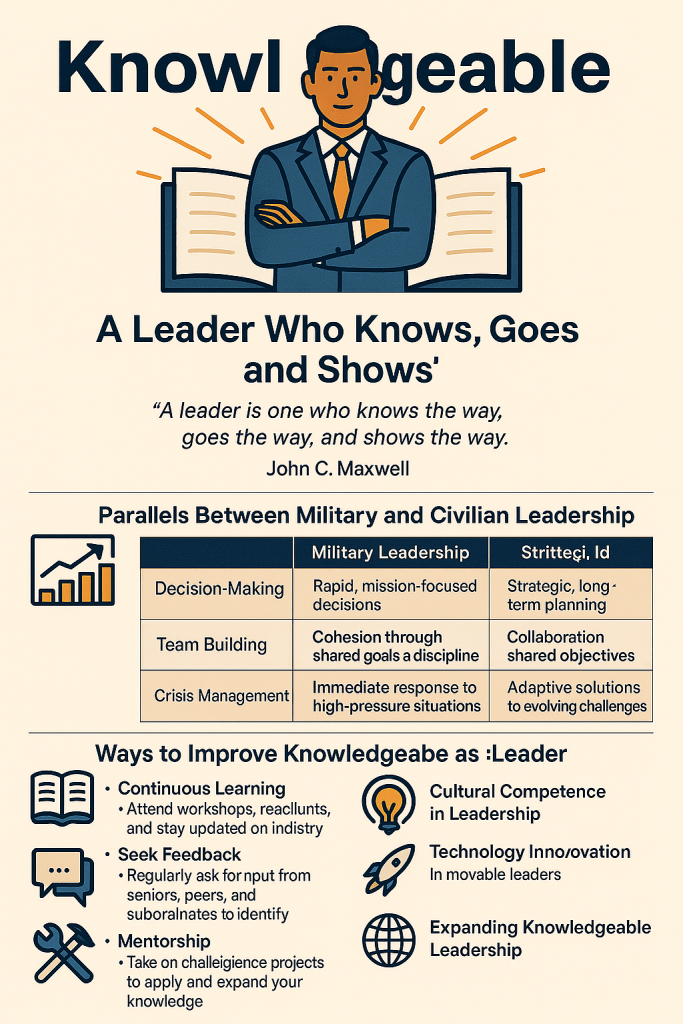
    John C. Maxwell summed it up best: “A leader is one who knows the way, goes the way, and shows the way.”1 This quote captures the essence of knowledgeable leadership, they know what needs to happen they walk the path all the while illuminating it for others.


    Parallels Between Military and Civilian Leadership

    📊 Military leadership emphasizes structure, discipline, and chain of command, while civilian leadership often focuses on adaptability, collaboration, and innovation. Despite these differences, both share the need for knowledgeable leaders who can inspire and guide their teams effectively.

    Examples of Knowledgeable Leadership

    AspectMilitary LeadershipCivilian Leadership
    Decision-MakingRapid, mission-focused decisionsStrategic, long-term planning
    Team BuildingCohesion through shared goals and disciplineCollaboration through shared objectives
    Crisis ManagementImmediate response to high-pressure situationsAdaptive solutions to evolving challenges

    Ways to Improve Knowledge as a Leader

    📚 – Continuous Learning: Attend workshops, read books, and stay updated on industry trends.

    💬 – Seek Feedback: Regularly ask for input from seniors, peers, and subordinates to identify areas for growth.

    🤝 – Mentorship: Learn from experienced leaders and share your knowledge with others.

    🛠️ – Practical Experience: Take on challenging projects to apply and expand your knowledge.

    🌐 – Networking: Build relationships with professionals in your field to exchange insights and ideas.


    Expanding Knowledgeable Leadership

    The Role of Emotional Intelligence

    💡 Knowledgeable leaders understand that emotional intelligence is key to effective leadership. By recognizing and managing their own emotions, as well as empathizing with others, leaders can build stronger relationships and foster a positive team environment. I was once told that people with high EQ (emotional intelligence) often make the best leaders. I believe that to be so because all the leaders that I have known, and over 28 years of serving with the best leaders in the world in the best leadership organization, I would have to agree. An authentic leader who can pick up on the tone of the room can identity what needs to be done to sway room and will build confidence in the future. This is someone that people will follow to the ends of the earth and beyond.

    Cultural Competence in Leadership

    🌍 In an increasingly globalized world, cultural competence is essential for knowledgeable leaders. Understanding and respecting diverse perspectives allows leaders to navigate complex social dynamics and avoid making cultural blunders at the expense of reputation. Know cultural norms, mores, and values this builds trust and shows you’re authentic and interested.

    Technology and Innovation

    🚀 Staying ahead in the digital age requires leaders to embrace technology and innovation. Knowledgeable leaders leverage tools and platforms to streamline processes, enhance communication, and drive progress. If it can be automated, then automate to free up human capital to do the higher level thinking that we are all capable of and unlock peoples innovation and creativity.

    The 3000-Year-Old Mind

    📜 Knowledgeable leaders understand the value of learning from history. By studying the works and experiences of those who came before us, we can cultivate the 3000-year-old mind. This approach allows leaders to avoid the pitfalls of others on the road to greatness and build on the wisdom of the past. Knowledge is power not just the power of rank or title, but the power to inspire and lead others through understanding and insight. The Marine Corps has really ingrained the 3000-year-old mind idea into their organizational leaders at all levels through reading lists, professional military education, tactical decision games, and online learning venues just to name a few tools they use.

    Real-Life Examples of Knowledgeable Leadership

    • Military Example: General Dwight D. Eisenhower’s strategic planning during World War II showcased his deep understanding of logistics and coalition-building.2
    • Civilian Example: Steve Jobs’ leadership at Apple exemplified visionary thinking and innovation, transforming the company into a global leader in technology and design.

    Actionable Tips for Aspiring Leaders

    🎯 – Develop a Learning Plan: Set specific goals for acquiring new skills and knowledge.

    🔍 – Engage in Cross-Disciplinary Learning: Explore topics outside your immediate field to gain broader insights.

    🗣️ – Participate in Leadership Forums: Join discussions and workshops to exchange ideas with other leaders.

    🔄 – Reflect and Adapt: Regularly assess your leadership style and make adjustments based on feedback and outcomes.


    Final Formation

    📖 Knowledgeable leadership is not a destination but a journey. It requires continuous learning, adaptability, and a commitment to growth. The best leaders are lifelong learners. By embracing the principles outlined in this blog, leaders can inspire their teams, navigate challenges, and leave a lasting impact. .

    Let’s lead with knowledge, empathy, and innovation—because the world needs leaders who know, go, and show.


    1: John C. Maxwell, “The 21 Irrefutable Laws of Leadership.”

    2: Eisenhower, Dwight D., “Crusade in Europe.”

  • Courage: The Backbone of Leadership

    Courage: The Backbone of Leadership

    Courage is the cornerstone of effective leadership, and it holds a special place in the JJDIDTIEBUCKLE series. This series, which highlights the core traits of leadership, emphasizes the importance of moral and physical courage in navigating challenges and inspiring others.

    Courage is not the absence of fear but the ability to face it head-on. It is about taking risks, standing up for what is right, and persevering in the face of adversity. Whether it’s making tough decisions, admitting mistakes, or defending your values, courage is the trait that enables leaders to act with integrity and conviction.

    🛡️ The USMC Definition of Courage

    The United States Marine Corps (USMC) defines courage as “the mental, moral, and physical strength ingrained in Marines. It steadies them in times of stress, carries them through every challenge, and aids them in facing fear and overcoming adversity with resolve.”1 This definition underscores the essence of courage as a steadfast force that empowers individuals to confront fear and adversity with resolve.

    ⚖️ Courageous Leadership

    Courageous leadership is about distinguishing between doing things right and doing the right things. While doing things right focuses on efficiency and adherence to rules, doing the right things emphasizes moral integrity and ethical decision-making. As the adage goes, “What’s wrong is wrong, even if everyone is doing it. What’s right is right, even if no one is doing it.” This principle serves as a guiding light for leaders who strive to uphold ethical standards and make decisions that align with their values.

    🌟 Everyday Acts of Courage

    Courage manifests in various forms, shaping the way leaders interact with their teams and communities. It is present in everyday decisions and actions, from admitting a mistake to supporting a colleague. Courageous leaders are unafraid to challenge authority or the status quo when necessary. They understand the importance of voicing concerns and advocating for change, even in the face of opposition.

    🌍 Courage Across Contexts

    In both the military and the corporate world, courage is a universal trait that transcends environments. Military leaders must make quick, high-stakes decisions under pressure, while corporate executives face critical choices that can shape the future of their organizations. Both understand the importance of fostering trust and unity within their teams, inspiring loyalty and collaboration.

    AspectMilitary LeadershipBusiness Leadership
    Decision-MakingCourage to make quick, high-stakes decisions under pressureCourage to make strategic, long-term decisions with organizational impact
    Team DynamicsCourage to foster trust and unity in high-stress environmentsCourage to build collaboration and loyalty across diverse teams
    Risk ManagementCourage to take calculated risks with potential life-or-death consequencesCourage to balance innovation with financial and reputational risks
    Ethical StandardsCourage to uphold strict codes of conduct and honorCourage to navigate complex ethical dilemmas in a competitive market

    🎖️ Final Formation

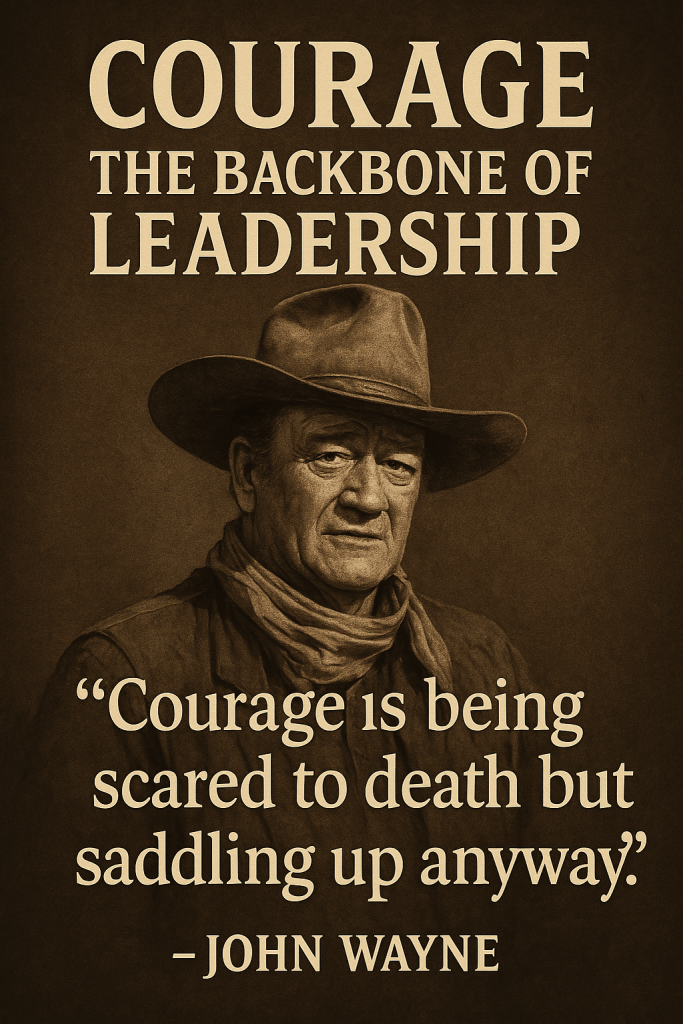
    Courage is the backbone of leadership, and it’s a trait that deserves to be celebrated and cultivated. Let it guide you as you navigate the complexities of leadership and strive to make a positive impact. As Billy Graham said, “Courage is contagious. When a brave man takes a stand, the spines of others are often stiffened.”2 And as John Wayne famously remarked, “Courage is being scared to death but saddling up anyway.”3

    Footnotes:

    1. The USMC definition of courage is sourced from the Leading Marines publication, which outlines the core leadership traits that define the Marine ethos.
    2. Billy Graham’s quote originates from his 1964 Reader’s Digest article, “A Time for Moral Courage,” where he emphasized the ripple effect of moral courage in inspiring others to act with integrity.
    3. John Wayne’s quote highlights the essence of courage as action in the face of fear, encapsulating the spirit of resilience and determination.
  • Unselfishness: The Leadership Trait That Commands Loyalty Without Demanding It

     Unselfishness: The Leadership Trait That Commands Loyalty Without Demanding It

    In the long march of leadership, one trait keeps proving itself in the field and in the boardroom: unselfishness. It’s not a buzzword. It’s the difference between managing and leading. Between commanding and inspiring.

    Those who lead with unselfishness don’t just hold positions they earn devotion. They don’t win compliance through rank. They win followership through sacrifice.


    🎖️ From the Battlefield to the Breakroom: Unselfishness in Action

    Whether you’re wearing combat boots or dress shoes, the fundamentals are strikingly similar. In the military, leadership starts with service. Officers eat last. They train with their troops. They are at point of friction, and they make the hard calls often quietly, and almost always with others in mind.

    The Marine Corps defines unselfishness as the “avoidance of providing for one’s own comfort and personal advancement at the expense of others.” It’s not just generosity it’s a mindset that puts mission over self and team over ego.

    In business, leadership should echo the same ethic. When managers handle heavy lifting, absorb pressure, and push credit toward their teams, they create loyalty no paycheck can buy.


    📊 Military vs. Business Leadership Applications

    Leadership QualityMilitary ApplicationBusiness Application
    Lead by ExampleTrain and endure alongside your unitTackle high-pressure work with your team
    Share PowerDelegate to build readiness and trustEmpower autonomy and accountability
    Mission Over SelfPrioritize the operation over egoFocus on purpose, not promotion
    Team LoyaltyNever leave anyone behindBack your team through wins and weather

    🛠️ How to Lead Unselfishly, Every Day

    • Take Initiative Before You’re Asked
      Spot pain points. Remove roadblocks. Be the teammate who eases burdens without being told.
    • Remove Obstacles Quietly
      Ask “What’s slowing us down?” then act. Leadership isn’t about being seen it’s about making sure others can move forward.
    • Give Credit, Hold the Blame
      Success? Spotlight your team. Failure? Take responsibility. It builds trust brick by brick.
    • Empower with Trust
      Share responsibility. Let others shine. Leadership is not a solo act it’s a stage for many.
    • Model Generosity That Costs Something
      Real unselfishness is inconvenient. That’s what makes it powerful. Give your time, your attention, your praise freely.
    • Win People, Not Just Titles
      Rank earns obedience. Unselfishness earns loyalty. If you’re respected beyond your role, you’re truly leading.

    🫡 Final Formation

    Unselfish leaders don’t ask for loyalty they earn it. They don’t demand respect, they generate it. The deepest kind of influence comes not from titles or policy, but from the kind of leadership that rolls up sleeves, stays late, and lifts others up being a bucket filler and not a bucket dipper.

    If you’re building a legacy, not just a career, then commit to unselfishness as your operational standard. Because teams won’t remember your title in five years. They’ll remember how you made them feel under pressure, how you led when it counted, and how you put the mission and the team ahead of yourself.

    This is the kind of leadership that lasts.

  • Dependability: The Backbone of Leadership

    Dependability: The Backbone of Leadership

    “Let your ‘yes’ be yes and your ‘no’ be no.”

    Dependability is more than a leadership trait, it’s the foundation of trust. Leaders who follow through on commitments, provide accurate information, and deliver under pressure earn confidence from both their superiors and subordinates. In military and business settings alike, reliability fuels strong decision-making, cohesion, and mission success.

    A dependable leader ensures that when something is said, it is followed by action. This predictability creates a leadership environment where teams instinctively trust decisions because they trust the leader providing them.

    Trust Through Reliability

    Leadership isn’t about grand promises it’s about consistent execution. Trust is earned when leaders commit to action and deliver. Seniors rely on a leader’s judgment and execution, while subordinates gain confidence knowing they are being led by someone who follows through.

    Showing Up When It Counts

    Dependability is proven in moments of pressure. Whether ensuring resources arrive on time or making a pivotal call in a crisis, leadership requires follow-through. A dependable leader operates with urgency, providing clarity when it matters most.

    Truth and Timeliness in Leadership

    Bad news does not improve with time. The sooner critical information is discovered and conveyed, the sooner teams can adapt and mitigate risks. Delayed communication weakens decision-making, erodes trust, and turns minor setbacks into major failures. Leadership requires delivering truth promptly and decisively.

    Decisions are only as strong as the information they rely on. When leaders consistently provide accurate updates, they strengthen confidence, allowing decisive action to unfold smoothly. Hesitation leads to uncertainty, but a dependable leader ensures every decision is backed by trustworthy intelligence.

    Dependability as Strategic Foresight

    Leaders operate with a vision, they see the battlefield, the boardroom, or the mission space with clarity. Dependable information shapes strategy, allowing leaders to maneuver with precision. A commander with reliable intelligence can anticipate threats, position forces for a decisive strike, or identify business opportunities before competitors.

    This ability to checkmate the opposition, whether in warfare or industry, depends on confidence in the data supporting each move. Without dependability, leadership becomes reactive, decisions falter, and momentum is lost. The most effective leaders never gamble on guesswork, they base every action on trust, clarity, and consistency in the intelligence they receive.

    A Culture of Dependability

    Effective leadership builds momentum. Reliable reporting leads to stronger confidence, which fuels better decisions, reinforcing trust at every level. Conversely, inconsistent or vague communication leads to operational delays, uncertainty, and weakened cohesion.

    Conclusion: The Power of Dependability

    Leadership is about more than just making decisions, it is about ensuring those decisions are built on a foundation of trust, reliability, and execution. Dependability is not a passive trait; it requires deliberate commitment, timely communication, and unwavering accountability. When a leader speaks, those words must carry weight because they are backed by action.

    The leaders who stand the test of time are the ones whose teams never have to question whether they will follow through. Dependability is not just a characteristic; it is a legacy that defines leadership effectiveness across generations.

  • Leadership Lessons from the Marine Corps: A Foundation for Success

    Leadership Lessons from the Marine Corps: A Foundation for Success

    Leadership isn’t about holding a title, it’s about how you influence, guide, and support those around you. Some of the most valuable leadership lessons I’ve learned came from my time in the United States Marine Corps, starting with Recruit Training, where leadership was ingrained in every aspect of our experience from day one.

    If you’ve never been through Marine Corps boot camp, imagine an environment designed to challenge you physically, mentally, and emotionally all while instilling essential leadership qualities. It’s a place where teamwork is non-negotiable, accountability is expected, and core leadership principles become second nature.

    For me, stepping onto the yellow footprints at Marine Corps Recruit Depot Parris Island was my first real introduction to formal leadership training. My drill instructors Staff Sergeant Roberts, Sergeant Falls, and Sergeant Stewart were relentless in pushing us to understand, apply, and live by the principles of leadership. These weren’t just words in a handbook; they were woven into every training exercise, every lesson, and every challenge we faced.

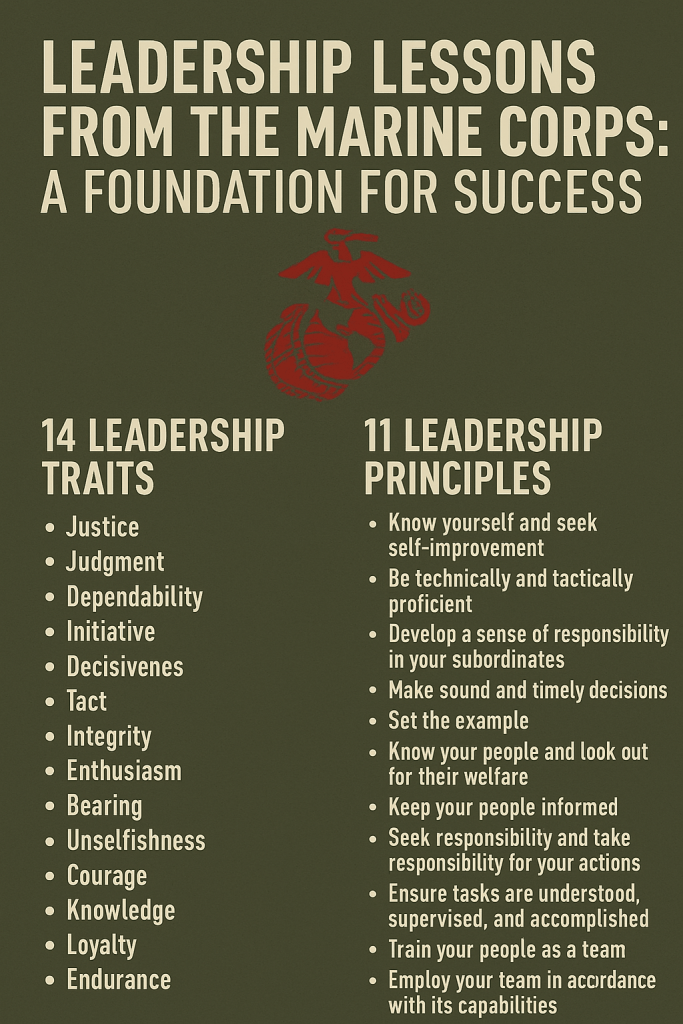
    One of the first things drilled into us was the 14 Leadership Traits and 11 Leadership Principles not as textbook definitions but as lessons we lived through daily. These concepts shaped the way Marines lead, and over the course of my 28-plus-year career, I’ve relied on them as a guide for leadership in any situation, whether in the military or beyond.

    The 14 Leadership Traits: JJDIDTIEBUCKLE

    Marines remember the 14 Leadership Traits using the acronym JJDIDTIEBUCKLE, each letter representing a critical trait that defines strong leadership:

    • Justice – Being fair and consistent in decisions.
    • Judgment – Making sound and logical choices.
    • Dependability – Being reliable and trustworthy.
    • Initiative – Acting without being told.
    • Decisiveness – Making firm, timely decisions.
    • Tact – Handling situations with diplomacy.
    • Integrity – Always being honest and ethical.
    • Enthusiasm – Bringing energy and passion to leadership.
    • Bearing – Presenting a professional and confident demeanor
    • Unselfishness – Putting the needs of others before your own.
    • Courage – Facing challenges with strength and resolve.
    • Knowledge – Continually learning and improving.
    • Loyalty – Staying committed to your team and mission.
    • Endurance – Pushing through hardships with resilience.

    These traits became second nature, not just during my time in the Marine Corps but throughout my career and life. And when leadership starts to feel overwhelming or challenges pile up, I always come back to these basics because they provide clarity when things get complicated.

    The 11 Leadership Principles

    While the leadership traits define who a leader should be, the 11 Leadership Principles focus on what a leader should do. These principles serve as a practical guide for leading effectively, ensuring that leaders not only possess strong character but also apply it in their actions:

    1. Know yourself and seek self-improvement – Leadership begins with self-awareness and continuous growth.
    2. Be technically and tactically proficient – Leaders must understand their role and the skills required to execute it successfully.
    3. Develop a sense of responsibility in your subordinates – Empowering others to take ownership fosters stronger teams.
    4. Make sound and timely decisions – Leadership requires decisiveness, especially in challenging situations.
    5. Set the example – Actions speak louder than words. Leaders must embody the values they expect from others.
    6. Know your people and look out for their welfare – True leadership involves caring for those you lead, both professionally and personally.
    7. Keep your people informed – Transparency and clear communication build trust and unity within a team.
    8. Seek responsibility and take responsibility for your actions – Leaders don’t shy away from challenges or accountability.
    9. Ensure tasks are understood, supervised, and accomplished – A great plan means nothing without execution.
    10. Train your people as a team – Cohesion and teamwork are the backbone of success in any organization.
    11. Employ your team in accordance with its capabilities – Effective leadership means understanding strengths and assigning tasks accordingly.

    These principles provide a framework for leadership in any environment, reinforcing accountability, trust, and execution.

    Why These Lessons Matter Beyond the Marines

    You don’t need to be in the military to benefit from these leadership principles. Whether you’re leading a business, a team, or even your own personal growth, these traits and principles create a solid foundation for effective leadership. They remind us that leadership isn’t about power, it’s about service, accountability, and making the right choices even when they’re difficult.

    This post is just the starting point. In future articles, I’ll dive deeper into each of these principles, sharing real-world applications and how they remain just as valuable today as they were when I first learned them. Strong leadership starts with a solid foundation so let’s build it together.

  • Leadership and Management are not the same thing

    Leadership and management may often be lumped together, but they’re not quite the same thing. Understanding the difference is really important if you want your organization to thrive in the long run. When the lines between the two blur, it can lead to all kinds of issues and confusion in decision-making, team dysfunction, and a lack of clear strategy. Simply put, leadership is about having a vision and inspiring people to rally around it, while management is about ensuring that vision is put into action through well-organized processes. Without both, things can go sideways fast, either you’re adrift with no direction or drowning in chaos because no one’s steering the ship.

    That’s why a blog about leadership and management has to begin here. Before we jump into deep-dive strategies, industry trends, or personal growth tips, it’s vital to lay down some basics. Yes, leaders and managers sometimes share tasks, but knowing how they differ, and how they work together is the secret to building strong teams, creating lasting change, and setting up organizations for success.

    Leadership is all about inspiration. It’s about guiding people, shaping a vision, and motivating teams to come together to achieve big goals. Great leaders set direction, influence the culture, and foster growth, both in individuals and the organization as a whole.

    Management, on the other hand, is more about making sure everything runs like clockwork. It’s about organizing projects, improving processes, and keeping operations efficient. Managers deal with the nitty-gritty of logistics, resource coordination, and sticking to plans to meet specific goals.

    Now, here’s where things get interesting: Strategic leadership and management take these roles to another level. Strategic leaders look at the big picture, they think long-term, make bold decisions, and position their organizations to stay ahead of the game. They anticipate changes, adapt proactively, and align people toward future success.

    Strategic management steps in to make sure all those big ideas and plans actually happen. It’s about creating systems, allocating resources, and keeping track of progress to turn leadership’s vision into measurable results.

    In a nutshell, leadership is about lighting the fire, and management keeps it burning. Strategic leadership plots the course for the future, while strategic management ensures the ship arrives safely at its destination.