Tag: mental-health

  • Principle #2: Be Technically and Tactically Proficient

    Introduction

    🛠️ Principle #2: Be Technically and Tactically Proficient

    Introduction

    Before you can lead others with confidence, you must first master your craft. This principle is not about perfection, it’s about preparation. Technical and tactical proficiency means knowing your tools, your terrain, and your trade. It’s the difference between guessing and guiding, between reacting and responding. In this post, we’ll explore what it means to be proficient, how to build it, and why it’s foundational to trust and mission success.

    What This Principle Demands

    • Technical proficiency is your ability to understand and operate within your domain. Whether you’re leading a team of engineers, educators, or Marines, you must know the systems, standards, and tools that define your field.
    • Tactical proficiency is your ability to apply that knowledge in real-world scenarios. It’s about decision-making under pressure, adapting to changing conditions, and executing with precision.

    Proficiency is not static. It’s a living commitment to learning, drilling, and refining. Leaders who neglect this principle risk becoming ceremonial figures, present but powerless.

    Why It Builds Trust

    People follow leaders who know what they’re doing. When you demonstrate competence, you earn credibility. Your team will mirror your standards, and your example becomes a stabilizing force in uncertain moments.

    • A technically proficient leader can teach, troubleshoot, and innovate.
    • A tactically proficient leader can plan, pivot, and prevail.

    Together, these traits create a leader who is not only respected but relied upon.

    How to Cultivate Proficiency

    • Study the doctrine: Read manuals, policies, and procedures. Know the rules before you bend them.
    • Practice deliberately: Repetition builds muscle memory. Drill until the basics become instinct.
    • Seek mentorship: Learn from those who’ve mastered the craft. Ask questions, shadow operations, and absorb wisdom.
    • Simulate stress: Train in conditions that mimic real pressure. Tactical proficiency is forged in friction.
    • Teach others: Explaining a concept forces clarity. If you can’t teach it, you don’t truly know it.

    Common Pitfalls

    • Overconfidence: Mistaking experience for expertise. Time served is not the same as skill earned.
    • Complacency: Assuming yesterday’s knowledge is sufficient for today’s challenges.
    • Delegation without understanding: Leaders must know enough to inspect what they expect.

    Leadership Is More Than a Title

    Rank may grant authority, but it doesn’t guarantee respect. True leadership is earned through demonstrated skill, not assigned through position. When leaders rely solely on their title, they risk becoming symbolic rather than strategic. Proficiency transforms a title into trust.

    The Three Types of Power

    Effective leaders draw from three core sources of power:

    • Positional Power: Authority granted by rank or role.
    • Relational Power: Influence earned through connection, empathy, and trust.
    • Expert Power: Credibility built through subject matter mastery.

    Subject matter expertise is especially vital. It signals to your team that you’re not just in charge, you’re equipped. When people see you as a source of knowledge, they lean in, listen, and learn. Expert power anchors your leadership in substance.

    Tactical vs. Technical: A Symbolic Split

    Think of technical proficiency as the blueprint and tactical proficiency as the battlefield. One is the plan, the other is the execution. A leader must be fluent in both languages, able to speak in schematics and act in scenarios.

    Military to Civilian Translation Table

    Military TermCivilian Equivalent
    Technical ProficiencySubject Matter Expertise
    Tactical ProficiencyOperational Execution
    DrillRepetitive Practice
    DoctrinePolicy or Best Practices
    Chain of CommandOrganizational Hierarchy
    InspectionQuality Assurance or Audit

    Core Insight

    Proficiency is the bridge between authority and authenticity. It transforms leadership from performance into presence. Without it, you’re a figurehead. With it, you’re a force.

    Discussion Prompt

    Think of a time when you were technically ready but tactically challenged. What did you learn about the gap between knowing and doing? How did it shape your leadership going forward?


    🧭 Final Formation

    We began by asserting that mastery precedes leadership. To be technically and tactically proficient is to be prepared, precise, and trustworthy. This principle demands continuous learning, deliberate practice, and the humility to seek help. It builds trust, sharpens judgment, and anchors your authority in competence. Without it, leadership becomes theater. With it, leadership becomes transformation.


    Disclaimer: The views expressed in this post reflect that of the author and the author alone.

  • 🛍 Principle #1: Know Yourself, Seek Self-Improvement

    🛍 Principle #1: Know Yourself, Seek Self-Improvement

    📣 Introduction

    Leadership begins with the individual. In this post, we explore the foundational Marine Corps principle of knowing yourself and seeking self-improvement. You’ll encounter biblical wisdom, strategic doctrine, psychological models, and tactical tools that translate military insight into civilian leadership. By the end, you’ll have a framework for personal growth that’s both reflective and actionable.

    🔍 Core Insight

    Before you can lead others, you must first lead yourself. This principle calls for honest introspection, a clear understanding of your strengths and weaknesses, and a commitment to continuous growth. Leadership is not a static trait; it is a discipline forged through reflection and refinement.

    This echoes the biblical wisdom of Jesus in Matthew 7:5, who taught, “You hypocrite, first take the plank out of your own eye, and then you will see clearly to remove the speck from your brother’s eye.” True leadership begins with humility and self-awareness.

    You are in the best position to assess your perceived strengths and weaknesses. Play to your strengths while you build your weaknesses. This is reinforced by Sun Tzu in The Art of War: “If you know the enemy and know yourself, you need not fear the result of a hundred battles.” Self-knowledge is not just moral, it is strategic. The battlefield of leadership demands clarity, not just of mission, but of self.

    Psychologically, we are three people: the person we think we are, the person others perceive us to be, and the person we truly are. Self-reflection helps reconcile these selves, aligning perception with reality and guiding authentic leadership.

    In Marine Corps boot camp, recruits are taught to critique their own performance before receiving feedback. This ritual builds the habit of self-assessment, a skill that separates reactive leaders from reflective ones. It’s not just about knowing what went wrong, it’s about owning it and improving.

    🧠 Civilian Translation

    In business, education, and community leadership, this principle shows up as emotional intelligence, professional development, and feedback loops. Leaders who seek improvement model a growth mindset, creating cultures of accountability and learning.

    Military ConceptCivilian Equivalent
    Self-critique after performanceReflective practice and performance reviews
    Boot camp feedback ritualsStructured onboarding and mentorship
    Owning mistakesAccountability and transparency
    Continuous improvement mindsetProfessional development and growth mindset
    Peer and subordinate feedback360-degree feedback and team evaluations

    🛠️ Tactical Application

    • Conduct weekly self-assessments using the STRAR method: What did I do well, what could I improve? STRAR stands for Situation, Task, Response, Assessment, and Repetition. It’s a reflective framework that helps leaders analyze their actions and refine their approach. Start by identifying the Situation and Task you faced, then describe your Response. Assess what worked and what didn’t, and finally, determine how you’ll Repeat or adjust your actions going forward.
    • Ask for feedback from peers and subordinates, not just superiors. This widens your perspective and reveals blind spots that rank alone can’t uncover. Peer feedback fosters mutual respect, while subordinate input builds trust and shows you value every voice in the chain of command.
    • Set one micro-goal each week tied to a known weakness. Micro-goals are small, achievable targets that chip away at larger challenges. By focusing on one area at a time, whether it’s active listening, time management, or delegation, you build momentum and reinforce the habit of improvement.
    • Keep a leadership journal to track patterns, progress, and blind spots. A journal isn’t just a log, it’s a mirror over time. Use it to record key decisions, emotional responses, and lessons learned. Over weeks and months, you’ll spot recurring themes and growth markers that inform your leadership evolution.

    🧕‍ Discussion Prompt

    What’s one area of your leadership that you’ve avoided confronting, why, and what would change if you faced it head-on?


    Final Formation

    We began with the idea that leadership starts within. Through biblical wisdom, strategic doctrine, and psychological insight, we explored how self-awareness fuels growth. We examined tactical tools like STRAR, feedback loops, micro-goals, and journaling, each reinforcing the discipline of reflection and refinement. Whether you’re in uniform or leading in civilian life, the path to improvement begins with the courage to look in the mirror, and the discipline to act on what you see.


    Disclaimer: The views expressed in this post reflect that of the author and the author alone.

  • Leadership Beyond Traits: Introducing the 11 Principles of Marine Corps Leadership

    🧠 Leadership Beyond Traits: Introducing the 11 Principles of Marine Corps Leadership

    Leadership isn’t just about who you are, it’s about what you do.

    In our last series, we explored the 14 traits of Marine Corps leadership through the lens of JJDIDTIEBUCKLE. Those traits, justice, judgment, dependability, and more, form the character of a leader. But character alone doesn’t build teams, solve problems, or inspire action. That’s where principles come in.

    This new series will walk through the 11 Marine Corps Leadership Principles, timeless, actionable guidelines that help leaders turn values into behavior.

    These principles were forged in the crucible of command, refined through decades of Marine Corps doctrine, and tested in every environment from boot camp to combat zones. They’re not reserved for those in uniform, either. They apply to parents, teachers, coaches, mentors, and anyone who chooses to lead with purpose.

    If traits are the ingredients of leadership, principles are the recipe. Traits define your potential, but principles determine your impact.

    🎓 What You’ll Gain from This Series:

    • Clarity on what effective leadership looks like in practice
    • Reflection prompts to help you assess and grow your own leadership
    • Real-world examples that show these principles in action
    • Challenges to apply each principle in your daily life

    Whether you’re leading a team, guiding a family, or simply trying to be better than you were yesterday, these principles offer a roadmap. They’re not about perfection, they’re about progress.

    🔍 Applied Leadership: Marine Corps vs Civilian Contexts

    PrincipleMilitary ApplicationCivilian Application
    Know yourself and seek self-improvementRegular self-assessment and fitness reportsPersonal development plans and feedback loops
    Be technically and tactically proficientMastering MOS and operational doctrineExcelling in your professional skillset
    Develop a sense of responsibility among your subordinatesDelegating authority and mentoring junior MarinesEmpowering team members and fostering accountability
    Make sound and timely decisionsRapid decision-making in high-stakes environmentsBalancing speed and judgment in business or family settings
    Set the exampleUpholding standards in uniform and conductModeling behavior and values in everyday life
    Know your Marines and look out for their welfareUnderstanding personal and professional needsSupporting well-being and morale of your team or family
    Keep your Marines informedClear communication of mission and intentTransparency in goals, changes, and expectations
    Seek responsibility and take responsibility for your actionsVolunteering for leadership roles and owning mistakesTaking initiative and being accountable in all roles
    Ensure assigned tasks are understood, supervised, and accomplishedMission clarity and oversightProject management and follow-through
    Train your Marines as a teamUnit cohesion through drills and exercisesBuilding collaboration through shared goals and practice
    Employ your command in accordance with its capabilitiesStrategic use of personnel and resourcesAligning strengths with tasks and scaling appropriately

    🫠 The 11 Marine Corps Leadership Principles

    1. 🔍 Know yourself and seek self-improvement, Growth starts with self-awareness.
    2. 🛠️ Be technically and tactically proficient, Master your craft to lead with confidence.
    3. 🤝 Develop a sense of responsibility among your subordinates, Empower others to own their roles.
    4. ⏱️ Make sound and timely decisions, Act decisively, especially under pressure.
    5. 🧑‍✈️ Set the example, Model the standards you expect.
    6. ❤️ Know your Marines and look out for their welfare, Leadership is personal, care builds trust.
    7. 📣 Keep your Marines informed, Transparency strengthens teams.
    8. 🔍 Seek responsibility and take responsibility for your actions, Step up and own your outcomes.
    9. Ensure assigned tasks are understood, supervised, and accomplished, Clarity and follow-through matter.
    10. 🧑‍🧳‍🧑 Train your Marines as a team, Cohesion is built through shared effort.
    11. 🌟 Employ your command in accordance with its capabilities, Align strengths with mission demands.

    🫤 Final Formation

    Leadership is a journey. These 11 principles are your next step.


    Disclaimer: The views expressed in this post reflect those of the author and the author alone.

  • 🏁 Endurance: The Final Push in Leadership

    🏁 Endurance: The Final Push in Leadership

    In the Marine Corps, endurance isn’t just a trait it’s a necessity. It’s what keeps you moving when your legs are shot, your mind is foggy, and the mission is far from over. It’s the quiet force behind every successful operation, every completed march, every fulfilled promise. And in the corporate world, endurance plays the same role, just with different terrain.

    Whether you’re leading a platoon through hostile territory or guiding a team through a volatile quarter, endurance is the ability to keep going even when you don’t want to. It’s the mental and physical toughness that separates leaders who finish from those who fade.


    🪖 Military vs. Corporate: The Endurance Parallel

    Marine CorpsCorporate World
    Long-range patrols under harsh conditionsLong-term projects with shifting goals and limited resources
    Sleep deprivation, physical exhaustionEmotional fatigue, decision overload, and constant pivots
    Mission-first mindset despite personal discomfortVision-first leadership despite personal setbacks

    In both worlds, endurance isn’t about brute force, it’s about commitment to the mission. It’s the leader who stays late to support their team, who keeps morale up during layoffs, who doesn’t abandon the strategy when the market turns.


    🧠 Why Leaders Must Master Endurance

    Leadership isn’t a sprint rather it’s a series of marathons. And each one tests your resolve:

    • When the team loses motivation, you carry the torch.
    • When the results stall, you keep the vision alive.
    • When the pressure mounts, you stay composed.

    Endurance is what allows leaders to see things through to the end, even when the end feels impossibly far away.

    One of my closest friends once told me, “The little things matter.” He shared a story from his first time in enemy contact, when chaos erupted and uncertainty loomed, all eyes turned to him. In that moment, his endurance and composure became the anchor for his team. They watched what he would do, ready to follow his lead. That’s the power of enduring leadership, it becomes the compass others rely on in crisis.

    My Recruiting Station Commanding Officer had a favorite line when talking about leadership: “The difference between good and great is that little bit extra.” He believed that going the extra mile, doing the service after the sell, and adding that final touch transforms the ordinary into the extraordinary. It’s not just about doing your job; it’s about doing it with excellence, with heart, and with purpose.

    This reminds me of the saying: “If not me, then who? If not now, then when?” Endurance is the answer to that call.


    🛠️ Practical Ways to Build Endurance

    Here are some actionable strategies to strengthen your leadership stamina:

    1. Train Your Mind Like a Muscle

    • Practice mindfulness or meditation to increase mental resilience.
    • Use journaling to track progress and reflect on setbacks.

    2. Break Big Goals into Tactical Wins

    • Divide long-term objectives into short, achievable milestones.
    • Celebrate small victories to maintain momentum.

    3. Build a Support System

    • Surround yourself with peers who challenge and encourage you.
    • Delegate when needed, endurance doesn’t mean doing it all alone.

    4. Embrace Discomfort

    • Take on tasks that stretch your limits.
    • Learn to sit with frustration and fatigue without quitting.

    5. Stay Physically Fit

    • Regular exercise improves not just stamina but discipline.
    • Physical health reinforces mental toughness.

    📌 Real-World Example: The Long Haul of Leadership

    Imagine a corporate leader navigating a multi-year digital transformation:

    • The initial excitement fades after year one.
    • Budget cuts, staff turnover, and tech failures pile up.
    • But the leader stays the course, adjusting strategy, rallying the team, and pushing through.

    That’s endurance. Not flashy. Not fast. But absolutely vital.


    🎖️ Final Formation: Leadership That Lasts

    With Endurance, we complete the JJ DID TIE BUCKLE series. Each trait: Justice, Judgment, Dependability, Initiative, Decisiveness, Tact, Integrity, Enthusiasm, Bearing, Unselfishness, Courage, Knowledge, Loyalty, has its place. But endurance is what holds them together when the mission gets hard.

    So, stand tall. You’ve earned it. And remember leadership isn’t about being the strongest in the room, it’s about being the one who never stops showing up.

  • Loyalty in Leadership: JJDIDTIEBUCKLE Principles in Military and Business Contexts

    Loyalty in Leadership: JJDIDTIEBUCKLE Principles in Military and Business Contexts

    Loyalty is essential for effective leadership. By examining its definition, manifestations, and challenges, we can uncover actionable insights for leaders in any field.

    🔍 Definition

    Loyalty is steadfast allegiance to a person, mission, or set of values even when tested by adversity or personal cost. It is not blind obedience; rather, it is a conscious commitment rooted in trust, respect, and shared purpose.

    Loyalty is the glue that binds teams together, enabling them to weather storms and achieve shared goals. It is a dynamic force that evolves with circumstances, requiring leaders to constantly evaluate and nurture it.

    🪖 Military Parallel

    In the military, loyalty is foundational to the chain of leadership, the unit, and the mission. Soldiers rely on loyalty for cohesion under pressure, knowing their team won’t abandon them when stakes are high. Loyalty flows both upward and downward: leaders protect their troops, and troops support their leaders.

    Example: A platoon leader who shields their team from unnecessary risk while still executing orders demonstrates loyalty both to their people and the mission.

    Loyalty in the military is not just about following orders; it is about creating a culture of mutual respect and trust. This culture ensures that every member feels valued and understood, fostering a sense of belonging that drives performance and resilience.

    💼 Business Parallel

    In business, loyalty is manifested as commitment to the organization’s vision, team integrity, and ethical leadership. It is tested during layoffs, crises, or when a leader must choose between short-term gain and long-term trust. Loyalty builds retention, morale, and brand reputation — but misplaced loyalty, such as toxic leadership, can be destructive.

    Example: A manager who advocates for their team’s well-being during budget cuts, even if it means challenging upper management, demonstrates principled loyalty.

    Loyalty in business is a delicate balance. Leaders must navigate the complexities of maintaining loyalty to their team while ensuring alignment with organizational goals. This requires transparent communication, empathy, and a commitment to ethical practices that inspire trust and dedication.

    🧭 Key Tensions

    Loyalty often comes with inherent tensions that leaders must navigate:

    • Loyalty vs. Integrity: When loyalty to a person conflict with loyalty to values, which wins?
    • Loyalty vs. Advancement: Will you speak truth to power if it risks your promotion?
    • Loyalty vs. Groupthink: Can you be loyal without becoming complicit?

    These tensions are not just theoretical; they play out in real-world scenarios where leaders must make tough decisions. Navigating these dilemmas requires a deep understanding of one’s values and the courage to act in alignment with them, even when the path is challenging.

    💡 Loyalty Insights

    Loyalty cannot be bought; it is earned through consistent actions, trust, and mutual respect. When leaders have loyal followers, they bear a responsibility to protect, support, and advocate for them. This responsibility is not just ethical but essential for maintaining the trust and cohesion that loyalty fosters.

    In the job market, identifying true loyalty is challenging. Candidates may display surface-level commitment, but discerning genuine loyalty requires looking for indicators such as:

    • Consistency in actions: Do they follow through on promises and demonstrate reliability?
    • Alignment with values: Are their actions and decisions aligned with the organization’s mission and principles?
    • Willingness to go above and beyond: Do they show initiative and dedication beyond their immediate responsibilities?
    • Resilience under pressure: How do they respond to challenges or setbacks?

    By understanding these indicators, leaders can better identify and cultivate loyalty within their teams, ensuring a foundation of trust and mutual respect that drives long-term success.

    🎖️ Final Formation

    In both military and business contexts, the final formation is where accountability meets reflection. It’s the moment leaders stand before their teams not just to give orders, but to embody the values they preach. Loyalty, when practiced with integrity and courage, becomes more than a trait; it becomes a legacy.

    Leaders who cultivate loyalty don’t just inspire compliance, they earn commitment. They create environments where people feel safe to speak truth, take risks, and grow. Whether you’re leading a squad or a startup, your final formation is not a speech, it’s the sum of your actions, decisions, and the trust you’ve built.


    By understanding loyalty’s nuances and applications, leaders can foster trust, resilience, and ethical alignment in their teams. Whether in the high-stakes environment of the military or the dynamic world of business, loyalty remains a vital trait that defines great leadership.

  • Courage: The Backbone of Leadership

    Courage: The Backbone of Leadership

    Courage is the cornerstone of effective leadership, and it holds a special place in the JJDIDTIEBUCKLE series. This series, which highlights the core traits of leadership, emphasizes the importance of moral and physical courage in navigating challenges and inspiring others.

    Courage is not the absence of fear but the ability to face it head-on. It is about taking risks, standing up for what is right, and persevering in the face of adversity. Whether it’s making tough decisions, admitting mistakes, or defending your values, courage is the trait that enables leaders to act with integrity and conviction.

    🛡️ The USMC Definition of Courage

    The United States Marine Corps (USMC) defines courage as “the mental, moral, and physical strength ingrained in Marines. It steadies them in times of stress, carries them through every challenge, and aids them in facing fear and overcoming adversity with resolve.”1 This definition underscores the essence of courage as a steadfast force that empowers individuals to confront fear and adversity with resolve.

    ⚖️ Courageous Leadership

    Courageous leadership is about distinguishing between doing things right and doing the right things. While doing things right focuses on efficiency and adherence to rules, doing the right things emphasizes moral integrity and ethical decision-making. As the adage goes, “What’s wrong is wrong, even if everyone is doing it. What’s right is right, even if no one is doing it.” This principle serves as a guiding light for leaders who strive to uphold ethical standards and make decisions that align with their values.

    🌟 Everyday Acts of Courage

    Courage manifests in various forms, shaping the way leaders interact with their teams and communities. It is present in everyday decisions and actions, from admitting a mistake to supporting a colleague. Courageous leaders are unafraid to challenge authority or the status quo when necessary. They understand the importance of voicing concerns and advocating for change, even in the face of opposition.

    🌍 Courage Across Contexts

    In both the military and the corporate world, courage is a universal trait that transcends environments. Military leaders must make quick, high-stakes decisions under pressure, while corporate executives face critical choices that can shape the future of their organizations. Both understand the importance of fostering trust and unity within their teams, inspiring loyalty and collaboration.

    AspectMilitary LeadershipBusiness Leadership
    Decision-MakingCourage to make quick, high-stakes decisions under pressureCourage to make strategic, long-term decisions with organizational impact
    Team DynamicsCourage to foster trust and unity in high-stress environmentsCourage to build collaboration and loyalty across diverse teams
    Risk ManagementCourage to take calculated risks with potential life-or-death consequencesCourage to balance innovation with financial and reputational risks
    Ethical StandardsCourage to uphold strict codes of conduct and honorCourage to navigate complex ethical dilemmas in a competitive market

    🎖️ Final Formation

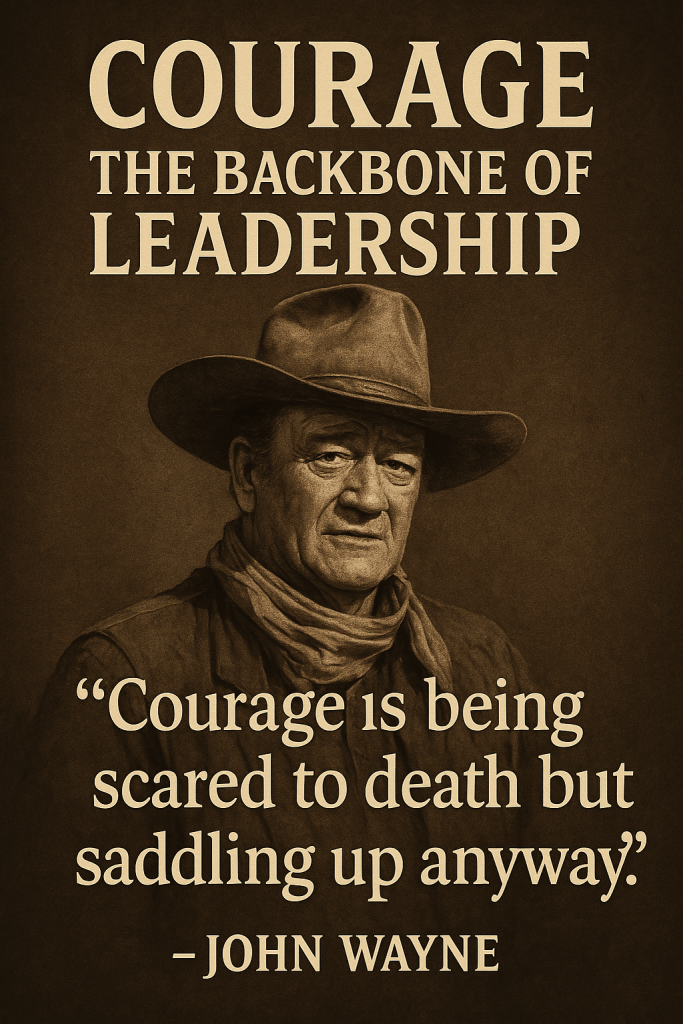
    Courage is the backbone of leadership, and it’s a trait that deserves to be celebrated and cultivated. Let it guide you as you navigate the complexities of leadership and strive to make a positive impact. As Billy Graham said, “Courage is contagious. When a brave man takes a stand, the spines of others are often stiffened.”2 And as John Wayne famously remarked, “Courage is being scared to death but saddling up anyway.”3

    Footnotes:

    1. The USMC definition of courage is sourced from the Leading Marines publication, which outlines the core leadership traits that define the Marine ethos.
    2. Billy Graham’s quote originates from his 1964 Reader’s Digest article, “A Time for Moral Courage,” where he emphasized the ripple effect of moral courage in inspiring others to act with integrity.
    3. John Wayne’s quote highlights the essence of courage as action in the face of fear, encapsulating the spirit of resilience and determination.
  • Enthusiasm: The Spark Between Initiative and Integrity

    Enthusiasm: The Spark Between Initiative and Integrity

    In the leadership arsenal of the United States Marine Corps, few traits exist in isolation. Initiative drives the action. Integrity ensures the action is right. But what brings both to life what gives direction heart and momentum is Enthusiasm.

    This isn’t about surface-level hype. It’s about belief made visible. In the Corps, we don’t follow empty energy. We follow leaders who care so deeply about the mission that it spills into everything they do.

    Earned in the Mud, Carried Through the Fog

    In the Marine Corps, enthusiasm is more than morale, it’s operational fuel. It’s the fire in a squad leader’s voice on a rainy field op. It’s the unspoken “let’s get after it” because things don’t get done by themselves. It’s showing up again, and again, and again, because the mission’s worth it.

    In civilian leadership, enthusiasm plays out differently but no less powerfully. It looks like a team lead who invests in their people. A startup founder who stays late because they believe in the product. A nurse who keeps showing up with compassion at the end of a long shift.

    In both worlds, enthusiasm invites buy-in without demanding it. It doesn’t coerce it compels it.

    Why Enthusiasm Isn’t Optional

    Let’s call it what it is: enthusiasm connects the dots.

    • It amplifies initiative. Energy fuels action that’s not just quick but committed.
    • It confirms integrity. Belief in the mission shows through when you show up.
    • It builds trust. When people see your fire, they feel safe striking their own match.

    If initiative says, “I’ll go,” and integrity says, “I’ll go the right way,” enthusiasm adds, “and I’m honored to do it.”

    Lead Like a Marine: How to Build Enthusiasm That Lasts

    This isn’t about loud. It’s about real. Whether you’re leading Marines, managing a team, or coaching a crew, enthusiasm is earned and built.

    1. Know your mission and own it.
      Reconnect with your “why.” If you don’t believe, no one else will.
    2. Celebrate wins, however small.
      Every step forward is a foothold for morale.
    3. Face adversity with curiosity.
      Marines embrace the suck but they learn from it. Bring that to your setbacks.
    4. Protect your inputs.
      Choose gritty over passive. Surround yourself with fire-starters, not flame-snuffers.
    5. Operate from your strengths.
      Lead from solid ground. Confidence breeds calm energy.
    6. Set the emotional tone.
      Whether you wear stripes or slacks, you’re the emotional barometer. Make it count.

    Final Formation

    Enthusiasm isn’t decoration it’s direction. It turns static values into kinetic leadership. Whether you’re leading a patrol through the bush or guiding a project through chaos, remember:

    As Steve Jobs once said, “If you are working on something exciting that you really care about, you don’t have to be pushed. The vision pulls you.” Let that vision become the gravity that draws others forward make it so clear and compelling that following you feels natural.

    Initiative drives the action. Integrity keeps it honest. Enthusiasm makes it contagious.

    So bring the fire. Let them feel it in your tone, see it in your choices, and believe it through your presence.

  • Above the Cut Line: Leading Before You’re Asked

    Above the Cut Line: Leading Before You’re Asked

    In the Marine Corps, Initiative is more than a buzzword it’s survival. You don’t wait for perfect orders when the fog rolls in and the situation shifts. You act. Because “no plan survives contact with the enemy,” and leadership means being ready to pivot, adapt, and push forward even when things fall apart.

    That mindset transfers directly to the civilian world.

    In business and life, Initiative looks like stepping up without being told not just spotting problems, but bringing solutions. That’s where most people fall short. Pointing out issues is easy. But proposing a fix, that’s operating above the cut line.

    Taking Initiative in industry might mean:

    • Drafting a project proposal to fill a capability gap you noticed weeks before anyone mentioned it.
    • Streamlining a bloated process.
    • Volunteering to lead a stalled-out effort and breathing new life into it.
    • Mentoring someone quietly struggling, because you saw what no one else was paying attention to.

    And when you do act, know this: it won’t go exactly to plan.
    So have a Plan B. Maybe even a Plan C. Then leave some white space for real-time adjustments. That’s leadership in motion action with awareness.

    That’s why Marines live by the mantra: Improvise. Adapt. Overcome.
    It’s not just a slogan it’s a mindset. When the terrain shifts, you shift with it. When the tools break, you find another way. When the plan fails, you build a new one mid-stride. That’s Initiative in its rawest form.

    Just like GySgt Highway in Heartbreak Ridge, Initiative means doing what needs to be done even if it ruffles feathers. Highway didn’t wait for permission to whip his Recon platoon into shape. He saw the problem, took action, and made leaders out of hooligans. He didn’t follow the manual he followed the mission. See the gap, fill the gap, and take the heat if it goes sideways.

    Sometimes you’ll have to execute with only 70% of the information. Sometimes the tools won’t be perfect. And sometimes the outcome will sting a little. But Initiative isn’t about flawless execution it’s about intentional momentum and the courage to take responsibility, even if it means later saying, “That one’s on me.”

    As legendary UCLA coach John Wooden, winner of 10 NCAA championships, once said:

    “The [person] who is afraid to risk failure seldom has to face success.”

    What I take from that is simple: the answer is always no unless you ask. Take the shot, and you’ll either fail—or you’ll learn. Either way, you’re moving forward.

    And here’s the truth most won’t say out loud: real leadership lives in discomfort. Growth doesn’t happen in the safe zone. It happens when you lean into the awkward, and uncertain. When you’re willing to be uncomfortable, to speak up, to take the risk, to own the outcome you’re not just showing Initiative. You’re showing grit.

    You don’t need rank to lead. You need vision, guts, and the willingness to step into uncertainty with purpose. Just like in the Corps, the people who rise are the ones who act when no one’s watching.

    So take the shot. Adjust fire as needed. Improvise. Adapt. Overcome.
    That’s how leaders emerge above the cut line.

  • Justice in Leadership: The Foundation for a Thriving Environment

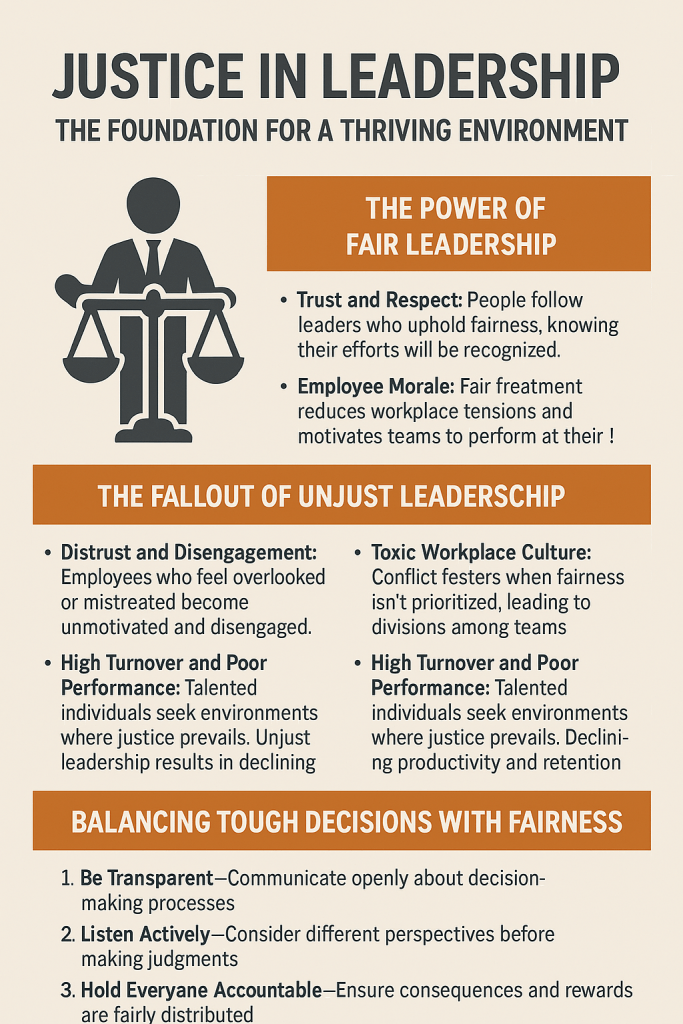
    Justice isn’t just a moral ideal it’s the bedrock of effective leadership. Leaders who prioritize fairness foster trust, loyalty, and collaboration, while those who act unjustly create resentment and chaos. In this blog, we’ll explore why fairness matters in leadership, how it shapes a positive work culture, and what happens when justice is absent.

    The Power of Fair Leadership

    A just leader ensures that decisions are made transparently, rewards are given equitably, and discipline is enforced consistently. This fosters:

    • Trust and Respect: People follow leaders who uphold fairness, knowing their efforts will be recognized.
    • Employee Morale: Fair treatment reduces workplace tensions and motivates teams to perform at their best.
    • Collaboration and Innovation: When employees feel valued and heard, they’re more likely to contribute ideas and work together seamlessly.

    The Fallout of Unjust Leadership

    On the flip side, unfair leadership erodes confidence and drives talented individuals away. An environment tainted by favoritism, inconsistent decision-making, or unchecked biases leads to:

    • Distrust and Disengagement: Employees who feel overlooked or mistreated become unmotivated and disengaged.
    • Toxic Workplace Culture: Conflict festers when fairness isn’t prioritized, leading to divisions among teams.
    • High Turnover and Poor Performance: Talented individuals seek environments where justice prevails. Unjust leadership results in declining productivity and retention.

    Balancing Tough Decisions with Fairness

    Fair leaders must make difficult choices, but justice ensures that even tough decisions are respected. Leaders should:

    1. Be Transparent—Communicate openly about decision-making processes.
    2. Listen Actively—Consider different perspectives before making judgments.
    3. Hold Everyone Accountable—Ensure consequences and rewards are fairly distributed.

    Final Thoughts

    Justice isn’t just about doing what’s right it’s about creating a foundation for success. Whether leading a company, a team, or an entire organization, fairness can be the difference between a thriving environment and a failing one. Great leaders recognize that integrity isn’t optional it’s essential.