
Introduction
🛠️ Principle #2: Be Technically and Tactically Proficient
Introduction
Before you can lead others with confidence, you must first master your craft. This principle is not about perfection, it’s about preparation. Technical and tactical proficiency means knowing your tools, your terrain, and your trade. It’s the difference between guessing and guiding, between reacting and responding. In this post, we’ll explore what it means to be proficient, how to build it, and why it’s foundational to trust and mission success.
What This Principle Demands
- Technical proficiency is your ability to understand and operate within your domain. Whether you’re leading a team of engineers, educators, or Marines, you must know the systems, standards, and tools that define your field.
- Tactical proficiency is your ability to apply that knowledge in real-world scenarios. It’s about decision-making under pressure, adapting to changing conditions, and executing with precision.
Proficiency is not static. It’s a living commitment to learning, drilling, and refining. Leaders who neglect this principle risk becoming ceremonial figures, present but powerless.
Why It Builds Trust
People follow leaders who know what they’re doing. When you demonstrate competence, you earn credibility. Your team will mirror your standards, and your example becomes a stabilizing force in uncertain moments.
- A technically proficient leader can teach, troubleshoot, and innovate.
- A tactically proficient leader can plan, pivot, and prevail.
Together, these traits create a leader who is not only respected but relied upon.
How to Cultivate Proficiency
- Study the doctrine: Read manuals, policies, and procedures. Know the rules before you bend them.
- Practice deliberately: Repetition builds muscle memory. Drill until the basics become instinct.
- Seek mentorship: Learn from those who’ve mastered the craft. Ask questions, shadow operations, and absorb wisdom.
- Simulate stress: Train in conditions that mimic real pressure. Tactical proficiency is forged in friction.
- Teach others: Explaining a concept forces clarity. If you can’t teach it, you don’t truly know it.
Common Pitfalls
- Overconfidence: Mistaking experience for expertise. Time served is not the same as skill earned.
- Complacency: Assuming yesterday’s knowledge is sufficient for today’s challenges.
- Delegation without understanding: Leaders must know enough to inspect what they expect.
Leadership Is More Than a Title
Rank may grant authority, but it doesn’t guarantee respect. True leadership is earned through demonstrated skill, not assigned through position. When leaders rely solely on their title, they risk becoming symbolic rather than strategic. Proficiency transforms a title into trust.
The Three Types of Power
Effective leaders draw from three core sources of power:
- Positional Power: Authority granted by rank or role.
- Relational Power: Influence earned through connection, empathy, and trust.
- Expert Power: Credibility built through subject matter mastery.
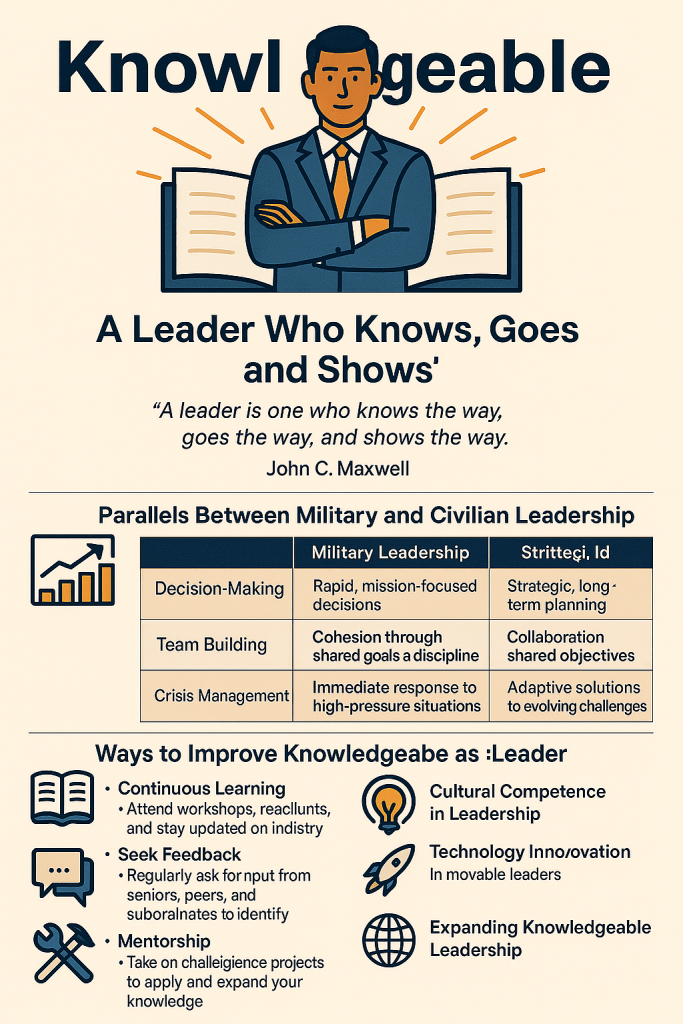
Subject matter expertise is especially vital. It signals to your team that you’re not just in charge, you’re equipped. When people see you as a source of knowledge, they lean in, listen, and learn. Expert power anchors your leadership in substance.
Tactical vs. Technical: A Symbolic Split
Think of technical proficiency as the blueprint and tactical proficiency as the battlefield. One is the plan, the other is the execution. A leader must be fluent in both languages, able to speak in schematics and act in scenarios.
Military to Civilian Translation Table
| Military Term | Civilian Equivalent |
| Technical Proficiency | Subject Matter Expertise |
| Tactical Proficiency | Operational Execution |
| Drill | Repetitive Practice |
| Doctrine | Policy or Best Practices |
| Chain of Command | Organizational Hierarchy |
| Inspection | Quality Assurance or Audit |
Core Insight
Proficiency is the bridge between authority and authenticity. It transforms leadership from performance into presence. Without it, you’re a figurehead. With it, you’re a force.
Discussion Prompt
Think of a time when you were technically ready but tactically challenged. What did you learn about the gap between knowing and doing? How did it shape your leadership going forward?
🧭 Final Formation
We began by asserting that mastery precedes leadership. To be technically and tactically proficient is to be prepared, precise, and trustworthy. This principle demands continuous learning, deliberate practice, and the humility to seek help. It builds trust, sharpens judgment, and anchors your authority in competence. Without it, leadership becomes theater. With it, leadership becomes transformation.
Disclaimer: The views expressed in this post reflect that of the author and the author alone.





 Lead.Manage.Succeed